


SpaceX’s IPO was predictably a success, making Elon Musk the world’s first trillionaire. He reiterated his goal of traveling to Mars and settling there.
There have been many instances in the past of an idea which, due to arrogance or optimism, seemed really good on paper but upon execution turned out to be catastrophic, from Napoleon invading Russia, to dumping auto tires in the ocean for the purpose of creating an artificial reef, to creating humanoid robots, to creating welfare, to creating artificial intelligence, to gain of function research, to forming a Children’s Crusade, to doing business in China, to buying stocks on margin, to NYC rent control, or putting tons of orange peels in forests.
The latest is the enthusiastic — and such ideas are always enthusiastic — proposal by both Elon Musk and President Trump, as well as others, to send people to Mars.
This has the potential of being catastrophic on several orders of magnitude.
First of all, so that there is no misunderstanding, I am all in favor of future space exploration. In fact, I am an enthusiastic supporter of space exploration — of all science — but it should be done with probes. Our present and future technology is capable of relaying enough information back to us, enough to sate our curiosity, which was not the case half a century ago. If one studies the history of the planet, then it becomes apparent that the survival of life on Earth is dependent to a very large degree on the astronomical environment of which we must be thoroughly aware. The universe is NOT a benevolent place.
So, let us ask ourselves: Why on Earth set foot on Mars?
I am old enough to remember when we knew practically nothing, nothing, of the surface of Venus and Mars. Zip. Nada. And this was true even (to a lesser degree) of our moon; for example, some scientists had opined that since the moon’s surface had been bombarded by micrometeorites for billions of years, a spacecraft landing on the surface would be swallowed up in lunar dust, like quicksand. We really did not even know what the Earth really looked like from space (look at the old sci-fi movies); the first pictures from the Apollo missions were surprising, awe-inspiring, and revealing.
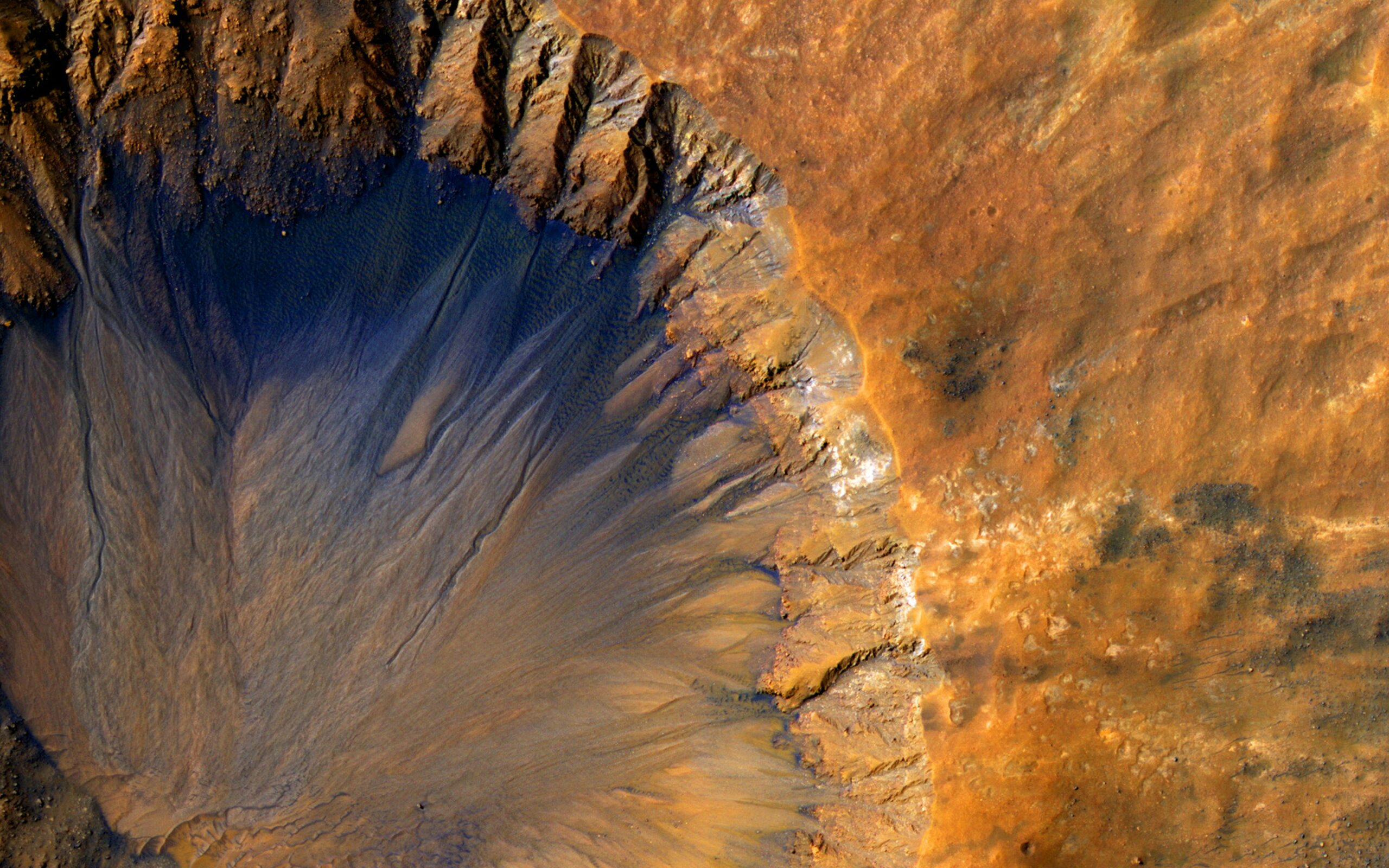
That was then. Half a century later, NASA’s numerous probes have revealed the surface of Venus and Mars. The old justification for going to Mars (“What’s it like up there?”) is now gone. We know exactly what Mars looks like.
It is a rock.
All anyone has to do is access NASA’s website, available to the public if they are curious. NASA has even recordings of the wind and other sounds on Mars. In the case of the red planet, we have ample images — movies, actually — that show us the surface of Mars; the Curiosity rover has been there for over 13 years, far longer than any astronaut could be there. A wasteland. Barren. If anyone wants to go to Mars to see what it’s like, they should go to Death Valley, the Namibian desert, or any desert on Earth. Occasionally, there are “dust devils.” No big deal. Unless one is a geologist or astronomer, it is a boring, boring, boring planet.
As to Venus, it is a sulfurous hellhole.
There is also the consideration that men going to Mars may very well die on the way for a myriad of reasons, or if they make it, they will die on the trip back. They will certainly die once they land back on Earth. Or be stranded there. Apollo XIII astronauts survived by the skin of their teeth partly because they were so near to us in space.
Remember Murphy’s Law, the bane of engineers.
Colonizing Mars
Central to the plan of going to Mars is to eventually form a colony there and begin “terraforming” the planet to convert it to a hospitable environment. However, anyone who wants to create a Martian colony should consider the European colonies in the New World and Africa throughout the past, which ended in disaster — and the settlers did not have to worry about oxygen, water, or cosmic rays.
But all this is likely beside the point, because scientists have discovered that there are perchlorates in the Martian soil that generally are lethal to essential Earth bacteria and plants. So growing essential crops on Mars by farmers is not a viable solution (contrary to the film/book The Martian), which means supplying the hypothetical colony on a regular basis.
“Because it’s there!”
Some could legitimately cite George Mallory’s answer to the question of why he wanted to scale Mt. Everest: “Because it’s there!”
In a recent essay, physicist Lawrence M. Krauss labeled Musk’s Martian plans a vanity project. It is very unfair to label Musk’s goal as a vanity project if for no other reason than all explorations, discoveries, and technological advances have, in fact, been partly based on vanity as well as curiosity, adventure, etc.
Elon Musk’s motivation is to have a potential second chance in case life ends on Earth. This is not an absurd worry. I agree with Musk that life on Earth is tenuous, which could be extinguished at any moment, if not all life, certainly a major portion of species. The past astro-geological evidence attests to that possibility having occurred many times in the past. The Earth has been lucky in having the moon as a shield, particularly in the past when the satellite was much closer to the planet (just take a look at the full moon with a telescope, and you will see the countless craters, 20 times more on the far side, whose bolides were blocked by the moon from reaching Earth).
Another impact with an extraterrestrial body is not a matter of IF, but WHEN, the last time being in 1908 in the Eurasian landmass. But building a risky colony on Mars, whose existence would hang by a very thin thread, is not the answer to prevent that. It would make more sense to increase the number of sites searching for near-earth orbit meteors, as well as formulate a practical plan for averting that potential cataclysm. This would also involve having the necessary equipment to implement an interception of the bolide at a moment’s notice. There have been recent meteors entering the atmosphere without our prior knowledge, such as the recent one-ton meteor that exploded over Houston.
In short, far, far better to preserve life on Earth.
Life on Mars — Stay Away!!
Everyone parrots the mantra that there must be other planets with advanced life (not just microscopic life). This is a view that has been put forth ever since Giordano Bruno. However, I hold the unpopular view that our planet may possibly be the only one to contain advanced life, that we are it (and for some, the idea is very unnerving).
We now know there is no advanced life on Mars or within the solar system. Scientists suspect there may have been bacterial life on Mars, or that there are still bacteria alive on the Red Planet, so we should go there and look for it, or conversely, bring back soil samples that may contain the dormant bacteria or viruses. And it would be terribly exciting to find life on Mars, even in a primitive form. Wouldn’t that be peachy?
Think about that for a moment.
It means that an unknown type of organism, used to an extreme environment and of which we know nothing about — absolutely NOTHING — would be brought back to a lush environment on Earth, whereupon it would quickly spread to every ecosystem like wildfire. And these extremophiles would be placed in a “safe” containment area.
A person would not even have to go to Mars to acquire soil samples. The Mars Sample Return mission is in the planning stages by various countries.
What could possibly go wrong?
Pay no attention to kudzu or fire ants or other invasive species.
Or to the Wuhan lab.
Or the Challenger Space Shuttle.
As for interstellar travel, don’t even think of it.
Logically, one would conclude that sending persons to Mars and/or bringing back soil samples would be off the table, and no one would be insane or arrogant enough to do so.
Likewise, logically, no sane person would use drugs. Or build humanoid robots. Or artificial intelligence. Or pet a bison. Or jump off a cliff. Or swim with sharks, or alligators.
READ MORE from Armando Simón:
The Constitution They Cannot Conquer
Uncovered: The Power of the Citizen Journalist
Armando Simón is a retired psychologist and historian, author of When Evolution Stops.




















