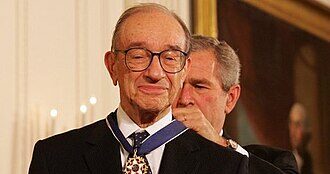


Alan Greenspan’s death at age 100 closes the chapter on one of the most consequential figures in the history of modern central banking. Few policymakers exercised comparable influence over financial markets, economic thought, and public policy. His accomplishments were substantial and deserve recognition.
Greenspan helped cement the inflation-fighting credibility established under Paul Volcker, guided the economy through the 1987 stock market crash, oversaw the long expansion of the 1990s, and correctly perceived that accelerating productivity growth from technological innovation was allowing the economy to grow faster and unemployment to fall lower than prevailing models suggested. He also played an important role in improving monetary policy transparency, reforming Social Security financing, and encouraging more accurate measurement of inflation.
History will likely remember Greenspan neither as a villain nor as an infallible maestro, but as the central figure who defined the transition … to the modern age of activist central banking.
For many observers, these successes formed the foundation of what became known as the “Great Moderation”: a period characterized by lower inflation, fewer recessions, stable growth, and rising confidence in technocratic economic management. By the time he left office in 2006, Greenspan was arguably the most powerful and revered central banker in modern history.
Yet from a free market perspective, Greenspan’s ultimate significance lies less in his successes than in the institutional transformation he helped accelerate. Early in life, Greenspan was closely associated with Ayn Rand’s Objectivist circle and was an outspoken defender of the gold standard. His 1966 essay “Gold and Economic Freedom” remains one of the most articulate popular defenses of sound money written in the modern era. It is therefore one of the great ironies of economic history that the same man later became associated with a far more activist and discretionary central bank.
Beginning with the Fed’s response to the 1987 crash, Greenspan increasingly embraced the role of financial market stabilizer, repeatedly supplying liquidity during episodes of stress and fostering the perception that the central bank stood ready to cushion significant market declines. The so-called “Greenspan Put” did not emerge from a single decision but from a pattern of interventions that gradually convinced investors that risk-taking would be partially socialized while gains remained private. Austrian economists have long argued that such arrangements create moral hazard, weaken market discipline, and encourage increasingly speculative behavior. What appeared at the time to be prudent crisis management may also have laid the groundwork for larger future instabilities.
The same criticism applies to the Great Moderation itself. While many economists viewed the period as evidence that enlightened central banking had largely solved the business cycle, some economists remained skeptical. A core argument among them held that suppressing volatility does not eliminate economic imbalances; it merely allows them to accumulate beneath the surface. Low and relatively stable inflation on the heels of repeated episodes of monetary accommodation encouraged growing leverage, rising asset prices, and increasingly complex forms of financial engineering. Greenspan’s reluctance to recognize the emerging housing bubble reflected a broader confidence that markets and financial institutions could regulate themselves and that monetary policy could address problems after they appeared rather than prevent them beforehand. The financial crisis of 2008 exposed the limits of that approach.
While Greenspan deserves credit for candidly acknowledging errors after the crisis, the episode raised fundamental questions about not just the wisdom, but the very ability, of discretionary monetary management to fine-tune a highly complex economy. (RELATED: The Washington Post Is Wrong: History Proves the Federal Reserve Econometric Models Cannot Make a Fiat Money System Work)
History will likely remember Greenspan neither as a villain nor as an infallible maestro, but as the central figure who defined the transition from the post-Volcker era of monetary restraint to the modern age of activist central banking. Yet he also helped institutionalize the expectation that central banks should respond aggressively to financial-market turbulence, a doctrine that subsequent Fed chairs expanded dramatically. Perhaps the most important lesson of Greenspan’s career is that short-term stability purchased through judicious monetary activism tends to come at the cost of larger, more unpredictable long-term distortions.
Many of the challenges confronting monetary and fiscal policymakers today — elevated debt levels, recurring asset bubbles, financial market dependence on central bank support, and persistent questions about the proper role of monetary authorities — can be traced, at least in part, to choices made during the Greenspan era. His career thus describes both a policy figure operating at the peak of influence and a cautionary tale about the limits of economic management, however brilliant the manager may be. Rest in Peace, Alan.
READ MORE from Peter C. Earle:
Good News, Bad Reactions: The Logic of Financial Markets