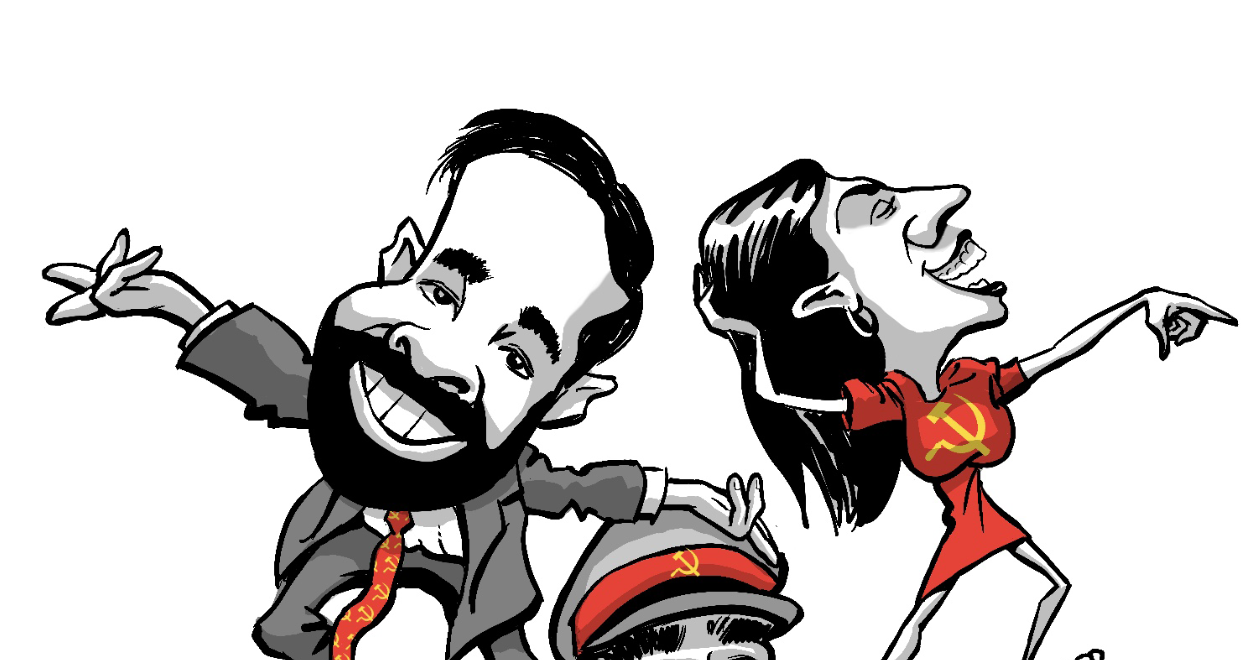


Socialism doesn’t just fail economies; it fails people, creating victims of the very people it promises to help. It separates effort from reward, replaces personal responsibility with political dependence, and displaces our rich civil society motivated by neighborliness and a commitment to the common good with an ever-expanding state. Yet the polling suggests that 62 percent of Americans ages 18 to 29 now view socialism favorably. It is important to understand this trend, but equally important to understand what it does to them and to us when we let it take root.
This article is from The American Spectator’s summer 2026 print magazine. Subscribe to The American Spectator to receive the magazine.
Young Americans are increasingly enamored with socialism and even communism. Yet this is at odds with a more recent Gallup survey suggesting that, while positive views of capitalism have fallen from 61 percent in 2010 to 54 percent in 2025, 95 percent of Americans viewed small businesses positively, and 81 percent viewed free enterprise positively. The disconnect is that you cannot have one without the other. The only type of entrepreneurship — a hallmark of an unfettered economy — you get in socialism is political entrepreneurship fueled by envy, which is institutionalized by policies executed with a patina of equity but that result in class divides and zero-sum games.
Subscribe to The American Spectator to receive our summer 2026 print magazine.
It may be easier to understand why older generations do not have the same affinities for central economic planning. They saw the threat of the Soviet Empire as it marched across Europe and of Mao’s takeover of China, resulting in the largest manmade famine in history. Perhaps for those generations, it is easier to connect socialism’s outcomes to its promises. But thankfully, the Soviet threat is gone, and China’s brief embrace of market reforms under Deng Xiaoping in the 1980s produced the largest poverty reduction in a single country in history, proof that even a little capitalism saves lives. That China is now retreating from those reforms should serve as its own warning.
No serious economist, political theorist, or public intellectual is arguing that we should return to the good old days of Vladimir Lenin, characterized by random executions, show trials, and labor camps. Still, it’s not 1989 anymore. There is no wall to tear down, and the creeping threat of socialism comes from the well-educated young generation of homegrown champagne socialists. Our flirtation with socialism is dangerous and internal. They decry capitalism as they rage-tweet from laptops while sipping on fair-trade lavender-infused matcha lattes.
Nobel laureate F. A. Hayek won the intellectual debate on the impossibility of socialism, and dedicated his 1944 book The Road to Serfdom to “the socialists of all parties.” This is not only a problem of the progressive left. The progressive right is alive and well, seeking equity stakes in American companies like Intel in the name of national security and Spirit Airlines in the name of jobs. Political entrepreneurship pays big dividends on both sides of the aisle, and the instinct to use government power to pick winners and losers is the same impulse regardless of party.
Part of this can be explained by clarifying our terms. The words socialism and capitalism get tossed around quite often without a true understanding of their meaning. A capitalist society is one where individuals often own land, labor, and capital through private firms. It is dictated by profit and loss, wherein firms must use prices to allocate resources to their most highly valued uses at any given time. In a socialist economy, we collectively own and allocate resources, so we must appoint guardians to make those decisions.
No economic system is perfect because it is run by human beings who are fallen and fallible. Thus, the relevant questions of political economy are not about obtaining heaven on earth, but rather about which system gives us the best chance of egalitarian human flourishing by advancing labor productivity in the service of strangers. As the great economist Thomas Sowell reminds us, there are no solutions, only tradeoffs. Prosperity advances for everyone, not just the rich, when we adopt institutions of economic freedom. These institutions include limited government, private property rights, and the freedom to compete, enter markets, and innovate.
As we approach America’s semiquincentennial, it is fitting to reflect on the Founders’ vision of a commercial republic. Their wisdom is reinforced by decades of research confirming that economic liberty is a fundamental pillar in securing civil and political freedoms. Yet, 250 years later, we find ourselves undermining these institutions from within. We cannot blame China, Cuba, or North Korea for our current flirtation with socialism; that responsibility lies squarely with us. If we fail to course-correct, we risk losing the vitality that America represents to the world. The proponents of “democratic socialism” are shrewd, and their movement ultimately rests upon the institutionalization of envy.
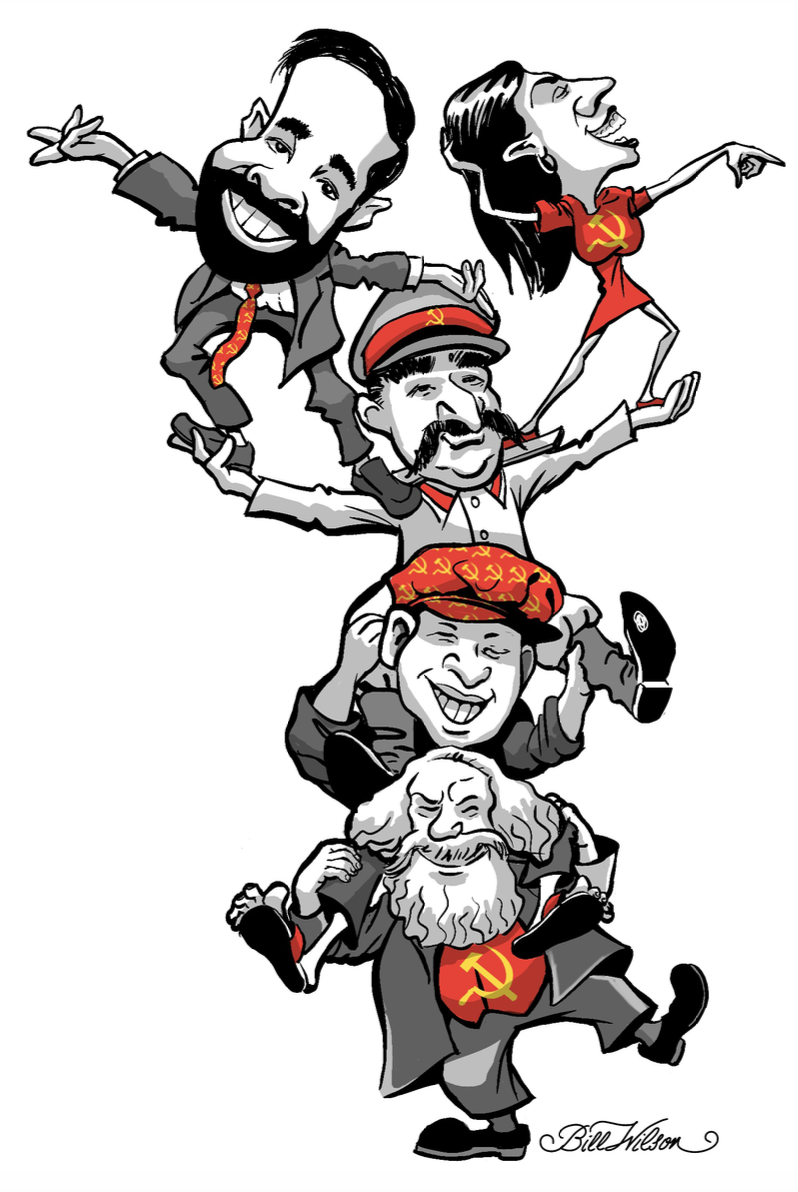
Consider Zohran Mamdani, the mayor of New York City. He is young, hip, charismatic, and built his campaign on the angst of the twenty-something crowd. And there is a good reason for some of that angst. Imagine being 25 years old, burdened by $200,000 in student debt, and having landed a great job in Manhattan. This is the stuff of their dreams. Yet they live in one of the most expensive cities in the world and must find three roommates for a 750-square-foot apartment. They are rightly worried about the cost of housing, groceries, and healthcare. Rather than addressing the underlying problems, which include concentrated benefits and special-interest capture — the byproducts of a mixed economy that is failing them — he addresses only the symptoms.
Art by Bill Wilson for The American Spectator
To get elected, Mamdani told people what they wanted to hear and made promises he cannot keep, promises that are economically impossible and have the dire unintended consequence of making life more expensive rather than more affordable. He isn’t the only one. Cities including Boston, Chicago, and Seattle are hiring democratic socialists who claim to have collectivist answers to the affordability crises in rent, housing, and transportation. Yet these false promises only exacerbate these problems.
Electoral politics often thrives on the rejection of basic scarcity, promising a free lunch to a public eager to believe in one. But the first lesson of economics is that there is no free lunch, and when you attempt to make lunch free, there is no lunch at all. Take Mamdani’s and Chicago Mayor Brandon Johnson’s suggestion of creating city-run grocery stores. This may sound appealing on paper, especially when you live in such expensive zip codes. Yet this has been done before, not just in Soviet Russia. Every American city or town that has tried running its own grocery store has either closed its doors or handed operations back to the private sector. Baldwin, Florida’s grocery store is closed. Kansas City’s Sun Fresh Market spent $17 million and closed its doors in 2025 with bare shelves. Kansas tried it in two towns and leased both back to private operations. Illinois funded six stores in food deserts, and four have already shut down. Chicago’s Brandon Johnson floated the same ideas and quietly dropped them after a feasibility study. This was after Chicago’s hostile business climate drove Walmart to close four stores, which had lost tens of millions of dollars annually for nearly two decades, only for Johnson to blast them for leaving the very communities his policies made inhospitable to business.
The idea of “free” is perhaps the most pernicious myth that bedevils our politics. Its depravity comes not from arguing that we can get things without cost, but from fundamentally claiming that you have a right to someone else’s labor. That’s how we will create “free” buses, daycares, and grocery stores. If you want food on the shelf when you enter the store, someone must pay for it to get there. If we are going to use government force to supply these things, we must take the fruits of someone’s labor. And this is expensive because there is no incentive for prudence and good stewardship. This is why, while Mamdani needs $70 million to open five grocery stores, Aldi could open over twenty, and would, as soon as zoning and permitting regulations allowed.
This is the inexorable problem with socialism, regardless of its political affiliation. As Margaret Thatcher argued, the problem with socialism is that you always run out of other people’s money. Socialism cannot work because there is no mechanism for people to discover how to get more from less. It separates reward from effort; we get less effort, and people suffer.
Pause for a moment and think about the hundreds of products each of us uses every day, and how we are entirely ignorant of their origins and designs. We take our abundance for granted and incorrectly believe that we can redistribute resources according to the ideas of benevolent technocrats. This, perpetuated over time, leads to class warfare by pitting the rich against the poor and middle classes. This erodes not only our sense of personal responsibility but also our commitment to generosity and philanthropy. This occurs when we believe that the U.S. economy is a zero-sum game. If the rich obtain their money by taking it from others, wealth redistribution and collectivism might sound appropriate. Yet, it is economic freedom, not socialism, that has made Americans so rich.
Champagne socialism may sound better than Leninism, but it has the same outcomes. We have so much abundance that we lack gratitude and wonder. G. K. Chesterton wrote in 1909 that “The world will not perish for want of wonders, but for want of wonder.” Imagine writing that at a time when there were no antibiotics, cell phones, air conditioning, or washing machines, and for most people indoor plumbing remained a luxury. It was a remarkable sentiment then and now, making his insight truer today than when he wrote it. Chesterton couldn’t type his words on a laptop, listen to his favorite music on Spotify, or order just about anything from Amazon for delivery to his doorstep. Socialism not only takes away these things that improve our well-being; it also erodes our character and replaces the market and civil society with calls for government to grow in both size and scope.
The American experiment is fueled by economic innovation, but it is buttressed by an exceptionally vibrant civic sector. When Tocqueville visited the United States in 1831, fifty-five years after the signing of the Declaration of Independence, he was awestruck. He wrote extensively about the American impulse to solve problems by creating civic institutions to serve the common good. People offered support for widows, children, and the sick, including education and cultural enrichment. Tocqueville believed that a commitment to religious freedom and to the importance of personal faith in the lives of ordinary people compelled them to live out that commitment by loving and serving their neighbors. He noted that this served as a check on government growth by anchoring our impulse for assistance within the community. When we seek help through civil society rather than the state, we maintain the essential incentives for personal responsibility. Tocqueville witnessed a privatized social safety net that held people accountable. Socialism erodes that civic virtue by replacing our interdependence on one another with a dependence on the state.
The young Americans drawn to socialism are not our opponents; they are our neighbors, and the best answer to their very real anxieties is not to dismiss them, but to make the case, with clarity and conviction, that economic freedom has done more to solve the problems they care about than any government program ever has or will.
Anne Bradley is vice president of academic affairs at the Fund for American Studies and a professor of economics at the Institute for World Politics.
Subscribe to The American Spectator to receive our summer 2026 print magazine.