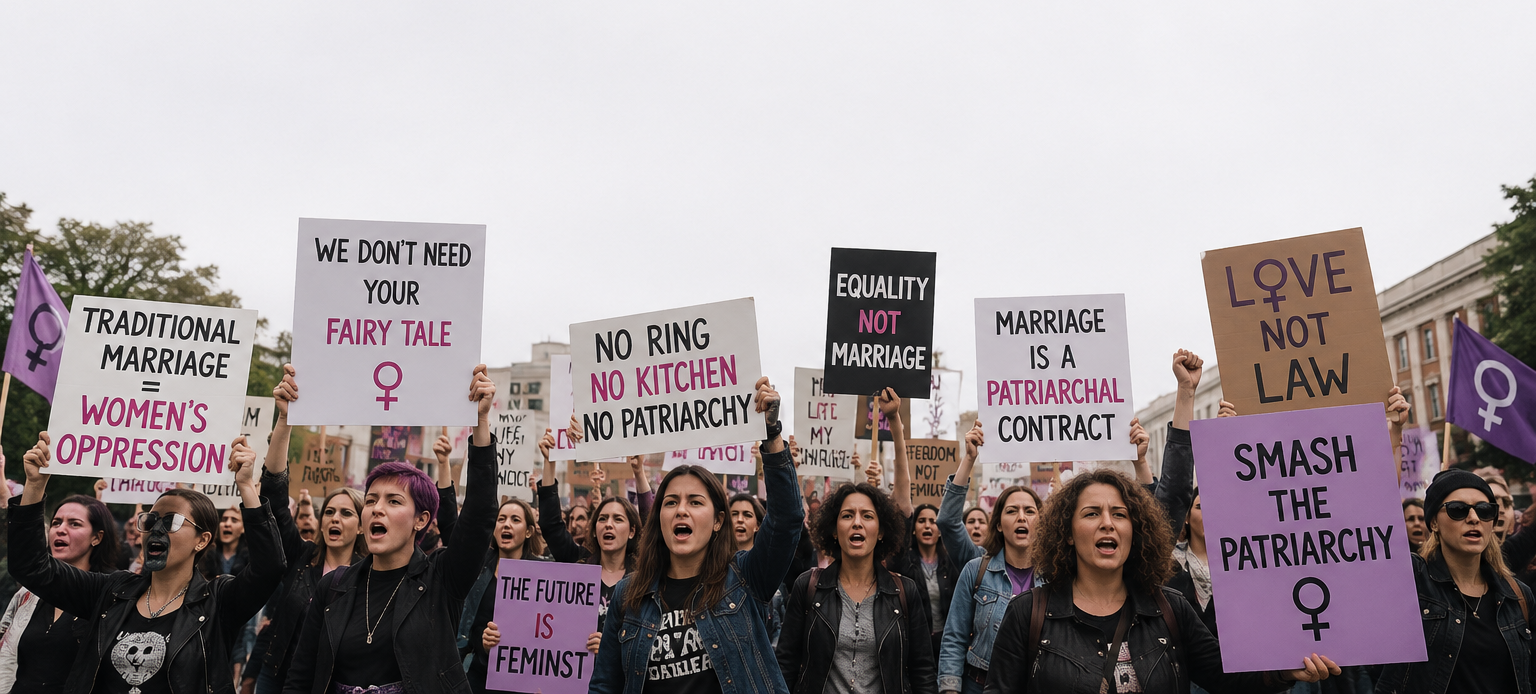


If modern feminism’s premises are correct, this should be a moment of unmistakable triumph. Since the second-wave pioneer Betty Friedan famously wrote in 1957 that she wanted “something more than my husband and my children and my home,” the movement’s central ambition has been equality in the workplace. That ambition has largely been realized.
As Helen Andrews detailed in a widely discussed essay last year in Compact magazine, women have moved from minority status to clear majorities in a range of influential fields: law schools (2016), medical schools (2019), the college-educated workforce as a whole (2019), law-firm associates (2023), and college instructors (2023). Women hold about a third of U.S. judgeships — with nearly two-thirds of recent appointments — and are nearing parity in management. According to the National Center for Education Statistics, women now earn the majority of undergraduate and graduate degrees in the United States, including doctorates.
Yet the celebration has been put on hold. Just as feminism’s primary demand has been realized, women across the industrialized world report lower levels of life satisfaction, both in absolute terms, and relative to men. The most recent 2024 General Social Survey found that between 2014 and 2024, U.S. females who report being “very happy” declined from 33 percent to 23 percent, while those reporting that they are “not too happy” has risen from 11 percent to 19 percent. These findings are only the latest confirmation of what social scientists have coined the “gender well-being” gap, in which women “report a higher number of bad mental health days and more restless sleep. They are also less satisfied with many aspects of life … and express less happiness in the moment in terms of peace, calm, and cheerfulness.”
While there are myriad possible reasons for the gender divergence in happiness, it is worth noting that the well-being gap emerged in the 1970s, a decade in which 25 million additional women entered the workforce and in which modern feminism’s influence was at its peak. That decade saw sweeping legal and institutional changes, including Title IX (1972), affirmative action (Bakke), expanded workplace and education rights, and the Supreme Court decision in Roe v. Wade.
An article on Medium makes the link between feminism, workforce participation, and rising female discontent explicit. Chris Bigaj writes,
Up until the 1970s, American women consistently reported higher levels of life satisfaction than men, but now, twice as many women suffer from depression than men. In lieu of a gender gap in income and political power, a new mental health gender gap has appeared.
The relative unhappiness of women is undoubtedly overdetermined. Feminism did not simply “force” women into the workforce against their will. Many women understandably embraced the expanded opportunities available to them, seeking the sense of purpose that comes from developing one’s talents and financial independence. At the same time, powerful economic pressures helped push the share of women in the workforce from 37 percent in 1970 to 47 percent by the early 2000s.
This article is from The American Spectator’s summer 2026 print magazine. Subscribe to The American Spectator to receive the magazine.
Yet it is striking that feminist thinkers rarely entertained the possibility that men and women might experience the modern labor market differently. Many simply dismissed the idea that women might possess innate tendencies — greater vulnerability to anxiety and depression, deep attachments to their children — that could shape their sense of well-being.
Despite internal disagreements, most strands of modern feminism shared a common premise: that meaningful psychological differences between the sexes were largely social inventions rather than products of our evolutionary past. Feminists rallied to Kate Millett’s 1972 book Sexual Politics and its central claim that “the sexes are inherently alike in all but reproductive function.”

Subscribe to The American Spectator to receive our summer 2026 print magazine.
By 1990, Judith Butler had given the “social construction” view its most influential formulation in Gender Trouble, arguing that there is no intrinsic link between biological sex and behavior. As the philosopher Michael Levin observed in Feminism and Freedom, much of feminist thought came to insist that genuine fulfillment would occur only when society abandons the idea that sex meaningfully shapes human nature.
Nevertheless, research across biology, neuroscience, psychology, and evolutionary theory over the past half-century has painted a far more complex picture of the sexes than feminists imagined. Just as Millett was writing, the recently deceased anthropologist Robert Trivers published one of the most influential papers in modern evolutionary biology, “Parental Investment and Sexual Selection.” Trivers’ central insight was simple but profound: the sex that invests more in offspring tends to be choosier about mates, while the sex that invests less competes more intensely for access to them.
From this basic asymmetry flow many familiar differences in male and female psychology. Psychologist Cory Jane Clark notes, women’s reproductive success historically depended not only on pregnancy but on surviving long enough to raise highly dependent children. This favored tendencies toward risk aversion, greater selectivity in mates, and heightened concern for vulnerable others, especially children. Men, by contrast, increased their reproductive chances through competition with other men for status and access to mates, encouraging traits such as competitiveness, promiscuity, and alliance-building.
These male tendencies map easily onto a competitive market economy that rewards status-seeking and resource acquisition. Women’s tendencies may be less easily reconciled with the marketplace. A 2025 report from the Institute for Family Studies shows that even as full-time work among married mothers of young children reaches new highs, it remains a minority preference: only 39 percent consider it ideal, while most favor part-time work or no paid employment at all.
Even apart from motherhood, the demands of full-time professional life may weigh differently on women. Psychiatrist Jennifer Payne Deligiannidis has noted that hormonal cycles and stress responses can cause women to experience workplace stress differently than men, with effects that reverberate through both physical and mental health. Meanwhile, journalist Ginevra Davis argues that the female body itself imposes constraints that men rarely face — fertility limits, pregnancy, menstruation, and other biological demands that inevitably divide attention and time.
Given all of this, the decades-long feminist effort to treat men and women as psychologically interchangeable in the struggle for status and resources may itself partially account for women’s relative dissatisfaction — particularly among mothers. As former Obama State Department official Anne-Marie Slaughter wrote recently in the Atlantic, “[T]he proposition that women can have high-powered careers … assumes that most women will feel as comfortable as men do about being away from their children…. In my experience, that is simply not the case.”
While work-related stress may be a significant factor in female unhappiness, it is probably worth noting that greater workforce participation has coincided with a 60 percent decline in marriage. In 2024, 31.2 women married per 1,000 unmarried women (age 15 and over), compared with 1970, when it was 76.5 per 1,000.
This matters because marriage, for whatever its challenges and imperfections, appears to remain a primary marker for happiness. In 2021, 70.8 percent of U.S. adults who are married report being very happy, compared to 57.1 percent of non-married adults. Indeed, new research from the University of Chicago has found that marriage is “the most important differentiator” of who is happy in America, and that falling marriage rates are a chief reason why happiness has declined nationally. Socio-economic indicators suggest some of the reasons why. On average, marriage affords both men and women better health and emotional well-being, more financial security, a greater sense of purpose, and a longer life compared to the unmarried.
All of which makes it remarkable that a bevy of powerful female writers and critics are once again advancing a vision that directs women away from a vital source of happiness. In a high profile essay in City Journal last summer, Kay Hymowitz notes that a wave of articles, novels, podcasts, and films now recasts divorce, even after years of mostly happy marriage, as liberation rather than tragedy — from magazine essays like Lara Bazelon’s claim that “divorce can be an act of radical self-love” to cultural commentary about Gen-X women having “the best sex of their lives.”
Best-selling books such as All Fours by Miranda July, This American Ex-Wife by Lyz Lenz, Splinters by Leslie Jamison, No Fault: A Memoir of Romance and Divorce by Haley Mlotek, A Life of One’s Own by Joanna Biggs, and Three Women by Lisa Taddeo, along with shows and movies such as Sex/Life, Big Little Lies, Easy, Wanderlust, The Idea of You, The Miller’s in Marriage, Baby Girl, Lonely Planet, and Divorce, tend to depict female-led exits from marriage — often sparked by sexual dissatisfaction. The protagonists in these works are typically professional women in midlife who feel constrained by the identity of “wife.” As Hymowitz puts it, “In this narrative, walking away from marriage is framed as empowerment, self-discovery, and sexual freedom, overturning the older image of the lonely divorcée with one of a confident woman reclaiming autonomy.”
The attempt to valorize midlife, sexually driven, female-initiated divorce cuts against a long-standing cultural script in which men — cast as the classic “cad” — are presumed more prone to straying. It also runs against durable psychological patterns: men historically maximized reproductive success through variety, while women did so through stability and partner investment. The result is a familiar asymmetry — female caution, male opportunism — that cultural fashion has not erased. Asked recently in Norway how many sexual partners they would want over the next 30 years, women said five on average; men, 25.
Yet the pro-divorce writers seek to blur these differences, recasting women’s relational and sexual aspirations as mirroring those of men and, as with career ambition, treating the sexes as essentially interchangeable.
This strained effort to invert traditional sex roles is vividly illustrated in Miranda July’s semi-autobiographical novel All Fours. The story follows a “semi-famous” 45-year-old artist who leaves her husband and child at home to embark on a cross-country drive, only to abandon the journey and begin an affair with a younger man she meets at a gas station. July cleverly frames this shift in desire through the lens of perimenopause, lending the transformation a kind of biological grounding. The unnamed protagonist, in this phase, pursues variety, beauty, and youth — traits more commonly associated with male attraction. Once adamant that her partners “always had to be older than me because if they were my same age then it became too obvious how much more powerful I was,” she now finds herself drawn to a “ripped” young Hertz rental car agent: “I had been caught off guard, his body had snuck up on me.”
More strikingly, she now desires a man’s whole body, where she used to desire the face, where emotions are kept — a female tendency. Suddenly, she moves from “mind-rooted” intimacy to “body-rooted” sex — something that even she associates with men: “Lusting for the whole length of a person, head to toe, was what body-rooted people did … and men.”
Without assigning motives to July or the others, the critical reception of All Fours suggests a concerted effort on the part of female opinion makers to recast female desire in traditionally male terms. New York magazine’s The Cut says All Fours is “a spectacularly horny story about pursuing sexual and creative freedom,” while The Guardian quotes a critic saying “I think what I felt [about All Fours], which I think is what a lot of us feel, is permission to be undone.” The New York Times excitedly called All Fours the book that sparked a cultural phenomenon through a “whisper network” among women.
Underlying the rapture over mid-life divorce seems a not-so-hidden desperation to dismiss women’s nature, or at least to render it unimportant, all in the service of a distinctly progressive logic. Author and psychologist Rob Henderson points out that progressives, including most feminists, “assume that casual sex is both natural and healthy. So when studies show that men … enjoy it more than women, many take this as a moral affront, as if it implies that men are liberated while women are repressed.”
None of this means that genetic tendencies are always the decisive factor in human behavior. Human beings are malleable and often find it necessary to regulate instinct through institutions. Monogamous marriage, for example, bound male sexuality to a wife in exchange for connection to offspring, redirecting male aggression away from rivals toward productive labor. But it is difficult to see how promoting divorce and encouraging in women a sexually opportunistic temperament would benefit more than a small minority of females.
The rules of attraction honed over centuries of biological constraints on reproduction remain embedded in human nature today. Women, on average, invest more of their identity and emotional significance in long-term relationships than men, and they are eight percentage points more likely than men to say a successful marriage is “one of the most important things” in life.
Men, on average, continue to express stronger preferences for multiple sexual partners, and report participating in non-monogamous relationships at about twice the rate of women.
The stridency of the pro-divorce crowd may itself reveal an underlying frustration with these persistent features of human nature. As with the unanticipated consequences of career-first feminism, the risks of modeling a glorified version of midlife divorce are high, and so are the potential psychic costs for women. One needn’t deny that some long-term marriages should end, or that women experience sexual desire in midlife, to see that the advocacy of midlife divorce looks less like women’s liberation than a risky attempt to bend enduring human nature to ideological ends.
Subscribe to The American Spectator to receive our summer 2026 print magazine.