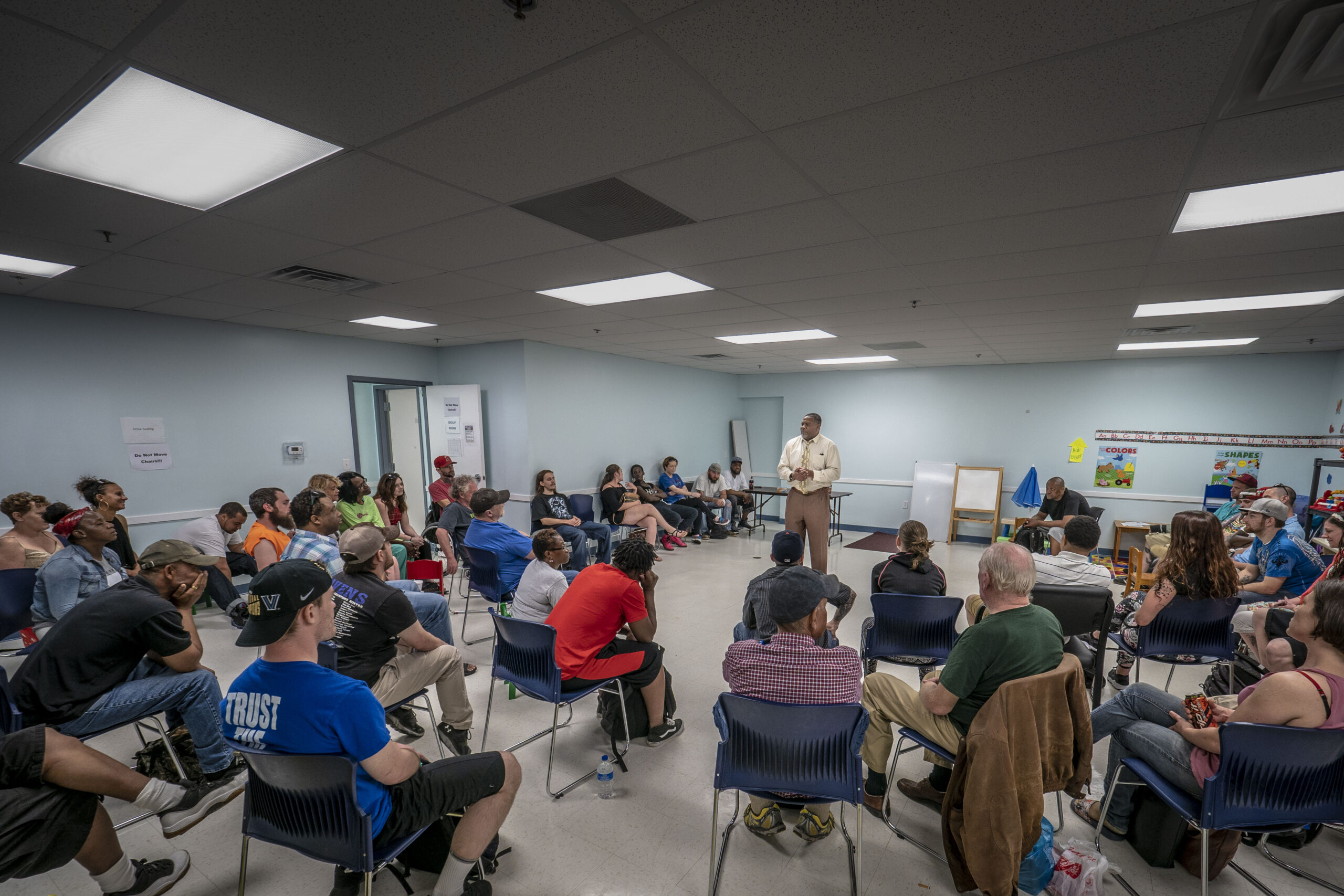


I was about two weeks into rehab when my brain started coming back online and I began to take an interest in my fellow inmates. I’ll never forget this young guy, Gabe. He was a handsome blond kid, a track star in high school, until he was spirited away by a mistress named Fentanyl and gave up his life to serve her.
I remember him because at first I couldn’t figure out what he was doing there with the rest of us shipwrecked losers. He was smart and funny and popular with the other addicts, and his life seemed to be just beginning and full of promise. The last time I saw him he was out in the parking lot, carrying a clear plastic garbage bag full of his clothes and climbing into a Cadillac Escalade.
The stern slaps of abstinence are what worked for me. About three weeks into treatment, I experienced the miracle of what we call “spiritual awakening,”
“Might as well put a gun to his head,” observed Lewis, an elderly black gentleman who had been in and out of places like this and seen a million junkies come and go. “He cried to his mama. Said ‘Mama, I wanna go home,’ and she come and got him.”
Now the social dynamics of rehab are a curious hybrid of high school and jail. There are popular kids, outcasts, class clowns — as well as sadists, snitches, psychopaths, and perhaps surprisingly, more than a few saints (as Lewis turned out to be). There are a few who, when paroled, make it. And many who don’t.
Like jail and high school, no one wants to be there. You’re stripped of the symbols of your liberty — phone, wallet, keys — and followed by minders everywhere you go (I called them “zombie wranglers” in my memoir). Above all, you are not trusted to perform any of the activities of daily life on your own recognizance, not even to eat or sleep or swallow your prescribed medication without someone watching. The only coping mechanism you’ve ever had, the only one that ever worked, has been abruptly ripped away following the de rigueur strip search, and you are left to stand (literally) naked before big bad ol’ life with all its terrifying vicissitudes.
It should come as no surprise then that we addicts and alcoholics, when confronted with this reality, seek to escape. We’ve been doing it our whole lives, and besides our using and drinking, it seems like the one thing we’re good at.
I know because this is exactly what I did when I begged my wife and my counselor and anyone else who would listen to let me go home. I was practically in tears, swearing I’d learned my lesson, promising to attend outpatient meetings, anything, just so I could go home and get high again. Thank God, they didn’t buy it.
I was doubly heartbroken later when I begged my doctor to let me go on one of the popularly-prescribed maintenance opiates like Suboxone or methadone, “at least for a little while,” and she informed me that, “My experience and the principles of this treatment center suggest that total abstinence is the best path for long-term recovery.” “So no ‘harm reduction’?” I said, hoping to get what I wanted by invoking the magic words that are currently in vogue, and meant, essentially, getting prescribed drugs.
“Total abstinence only,” she replied sternly.
This is the schism that divides families, treatment centers, and most consequentially, public policy. In blue states, the doctrine of “harm reduction” — giving addicts needles, shelter, and often drugs, is firmly entrenched. While there is some evidence this reduces total overdose deaths, the life that it offers is a kind of living death. Witness the scenes in Philadelphia, Portland, and Seattle of addicts wandering like zombies or frozen in the streets, their bodies contorted by the “fentanyl fold.”
Though the majority of policy experts (who are often far-removed from the frontlines of addiction) still advocate so-called harm reduction efforts, some have become skeptical. Dr. Keith Humphreys, professor of Psychiatry and Behavioral Sciences at Stanford University and prominent addiction policy researcher says, “When you start distributing opioids in the community, including to people to stop overdose, they will, in some cases, sell them and initiate new people onto drugs. And those people will overdose. If you just say, we’re just going to supply these drugs, what is the end game?”
Likewise, Dr. Nicholas King, professor of psychiatry at McGill University, says in “Harm Reduction: A Misnomer”: “[These programs] do not, however, reduce many of the other harms associated with illicit drug use, including the negative aspects of addiction itself; indeed, a successful abstinence program would arguably do a better job at harm reduction than any extant harm reduction program.”
In the microcosm of rehab I learned to lament people like Gabe’s mother as “enablers,” people who, for their own overwhelmingly selfish reasons (conveniently disguised as compassion), gave in to our demands, believed our lies, and “gave us another chance.” But what happens when society itself becomes the enabler?
A psychiatrist friend calls this “mother mind.” Addicts as pets and pity objects, the fur babies of liberal politicians who can’t bring themselves to set boundaries or impose consequences and are literally mothering addicts to death.
But what junkies and alcoholics like me need is not toxic empathy but real compassion, which includes coerced treatment and a lifetime of strict accountability. Because, as Lewis told me later, “Our problem ain’t drugs. Our problem is us.”
After I graduated from treatment I kept in touch with some of my classmates. I asked about Gabe but nobody had heard from him. Then somebody said he’d bounced back right after I left. He’d stayed a few days, enough to detox, then his mom came and got him again. A month later he overdosed and died. They said his mother found him with the needle still in his arm.
My friend, the late poet Coleman Barks, translates the 13th century Persian poet Rumi thus:
“Your old grandmother says, ‘Maybe you shouldn’t go to school. You look a little pale.’ Run when you hear that. A father’s stern slaps are better.”
Like old Lewis, Rumi was a wise man. The stern slaps of abstinence are what worked for me. About three weeks into treatment, I experienced the miracle of what we call “spiritual awakening,” and lost all desire to drink or use drugs. With the help of a recovery program that emphasizes faith, community, and accountability, I’ve been able to maintain sobriety for a little over nine years now. Had I been treated more indulgently I’m certain I’d be dead now. Just like Gabe.
READ MORE from Chris Jansen:
The Soul of Man Under Socialism, Revisited
Chris Jansen is a translator, essayist and poet. His books include Hamlet Decoded, We Can Be Heroes: A Rehab Memoir, The Last Mayan, and The Lost Poems of Juan Ramón Jiménez. He lives in Athens, Georgia.