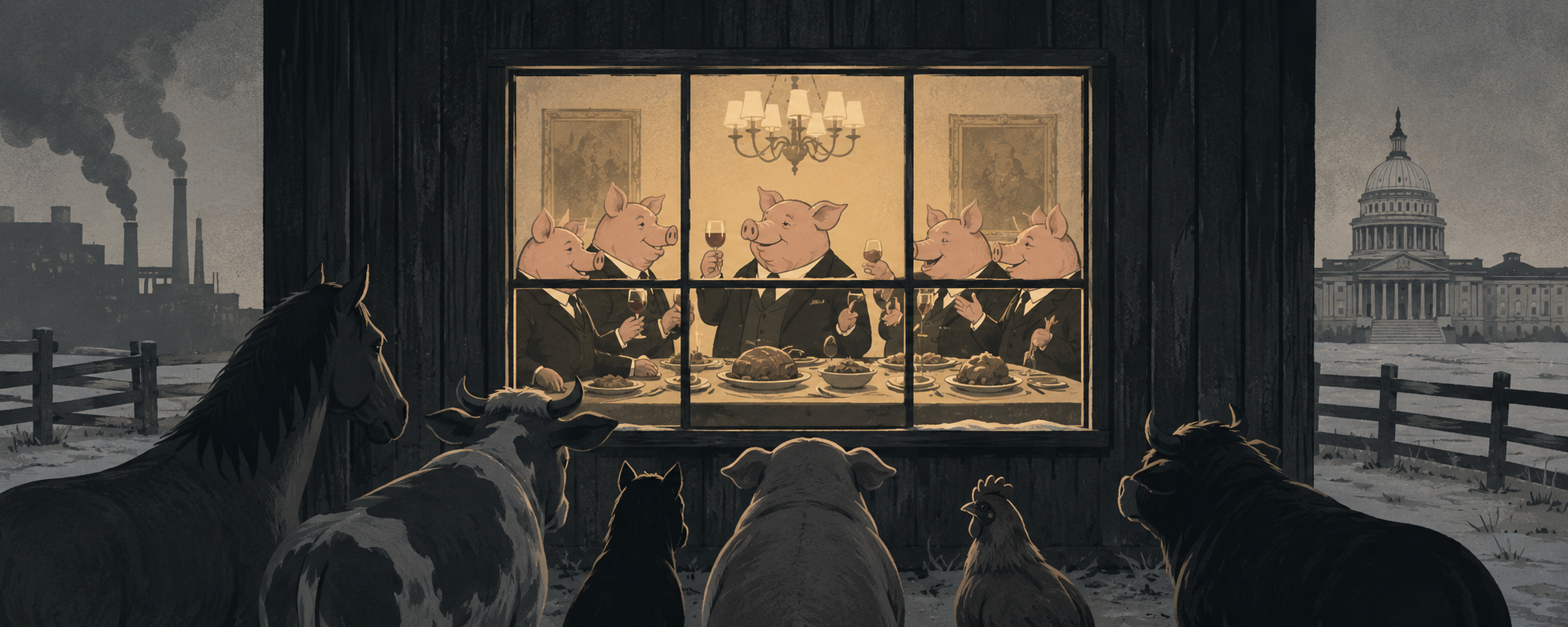


At the conclusion of George Orwell’s classic novel Animal Farm, the animals who think they have taken control of the property from the exploitative human oppressors peer through a window and watch their leaders — the pigs — dining, chatting, and interacting just the same as the humans the pigs had told the other animals they’d liberated them from. The pigs who’d led the revolution and taken over the farm in the name of all the animals had become special animals indistinguishable from their oppressors.
They even walked on two legs now.
Orwell used the pigs to convey a point about authoritarianism — and human nature.
Labor union leaders these days are more likely to come from a university than from the shop floor.
Consider the history of the Labor movement. In its earliest days, unions actually did represent the workers and improved the pay and working conditions of the workers. Rank-and-file workers had something important in common with the leadership of the unions because in many cases, those leaders were also workers — or at least, had been workers. A key organizer of the 1936 strike in Flint that unionized General Motors was Roy Reuther. After he was wounded while supporting striking workers at the Briggs Corporation, he literally worked on the production line at Chevrolet’s Gear and Axle plant in the months leading up to the strike. When Roy and his brother Walter moved into administrative positions at the United Auto Workers, employees on the production line never doubted that those men spoke for them in negotiations with corporate honchos.
Things have changed.
Labor union leaders these days are more likely to come from a university than from the shop floor. The current head of the AFL-CIO, for example, is Liz Shuler. She earned a journalism degree and spent years working through the bureaucratic back alleys of unions before emerging as the leader of the union’s 12.5 million members. She hasn’t ever worked like the members of the AFL-CIO work because paperwork is not the same thing as physical work. Shuler and other union leaders may be well-intended, but it is hard to relate to people you claim to represent when you haven’t walked in their shoes and don’t really have much in common with them.
So, it isn’t surprising that some labor union leaders are pushing for federal legislation that would shift power from rank-and-file members to the union leadership itself. For the good of the workers, of course.
That was sarcasm.
Union leaders support The Faster Labor Contracts Act, which they say will protect workers. In reality, it would diminish the power of rank-and-file workers to vote on the terms and conditions of their own employment. The Act would hand the feds the power to force a business and its workers into a union contract without either party’s consent. This idea is undemocratic on the face of it, and it would also give union leaders — who get to do the negotiating — more power while forcing both union leaders and members to serve a new set of masters in the federal government.
To date, the federal government has lacked the power to force a labor contract on a union or an employer. The Faster Labor Contracts Act would give the federal government — federal bureaucrats — exactly that power. Once workers vote to unionize, the federal government would have the power to compel the union to accept a particular contract, thus setting workplace rules, pay, and benefits.
Supporters claim the Act would “speed up” contract negotiations, but speed isn’t or ought not to be the primary object of contract talks. Getting a fair result for the workers ought to be.
If the Act becomes law, by day 100 of contract talks, either party could trigger federal mediation through something called the Federal Mediation and Conciliation Service. Once that happens, the process rolls along under its own power, thus taking power away from workers. On day 130, an unresolved process automatically would be sent to a three-person, binding arbitration panel. After day 144, arbitrators would determine the contract terms, which would remain in force for two years; far longer than the negotiation process.
Three federal bureaucrats would be the deciders. The pigs inside the farmhouse. Everyone else gets to shiver in the cold outside.
Unfortunately, this bill has bipartisan support — of the sort on display in Animal Farm, when the animals saw the pigs enjoying a nice meal inside the Farmer’s house. The Wall Street Journal notes that “Seven House Republicans crossed the aisle to hand unions the 218 votes they needed in a discharge petition to bypass a committee and send the Faster Labor Contracts Act (FLCA) to the House floor.”
READ MORE from Eric Peters: