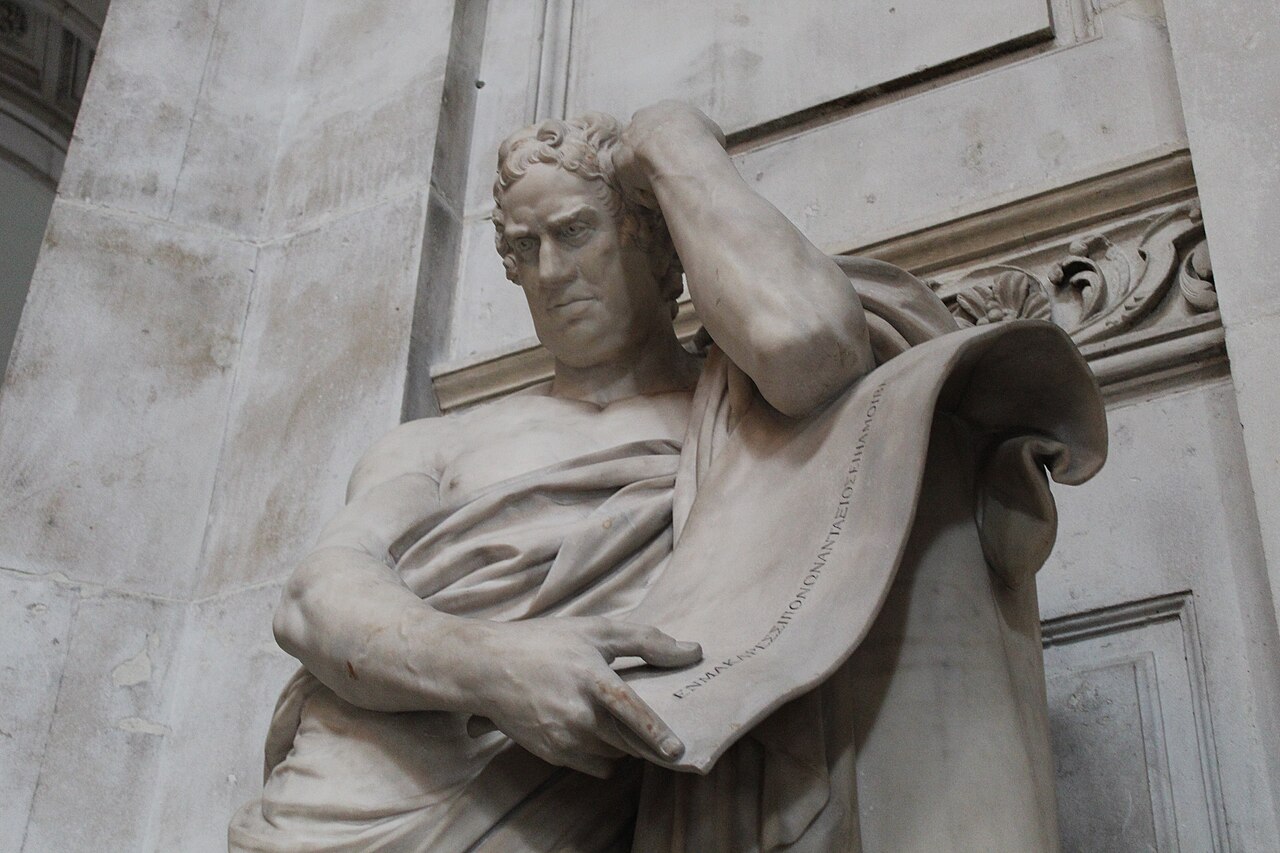


The Cambridge Introduction to Samuel Johnson
By Robert Demaria, Jr. and Dan Hitchens
Cambridge University Press, 163 pages, $49
One question any new book about Samuel Johnson is bound to address sooner or later is why he remains with us. That he does so remain is unmistakable. His continuing distinction is more secure than that of many of the authors and public men with whom he lived on terms of friendly or unfriendly acquaintanceship. In his own circle, Joshua Reynolds and Edmund Burke and Oliver Goldsmith and Frances Burney created enduring works whose craftsmanship was beyond Johnson in more ways than one. Within his particular set, Johnson does not stand out necessarily as the figure most blessed with creative gifts any more than with social graces. During the 75 years of a busy and productive life, Johnson produced a vast quantity of moral essays and occasional journalism, a rather flat verse tragedy, a wise and melancholy novella, two long and rewarding satires full of Christianized Stoicism, and a series of short biographies of England’s poets from the time of Milton down to the middle of the 18th century.
In addition to these, there is also to be considered his great mass of miscellaneous writings, sermons, and occasional verses, translations, and reviews; and the great Dictionary, a Herculean labor that almost no other man with the same paucity of resources could have carried through to its consummation. If we count the good alone in his collected works without the dispensable, or only the dispensable without the good, we find more of each than most of us could produce in two or three lifetimes. Such a figure can never be merely a footnote.
This book’s two authors make a real and laudable effort to reveal every side of Johnson without reducing him either to a dispenser of stereotyped wisdom or a period eccentric
Apart from the writer, there is the conversationalist to consider. Probably no man apart from Socrates has acquired such fame merely for the quality of his talk. Certainly no talker of comparable eminence has given evidence of taking such delight in the sheer combative sport of argument: Johnson: “Well, we had good talk.” Boswell: “Yes, Sir; you tossed and gored several persons.” More impressive even than the limitless arsenal of Dr. Johnson’s assertions, rejoinders, anecdotes and repartees was his integrity in debate; even when manifestly wrong, he never descended to sophistry or equivocation to score points off an opponent, despite Goldsmith’s often-quoted observation “There is no arguing with Johnson, for if his pistol misses fire, he knocks you down with the butt end of it.”
His religion has been much written of as well, mostly by authors inclined to emphasize the morbid and dismal aspects of it. This is to grasp the matter by the wrong end. It is true that Johnson was beset with many fears and doubts respecting his own destiny in the life to come: “Some people are not afraid, because they look upon salvation as the effect of an absolute decree, and they feel in themselves the marks of sanctification. Others, and those the most rational in my opinion, look upon salvation as conditional.” In the latter of the two camps was Johnson, with his many qualms and tremblings at the thought of death and the Particular Judgment. In the former may be numbered many respectable and unreflective believers who pass through life without ever asking whether any evil thing they have done or might be tempted to do could exile them from that state of grace they are inclined to take for granted.
In the England Johnson knew, during the bright noon of its Augustan heyday, the first of these attitudes was much in the ascendant, especially in the Deistic world of letters and moral philosophy. Even so sensible and genteel a man as Joseph Addison was capable of ordering his estranged stepson to attend him on his final sickbed that he might be edified by the spectacle of a peaceful Christian death. There is a smugness in this picture that is a trifle repulsive, albeit less so than that of its modern descendants. Many of us have encountered on social media someone posting a photo of herself and her kindred gathered round the hospital cot of Grandma Mildred as she, semi-conscious and full of breathing tubes, passes from this life into its glorious sequel. Johnson’s doubts were both more honest and less self-serving.
This book’s two authors make a real and laudable effort to reveal every side of Johnson without reducing him either to a dispenser of stereotyped wisdom or a period eccentric, as many from Thomas Macaulay to a host of lesser fry have done. After a short introduction to his life and times, the book is divided into chapter-long studies of his activities as a poet, political thinker, biographer, critic, and so forth. It concludes with a final chapter on the Johnson Legend, an eternally nettlesome problem for any student of his literary and moral reputation.
There is the Johnson we meet in Boswell, who will always possess our imaginations and hold ourselves in his debt. It is right also to remember that Boswell did not meet the Great Bear until Johnson was well past 50 years old (Johnson: “I understand, Sir, that you are from Scotland.” Boswell: “I am indeed, but I cannot help it.” Johnson: “That, Sir, is what I find a great many of your countrymen cannot help.”).
By far the greater and more memorable part of Boswell’s book is taken up with the man whom he knew and worshiped during the years of Johnson’s literary dictatorship. These and other biographical issues Messrs. DeMaria and Hitchens address with care and a standard of scholarship that is visible from the first page to the last. The book shows such fine sense in its presentation of a man who was in life Britain’s reigning man of letters and in death the incarnation of Tory-Anglican John Bullishness that, after Boswell’s great Life, it is one of the best places to begin a serious study of Johnsoniana. After setting it down, we are not left with any stray doubts concerning Johnson’s importance, any more than his honesty, his depth of mind, his moral acuity, as well as his foibles, narrowness, and sometimes too short temper. As much as Shakespeare, he was not for an age but for all time.
Almost the only detectable error chargeable to the authors occurs on page 16, where we read that “[Johnson] was particularly moved by the deplorable case of Admiral Byng, who was unfairly sentenced to death in the aftermath of the Spanish victory at Fort Mahon, Menorca.” Admiral Byng was indeed executed for his failure to relieve the British garrison, which was in consequence forced to surrender. The incident provoked Voltaire’s caustic remark, “In this country, it is considered good from time to time to shoot one admiral in order to encourage the others.” But it was the French, and not the Spanish, who were the victorious antagonists in this battle. In a book like this, a mistake of this kind counts for very little.
READ MORE from Thomas Banks:
The Man Who Pulled the Trigger, the Saint Who Changed a Kingdom