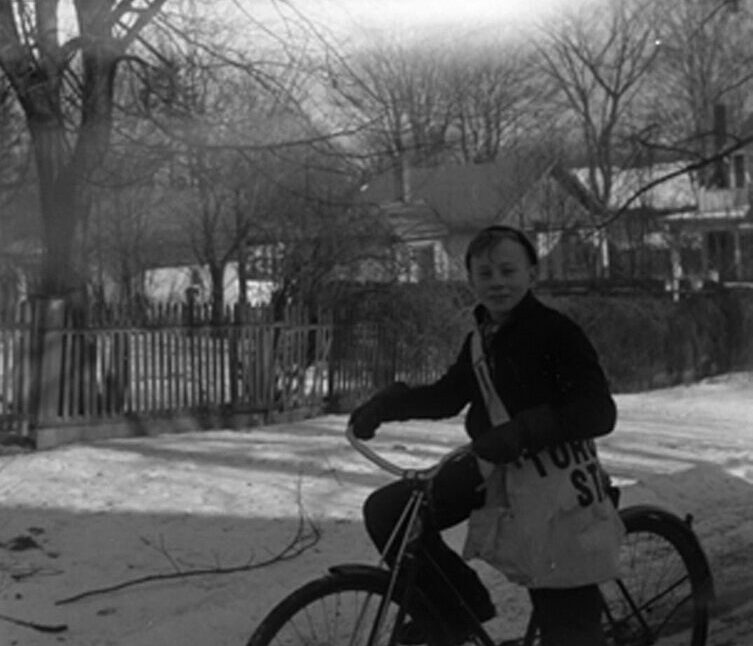


I was struck by the many fun reactions to my column last Saturday on “Your Vanishing Newspaper.” One reaction I didn’t expect was the readers celebrating the decline if not disappearance of newspapers because of their left-wing biases. Then again, in a publication like ours, focused on politics and ideology, I suppose I shouldn’t be surprised by that reaction. Still, I wasn’t thinking about that. Now that I have thought about it, I’ll make just a quick observation:
In the old days, because there were multiple print dailies in major cities, you often had the option of picking a more conservative or Republican-leaning newspaper over a liberal one. Admittedly, too often you had a choice between a liberal paper or a moderate/liberal one. But you frequently had a legitimate choice between a “Democrat” or “Republican” paper. Many townsfolk read both, expecting the slant and reading accordingly.
Big cities aside, smalltown newspapers were generally more conservative. My hometown paper, the Butler Eagle, was Republican. And either way, you didn’t rely on your local paper for national political news. Most people read the local paper for local news, sports, classifieds, letters to the editor, obituaries, community events, photos, and more.
Indeed, some readers of my column noted that a big problem with local print dailies (including those still barely surviving) is that their national news coverage is quickly outdated and trumped by online dailies. Well, that’s true—if you’re going to your local newspaper for coverage of, say, Iran or Ukraine. But who does that?
On a separate point, another reader noted that “What killed most of those papers wasn’t politics but labor costs and the refusal of the unions to permit any automation. So everyone lost their jobs, much better.”
Precisely. I noted the meltdown in Pittsburgh in the late 1980s with the Pittsburgh Press and Pittsburgh Post-Gazette. It was based on labor-union nonsense, the same junk that destroyed the steel industry in our area. And more recently with the Post-Gazette (i.e., this year), it was labor issues once again that nearly destroyed the paper entirely.
But that aside, there was another subject raised by a couple readers that really struck me, and I’ll be surprised if anyone cheers “Good riddance!” to this. That would be the vanishing not of newspapers but newspaper boys.
Yes, paperboys. Remember those? Of course, you do. How many of you reading today delivered newspapers as a boy? It was probably your first job. It was for me.
I delivered the Butler Eagle. Each morning, the delivery truck stuffed a stack of newspapers in a large circular metal container at the end of our driveway. I would grab the stack and shove them in a huge bag with a large shoulder strap. Like other paperboys, I was just that, a boy—a young kid—and those bags were heavy. You had to build up the muscle to get used to hauling around that weight. It could be doubly, triply difficult on heavy snow days when you trekked across massive fields in boots and coat. And no matter what the weather, you delivered the newspaper on time. Customers expected it, whether the paper was tossed sidearm to their doorstep, or placed between their doors, or inside a screened-in porch.
This taught young boys a sense of responsibility—a work ethic. The paperboy not only collected newspapers but also the money for the subscriptions, usually provided as cash in envelopes from the customer. The cash always included coins. Credit cards were not used. If you did your job well, you got tips.
How common was newspaper delivery? There wasn’t a house in my neighborhood that didn’t get a paper. Not one. Everyone read the local newspaper. Indeed, that’s quite the contrast to today. Some readers reacting to my last column hailed the convenience of getting their news today online, via their phone or laptop. Sure, but how many citizens of your town read the local newspaper even electronically? Not nearly as many who once read it in print. That’s why those papers are vanishing. In the old days, everyone read it in print and paid for it. And it wasn’t expensive because there were so many subscribers.
Today, those papers are online and struggling to get subscribers behind their paywalls. And they’re not getting them. They’re going bankrupt. They’re vanishing.
Anyway, I heard from several of you who were paperboys. We swapped stories about our adventures. My friend Lee told me about the moment he carefully contemplated crossing a raging creek of ice-cold water on a fallen tree to shorten his time one freezing winter day. He stared at the tree as he decided whether to risk his 10-year-old life. What did he do? You guessed it. He walked across, high above the water. He didn’t die, but he damned well could have.
Could you imagine if his parents knew?
That story reminded me of a friend of mine. His last name was Fleming, and thus we called him “Flem” (my wife and daughters find that “gross”). I sometimes walked his paper route with him. One day he ventured across an ice patch that wasn’t very thick. Flem was a very heavy kid. The ice cracked and he fell in. Fortunately, I was there to pull him out.
Did his parents ever know? Of course, not. They never knew anything. Gosh, if only they knew half of it.
In fact, today, most parents wouldn’t let their kids deliver newspapers. They would fear (not wrongly) weirdos and perverts and predators. Nonetheless, we delivered in those days, and we were very young.
One reader, Phil, told me that he was eight years old when he delivered the afternoon edition of the Buffalo News. No fear. He rode his bike from house to house. Personally, I walked my route, because it was more rural, but I could’ve benefited from a bike in trying to escape the angry German Shepherd that growled and chased after me. The Neanderthal owners refused to tie up the monster. I started placing their paper in the mailbox at the end of the driveway, which they didn’t like. The delivery department at the Butler Eagle intervened. The two people acted like cavemen, utterly unsympathetic to a boy getting attacked by their stupid animal.
Ridiculous as that experience was, it was a life lesson for a young boy, namely: people are jackasses. Getting through life—and a job—means learning to deal with idiots.
How many paperboys exist today? Not many. If you ask AI, it says that paperboys are virtually extinct. I’m sure that’s true. The New York state legislature last year passed a child-labor law banning newspaper deliverers under the age of 12. That would have killed Phil’s job with the Buffalo News.
This is a loss. These were nice jobs that taught boys a sense of responsibility. I would like to see a statistic showing the percentage of males for whom paperboy was their first job. I can’t think of another first job more common to guys.
Alas, with the vanishing daily print newspaper, paperboys are vanishing as well. And that’s nothing to celebrate.