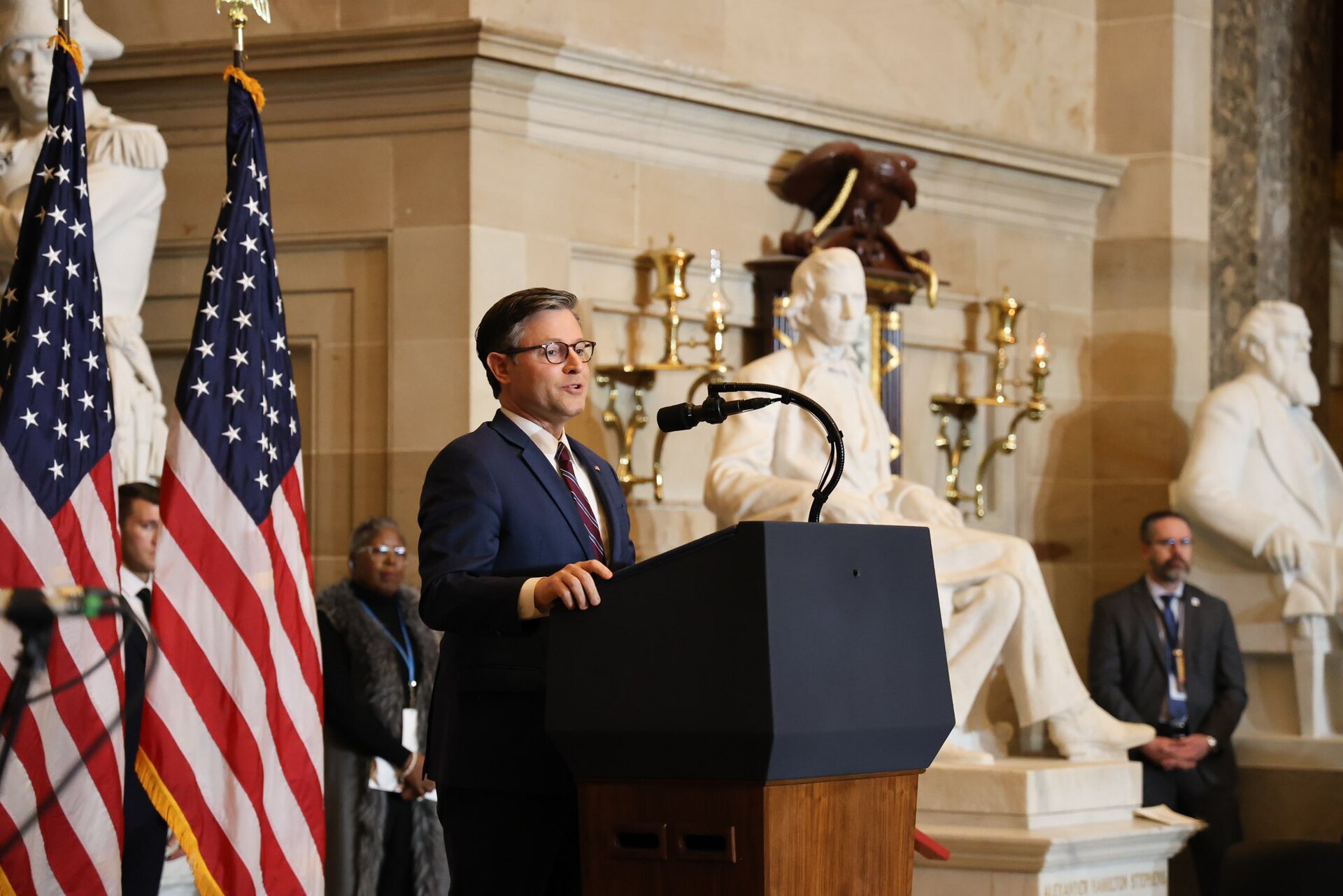


On Sunday, U.S. House Speaker Mike Johnson (R-LA) encouraged a legislative fight against the recent Supreme Court decision, Trump v. Barabara, concerning birthright citizenship. Johnson said in an interview with Shannon Bream, “We do need to address it. We’re looking at all angles,” to find a congressional solution for upholding President Donald Trump’s executive order. which denied automatic birthright citizenship to children born in the United States if their parents were illegal immigrants or were only temporary visitors (including students and tourists).
On June 30, 2026, the Supreme Court released its 6-3 decision, ruling against the president’s executive order. However, their opinion was split 5-4 over the constitutionality question. Five justices voted that the executive order was unconstitutional, but one, Brett Kavanaugh, voted that it only violated federal law.
This difference in ruling based on constitutional law vs. federal law is an important distinction. If the ruling is based on the unconstitutionality of the executive order, then the only way Congress could change the effects of this decision would be to change the Constitution itself.
Trump seems to think that will not be necessary. As he posted this on Truth Social, “We can easily make it up in Congress through Legislation … No long and unwieldy Constitutional Amendment is necessary!”
Others think a Constitutional amendment is the only way to change this decision. “It is a substantive decision that says the 14th Amendment requires citizenship for those born to, among others, birth tourists or those unlawfully present in the country. Will need either a constitutional amendment or a future court to overrule this,” Florida Gov. Ron DeSantis stated.
As a former constitutional litigation attorney, Johnson said he enjoyed Justice Clarence Thomas’s dissent. Johnson summarized Thomas’s main points, saying, “The 14th Amendment’s original intent was to enhance and really value citizenship.” But today, citizenship “has been devalued because of birthright tourism.” Johnson says future steps may include legislation or a longer process of a Constitutional amendment, either of which he is willing to work towards in Congress.
The major issue in this case sheds light on what the constitutional debate was about. The majority and dissenting justices were debating one little clause in the 14th Amendment, “Subject to the jurisdiction thereof.” The difference of opinion was based on the question of whether jurisdiction involves merely being born in the country or if it also involves one’s political allegiance.
In the majority opinion, Chief Justice Roberts advocated for adopting the old English common law view of jurisdiction, “jus soli” or the right of the soil. Simply, the old English common law interpretation of jurisdiction implies if one is born in the U.S. then that person should have the right of citizenship in the U.S.
Justice Samuel Alito noted that accepting an English law definition of citizenship is greatly ironic, given the timing of America’s 250th. “That is a curious claim, and it is ironic that the Court should embrace it only days before we celebrate the 250th anniversary of our Declaration of Independence, which emphatically renounced the foundation on which the British rule rested,” Alito stated in his concurring opinion.
However, Roberts’ adherence to the British definition is not so black and white. He further outlined a couple of exceptions to the rule of birthright citizenship, which seem to collide with his previous blanket definition of jurisdiction. Roberts wrote that the children of diplomats and the children of an invading army do not count in this automatic citizenship group. Why? The dissenting justices had a clearer answer.
Justice Clarence Thomas wrote the court’s dissent and defined jurisdiction as including not only a person’s physical location at birth but also something that must be dependent on one’s political allegiance. This is why children of diplomats, invading armies, and also children of illegal immigrants do not have automatic citizenship rights if born on U.S. soil, according to Thomas.
Whatever happens with Johnson’s claims to advocate for a legislative response, it is undeniable that there has been some significant change in the birthright citizenship debate. Going into this case, many thought the ruling would be closer to a 9-0 decision. Amy Swearer, a senior legal fellow at Advancing American Freedom, said in an interview with World she thinks the change in opinion is “a testament to the strength of the historical arguments that the Trump administration put forward and a lot of the scholarship that had been done … even in just the last year or two on this issue.”