

The Holy Spirit has taken wing over the American landscape. Hardly a day goes by without another story appearing in the press about reenergized Christianity — conversions, revivals, young people flocking to churches en masse. No less a skeptic — even antagonist — of all things Christian than the New York Times has taken notice. In an April article, the paper declared, “Christianity is in the midst of a nationwide revival, they say.” But the Times then cut down that claim with a thousand qualifications.
But baptisms are up. Kids are getting saved. Campus ministries are booming. In some places, you could even call it revival. For some churches, it’s get-to-church-early-or-don’t-get-a-seat for the first time in their history.
This article is from The American Spectator’s summer 2026 print magazine. Subscribe to The American Spectator to receive the magazine.
Secularization theory — the belief that as civilizations modernize, religion inevitably declines in influence — long an ironclad credo in the sociological canon, is on its back foot as the rise in unchurched Americans has stalled, and even dipped marginally in recent years.
Much of the action is occurring in the Catholic space. Easter Vigil baptisms — the traditional entry point for new members — were up in large numbers across the country in April. A Catholic prayer app saw conversions increasing by 38 percent from 2025 to 2026, with some locations boasting double-digit, even triple-digit, rates of increase. Baptisms in the Diocese of Duluth rose by 145 percent year over year, and in the Archdiocese of Los Angeles by 139 percent. Rapid City (96 percent), Pensacola-Tallahassee (85 percent), and Chicago (52 percent) were also big gainers. According to another survey, 66 of 71 U.S. dioceses that responded expected a rise in converts in 2026, with many of them experiencing over 50 percent growth, some even over 100 percent.

Subscribe to The American Spectator to receive our summer 2026 print magazine.
As for the Protestant world, any discussion of American Protestantism is clouded by the collapse of the traditional denominations. The Seven Sisters of the Mainline, as they’re called, have been shedding members for fifty years, but most dramatically since 2000. According to one report, from 2000 to 2020, the Disciples of Christ lost 57.25 percent of its members; the Presbyterian Church USA lost 50.68 percent; the United Church of Christ, 43 percent; the Evangelical Lutheran Church in America (ELCA), 38.6 percent; the Episcopal Church, 32.42 percent; the United Methodist Church (UMC), 24.4 percent; and the American Baptist Church, 21.7 percent.
Where have all those former members gone? Many are retreating to their couches, or worshiping in the mountains or on the seashore or on the golf course — it’s easy to find a reason not to go to church. And, of course, because of demographics, a fair number are finding more permanent repose. Half of the membership of the Episcopal Church is over 65 years of age; as for the Presbyterians, 58 percent are 56 or older (one-third are over 70).
Not many seem to be filling the pews of conservative Protestant churches. In the established American Protestant world, the Assemblies of God is the only historic denomination that is growing, jumping from 1.24 million members in 1975 to 2.98 million in 2025, peaking at 3.26 million in 2019–2020.
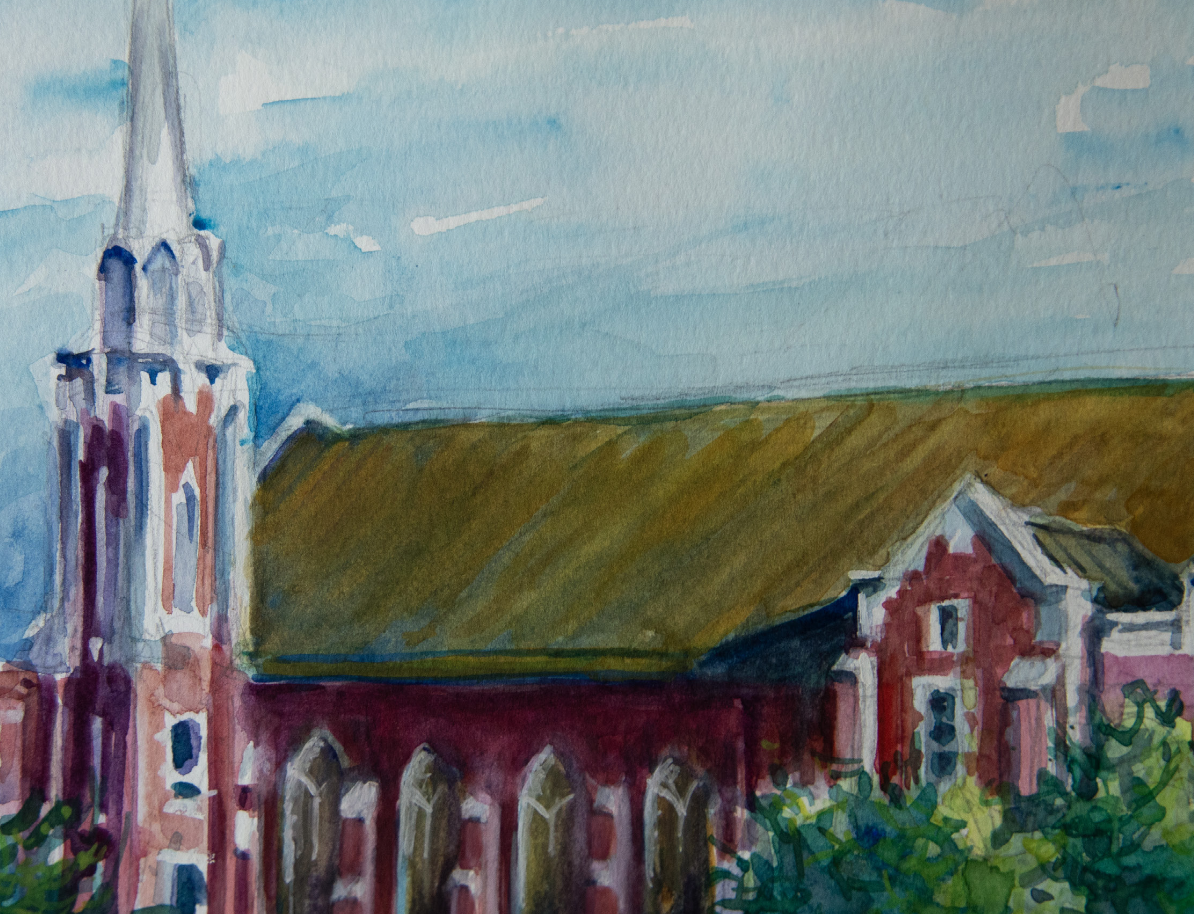
Art by Bill Wilson for The American Spectator
Other traditional, conservative Protestant denominations have also lost members over the past twenty years, most notably the Southern Baptist Convention. After a steady increase in membership from 1944 to 1984, from 5.7 million to 14.4 million, the denomination reached peak membership in 2006 (16.3 million). Today, it has given back forty years’ worth of growth — only 13 million now claim membership. The growth charts in other traditional Protestant denominations also point downward.
The Rise of the Nones
While the historic Protestant “brands” are tanking, the churches that have eschewed denominational labels are getting plenty of action. Religious pollster Ryan Burge has said, “Non-denominational Protestants are gaining new members hand over fist, while other denominations are losing folks by the tens of thousands.”
All those big-box worship centers with huge parking lots and names like Elevation, LifeChurch, Resolution, and So-and-So Community Church draw scads more than the Southern Baptists and Methodists and, if considered a denomination, would lead the Protestant field by millions.
In 1984, a mere 5 percent of Protestants attended these nonaffiliated congregations. That number is now 22 percent, with 21 million Americans currently calling nondenominational churches their home. And these churches are overwhelmingly conservative in theology, and, coincidentally, if Donald Trump’s 80-some percent evangelical vote in 2024 is any indication, in politics as well.
But that is not all. Many of the mainline denominations spawned breakaway churches that bolted mainly to preserve the conservative theology their denominations originally confessed. These churches are growing as well, albeit in smaller numbers than the nondenominational units.
The Presbyterian Church of America, an evangelical group espousing conservative doctrine — no women’s ordination, marriage exclusively between a man and a woman — boasts about 400,000 members at around 1,700 churches. But the denomination is adding 1.5 to 2 percent to its rolls every year.
The Episcopal breakaway, the Anglican Church of North America (ACNA), is reporting double-digit growth for the third consecutive year, and now boasts about 130,000 members at a little over 1,000 congregations. Originating in 2009, the ACNA broke away from the Episcopal Church to chart its own way on women’s place in the church and gay ordination.
Speaking of which, the catalyst for the largest denominational fissure since the Civil War was the radical shift toward gay marriage and LGBTQ ordination in the United Methodist Church (UMC). Brewing for decades, this big split finally came to a boiling point in 2023, as 7,600 congregations, from 20 to 25 percent of member churches, left the larger group, cratering UMC membership. Many of those churches ended up in a new denomination, the Global Methodist Church, which proclaims fealty to traditional marital norms and other aspects of conservative theology.
Also benefiting from mainline profligacy were two smaller Lutheran denominations. The North American Lutheran Church, formed in 2010 because of the ordination of non-celibate homosexual ministers in the ELCA in 2009, has grown to over 500 churches, and the already-existing Lutheran Congregations in Mission for Christ (founded in 2001) became a primary landing zone for disgruntled ELCA churches unhappy with the leftward dive of that denomination.
The Kids Are Going to Church
While the growth of conservative churches has been modest but encouraging, more sanguine developments may be happening among the young, specifically Generation Z.
On February 8, 2023, following a routine morning chapel service at Asbury University in Wilmore, Kentucky, a couple of students hung back to pray and sing Christian songs. Word spread across the campus that something — or some One, as in the Holy Spirit — was afoot, and soon students at the nondenominational evangelical college rooted in the Wesleyan-Holiness tradition were flocking to the chapel to get in on the spiritual action. Within a couple of days, buses were arriving from out of town, soon out of state, and even out of the country. Crowds lined up by the thousands to get into Hughes Auditorium and, once inside, remained — praying, singing, confessing — until authorities kicked them out at 1 a.m. to clean for the next day. The revival lasted sixteen days, drew over 50,000 worshipers representing hundreds of colleges and universities, and became known as the Asbury Outpouring.
Similar events, albeit less intense or long-lasting, were recorded at Lee University in Tennessee, Cedarville University in Ohio, Auburn University, and the University of Pittsburgh.
And even in less formal venues, campus ministries report increased interest in theology and increased participation in ministry events. In 2025, one Christian journal reported that optional chapel services at Dordt University in Iowa are packed; at a church event in Durham, North Carolina, seventy students accepted Christ; and the Salt Company, a national campus network, boasted a 40 percent increase in attendance at ministry kickoff events over 2024.
This is Gen Z doing this, a cohort until recently high-flyers in the no-religious-affiliation category. In 2020, 45 percent of Gen Zers placed themselves in the “none” category. In 2022, that number bumped up to 48 percent. But in 2024, it was down 6 points, to 42 percent.
This corresponded to reports of kids returning to the churches of their upbringing, or, more often, walking through church doors for the first time in their lives.
Members of Gen Z, the generation of looksmaxxing, TikTok doomscrolling, Netflix binge-watching, and spending six and a half hours a day on their phones, are turning to substantial things in their lives, to conservative Christianity, to the faith with theological meat on its bones.
This is in concert with a general flattening out of the nones. From 2008 to 2013, the number of people who claimed no religious affiliation exploded, from 21 percent of the population to 30 percent. But since the pandemic, that number has leveled off, holding steady for the past five years at around 35 percent. The number of nones, says Burge, “definitely hasn’t continued to explode in the last few years. If anything it’s steady as she goes.”
Why? Burge hypothesizes:
I think the easiest explanation is that a lot of marginally attached people switched to “no religion” on surveys over the last decade or two. Eventually, there weren’t that many marginally attached folks anymore. All you had left were the very committed religious people who likely won’t become nones for any reason. The loose top soil has been scooped off and hauled away, leaving nothing but hard bedrock underneath.
That the slide into “none-hood” has been halted is good news, and given the fact that older nones will eventually die off and hopefully be replaced by more religious young people, as well as the difference in birthrate proclivities between Malthusian liberals and be-fruitful-and-multiply conservatives — atheists reproduce at 1.2 babies per woman versus the 2.2 babies of evangelical women — the horizon might be brightening for conservative Protestants.
Subscribe to The American Spectator to receive our summer 2026 print magazine.