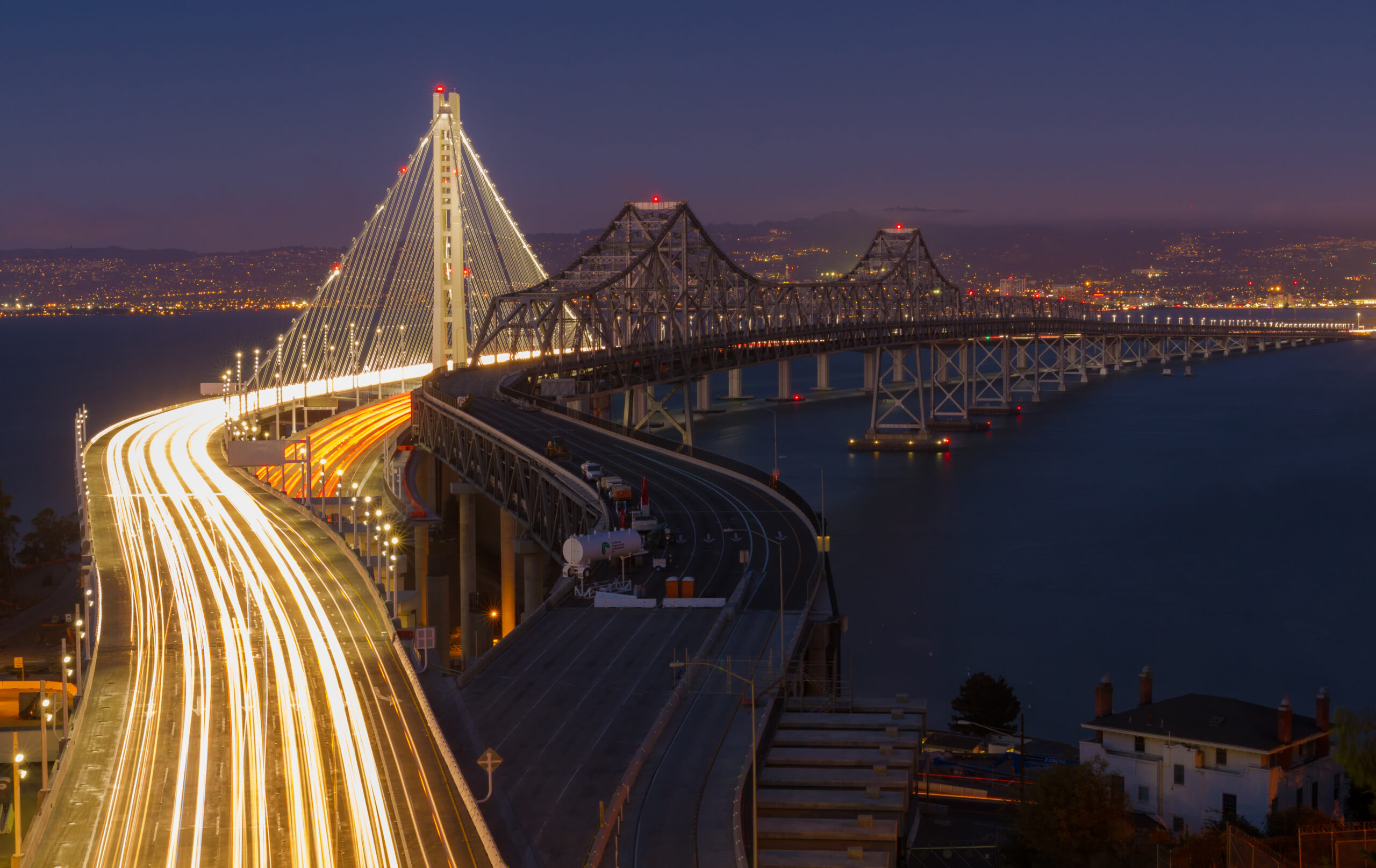


On Monday July 27, Michigan Governor Gretchen Whitmer and Ontario Premier Doug Ford will cut the ribbon on the Gordie Howe International Bridge linking Detroit and Windsor. As the opening awaits, motorists across the two nations might compare the new span of the Bay Bridge linking San Francisco and Oakland, California.
In the spring of 2013, as the opening approached, reports emerged of cracked bolts and rods that could render the bridge vulnerable in an earthquake.
Gordie Howe played professional hockey from 1946 to 1980, including 25 years with the Detroit Red Wings. The bridge bearing his name was constructed by Bridging North America, composed of Fluor Canada, the Aecon Group, and ACS Infrastructure.
The contractor used steel and construction materials from North America, including stainless steel, not susceptible to rust. Local unions in Michigan and Ontario supplied the welders and ironworkers. So far, no complaints on work quality or concerns about bridge safety.
Launched in 2018, the Gordie Howe Bridge opens two years late, with a cost overrun of about $500 million. By contrast, California’s new Bay Bridge came in ten years late and $5 billion over budget, hardly the only difference between the spans.
California politicians hired American Bridge Fluor and China’s state-owned Shanghai Zhenhua Heavy Industries (ZPMC), which at the time had never built a single bridge. California politicians also turned down federal funding and opted for steel from the People’s Republic of China.
China’s ZPMC welders fabricated parts of the Bay Bridge in China. They arrived with hundreds of cracked, defective welds and sections of the deck had to be repaired at great cost to California taxpayers.
In the spring of 2013, as the opening approached, reports emerged of cracked bolts and rods that could render the bridge vulnerable in an earthquake. This came to the attention of recurring Gov. Jerry Brown, a big promoter of the bridge when he was mayor of Oakland, from 1999 to 2007.
“Don’t know if it’s a setback,” Brown famously told reporters, “I mean, look, shit happens.” The bridge did open over the 2013 Labor Day weekend but Gov. Brown failed to attend the ceremony. In 2014, the lingering safety issues became the subject of state hearings.
One inspector on the bridge foundations was known for falsifying data. This was discovered after steel had been erected on the foundations he inspected, which made precise testing difficult. According to metallurgical experts, the Chinese steel was subject to embrittlement, a poor choice for the bridge project.
Engineers called attention to the faulty welders, but officials from the California Department of Transportation (Caltrans) transferred the whistleblowers to other projects. Caltrans bosses testified that the bridge was safe but the structure has yet to face a major earthquake.
According to the United States Geological Survey (USGS), a major quake in the Bay Area is likely to occur before 2032. The old span of the Bay Bridge was damaged by the 1989 Loma Prieta earthquake, with a magnitude of 6.9, followed by aftershocks as strong as 5.0. A similar seismic event in the Bay Area could now make things exciting.
The final comparison between the Gordie Howe and Bay bridges may be which one stands or falls. California’s Golden Gate, Carquinez, and Coronado bridges survived earthquakes with no damage. But unlike the new Bay Bridge, they were not built with Chinese steel and labor.
Last November, China’s Hongqi Bridge, completed in January 2025, fractured and collapsed without the agency of an earthquake. In 2024, one section of a highway bridge in Shaanxi province “snapped and folded at almost a 90-degree angle” sending at least 25 cars into the river below.
For all but the willfully blind, the lesson is simple. Chinese infrastructure is dangerous, even in China. The USA, Canada, and all other countries would be wise to avoid it entirely.
READ MORE from Lloyd Billingsley:
UC Berkeley Joins Forces With Nancy Pelosi
Lloyd Billingsley, a former resident of Detroit and Windsor, is a policy fellow with the Independent Institute in Oakland, California.