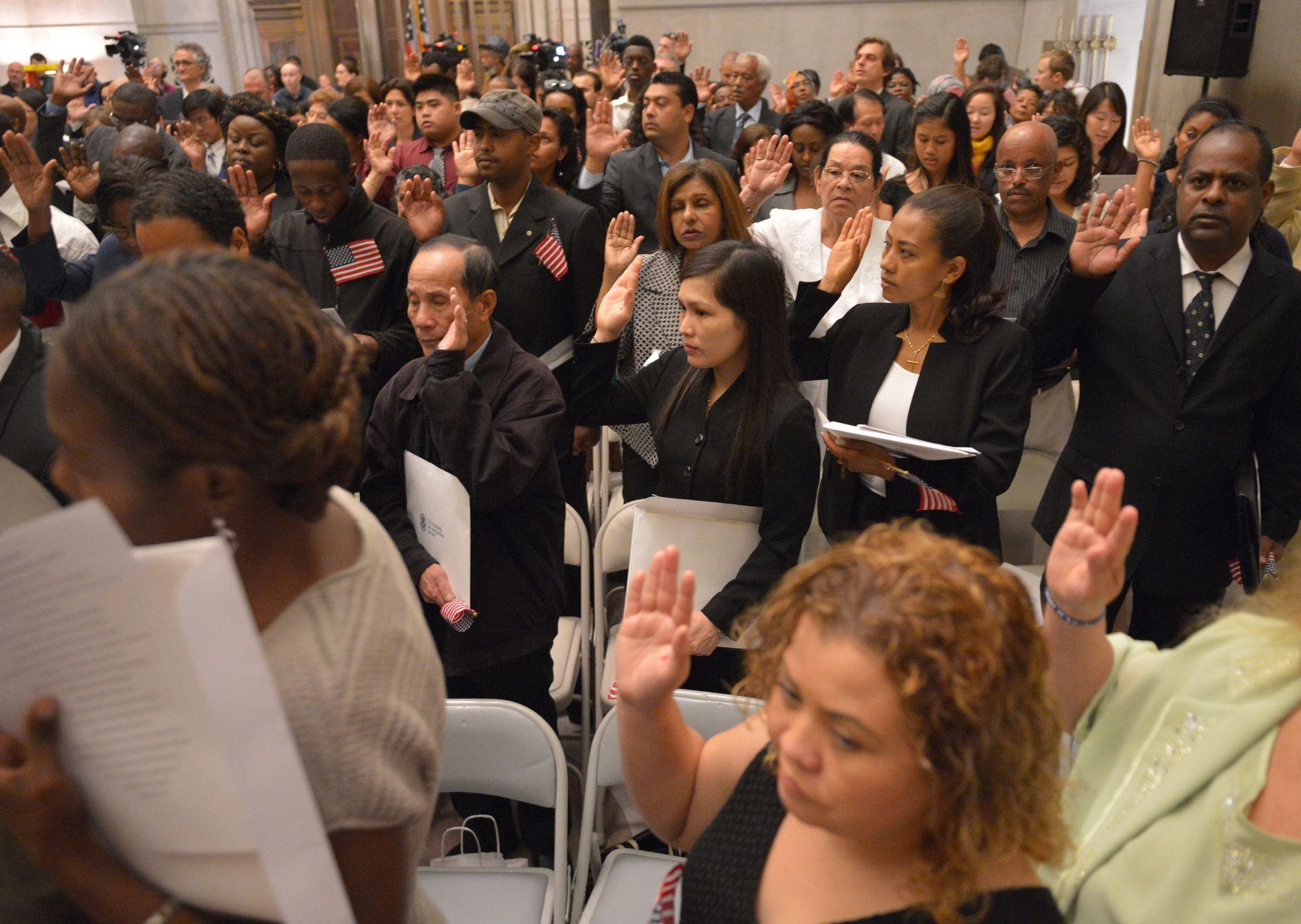


In the long-awaited birthright citizenship decision, the majority ruled that anyone born in the United States is a citizen, even if his parents are here temporarily or illegally.
Writing for the majority, Chief Justice Roberts argues that birthright citizenship is a part of the Common Law. The key is Justice Coke’s decision in Calvin’s Case of 1608, recognized as authoritative in England and in British America. The Dred Scott case rejected this when it ruled that Scott was common-law property and not a citizen, and America rejected that decision in the war fought largely over the issue of slavery.
If sovereign law doesn’t hold, being born there can bring no benefit from that law. No law, no citizenship.
Roberts makes a clear argument and presents it ably. His defense of it against Justice Thomas’ dissent is not as able.
This relatively short article allows only a brief look at the many pages of the Trump v. Barbara decision. As Roberts’ key argument is that birthright citizenship is based on Common Law and everything subsequent, such as the language of the Fourteenth Amendment, must be read in the light of its use in Common Law, the Common Law is where we will focus.
Basing himself on Coke’s decision in Calvin, Roberts sets out the Common Law claim — anyone born under the sovereign protection of the King owes him allegiance. Roberts elides over the difference between a subject and a citizen.
Justice Thomas attacks this elision. The feudal sense of allegiance due someone who enjoys sovereignty by reason of birth is alien to a republic in which the sovereignty belongs to the citizens. To be a citizen is to be invested with sovereign rights; to be a subject simply means one owes obedience to laws someone else has the right to make. As King Charles I said just before his execution, “A subject and a sovereign are clean different things.”
As the king made clear, such liberties as the people enjoyed came only through his sufferance in guiding his subjects through his laws — not the unalienable rights asserted later in the Declaration of Independence as the basis of self-governance.
The difference between subject and citizen has been bridged historically only by gelding the monarch politically. The last attempt of a monarch to revive political power, Queen Elizabeth’s decision acceding to PM Boris Johnson’s request to prorogue Parliament, was unceremoniously scuttled by a British court asserting powers their judiciary had not claimed since the days of Justice Coke. Coke failed, but his heirs are doing much better than the monarchs in wielding power in the British state.
America, on the other hand, rejected the very idea that sovereignty belongs to royalty or nobles. At the same time, it proclaims fidelity to common law concepts of liberty and some kinship with the evolving British constitutional tradition.
What Thomas is saying is that, while we maintain continuity with the English law tradition, we must not ignore the crucial differences over which we split. No kings! Power to the people! Roberts’ attempt to dismiss this fundamental difference weakens his case.
There is also another line of argument.
Grant Roberts’ reasoning, for the sake of argument, and say that Cokes’ Calvin ruling determines how we understand the Fourteenth Amendment and other relevant American law sources. As Roberts notes, Coke sets out some limitations to this birthright, which he acknowledges, such as ambassadors and the like who are here to represent another sovereignty. Coke also sets as exceptions such places where the king’s sovereignty is in name only, such as the claim of the British monarch to be the ruler of France. Coke ruled:
Seeing the King is not in actual possession thereof, none born there since the Crown of England was out of actual possession thereof, are subjects to the King of England.
Furthermore:
Any place within the King’s dominions without obedience can never produce a natural subject.
That is, if some other power holds part of the realm, say, a castle, those born there would have no natural allegiance to the king, for his law does not hold there. And that is the core issue for Coke, for he calls this a natural law of God that the one who is by nature subject is bound by the sovereign’s law. Here, since the king has no power, the subject has no obligation to obey.
There are places here where this applies in the U.S. Victor Davis Hanson has been talking much of the decline of California, where he still lives on land his grandfather owned. His area had been largely an area of immigrant farmers, who worked hard and thrived, loved their adopted home, treasured their shared community, and upheld its legal order.
Nearly all those families have left, and their land is in tatters. Laws there are enforced only among the remnant of the original families. The rest ignore the web of laws governing zoning, trash disposal, construction, and traffic. Little attempt is made to make them. And most of them got here due to a studied refusal to enforce the immigration laws of this sovereign nation.
Among the most irritating areas of the law’s unequal enforcement is taxes. A gigantic cash-only black market has developed in which the steep sales tax and other taxes are not enforced. Those left obeying the law are playing on an unequal playing field.
Is this not Coke’s exception? The laws do not apply here. The sovereign, who in America is “We the People,” holds no effective sway. There is allegiance to the sovereign’s laws, so there are no rights from the sovereign. The freedoms under law have been lost, citizenship is meaningless.
Thisfundamental issue lurks only in the background of the arguments in Trump v Barbara, it still looms large in the minds of many Americans. Is our entire sovereignty being gutted as the rule of law fails? How can we award citizenship’s shared sovereignty when the laws of that sovereignty do not hold?
There is a long history of the Left seeking to take back power by surging in large numbers of people selected for their likelihood to support the Left’s cause. Books were written on this topic, such as The Emerging Democratic Majority and Diversity Explosion. The unprecedented abandonment of all but a pretense of legal control of immigration under Biden has resulted in the abandonment of wide swaths of America to being less than sovereign within its own borders.
The Jewish law tradition has some insight on this situation. Jews have lived for much of their history under the sovereignty of other nations. Beginning from Jeremiah’s message that they were to seek the welfare of wherever they lived, they were and are explicitly bound by Jewish law to observe the civil laws of the lands where they live.
There is a large exception to this rule: if the laws are enforced unequally, the sovereignty is no longer legitimate and is in effect just a gang of robbers. If one group of people are free to evade law and taxes and the others are not, God’s authority no longer lies with the putative authority. It has failed its role under God’s law and is illegitimate.
This lawlessness as political policy undercuts Roberts’ argument. Natural law, as Coke rules this is, should manifest everywhere given the same circumstances, and that is what we see in Western Europe: whether in immigrant areas where police can only enter in a quasi-military role, and organized rape gangs targeting the native population have operated with impunity for many years.
If sovereign law doesn’t hold, being born there can bring no benefit from that law. No law, no citizenship. Those who flout the sovereign law can’t be rewarded with the privileges of that very sovereignty. Ruling otherwise is a significant step towards civilizational suicide.
This decision cannot be the last word.
READ MORE from Shmuel Klatzkin:
A Rabbi, a Priest, and a Minister