

It finally happened. After nearly four decades of dialogue, concessions, and peace-making efforts from the Vatican, the Society of St. Pius X (SSPX) was officially excommunicated on Thursday after explicitly, persistently rejecting the authority of the pope and the Second Vatican Council. I wrote a fairly detailed summary of the history of the conflict between the schismatic traditionalist sect and Rome last month, but a brief recap may be helpful.
While it’s true that progressive priests likewise question the authority of the Church on particular issues…. [T]hey rarely challenge the authority of the Church openly,
Following the Second Vatican Council, French Archbishop Marcel Lefebvre founded and led the SSPX in rejecting several key teachings of the Council, thus rejecting the magisterial authority of the Catholic Church. As the long, sad history of fractures and fissures amongst Christians throughout the world has demonstrated, authority is kind of a big deal for the Catholic Church. The simmering conflict with Lefebvre came to a head in 1988, when the bishop openly defied Pope St. John Paul II and consecrated four new bishops for the SSPX. Both Lefebvre and the four men he consecrated were excommunicated — the gravest and strictest penalty the Church can impose.
Later on, Pope Benedict XVI lifted the excommunications on the four priests who had been consecrated bishops in an effort to repair the relationship between the Vatican and the SSPX and bring the sect into full communion with the Church. These conciliatory efforts were — somewhat surprisingly, given his marked disdain for traditionalist Catholics — continued by Pope Francis.
Nonetheless, the SSPX has refused to embrace the Church, preferring instead to sit outside in the cold, shivering, while those within the Church enjoy the warmth of the Truth that the Church has safeguarded throughout the centuries. While Lefebvre’s consecrations in 1988 were a novelty at the time, requiring a firm response from the Vatican, the SSPX of today knew exactly what the consequences would be and, even after decades of effort at reconciliation by the Vatican, went ahead with their petulant defiance. Can’t say they weren’t warned.
Unlike the 1988 excommunications, however, the Vatican formally extended excommunications this time to all clerics of the SSPX and even to laity who continue to adhere to the SSPX following last week’s illicit consecrations. “From the time of Saint Paul VI up to the most recent talks, held recently at this Dicastery, the many attempts to bring the members of the movement begun by Archbishop Marcel Lefebvre back into full communion with the Catholic Church have proved vain,” the Dicastery for the Doctrine of the Faith (DDF, the Vatican’s doctrinal office, formerly known as the Holy Office) wrote in a formal pronunciation Thursday. “This situation has been further aggravated by the recent episcopal consecrations celebrated without pontifical mandate, against the will of the Holy Father, and in open violation of canon law.”
“The sacred ministers belonging to the Priestly Fraternity of Saint Pius X are in schism and must therefore be considered schismatics, and are subject to the excommunication prescribed by law,” the DDF explicated. (Internal citations omitted.) “As regards the lay faithful, those who formally adhere to the Priestly Fraternity of Saint Pius X are to be considered schismatics and excommunicated.”
This result is highly unfortunate, as it imperils the souls of those who adhere to the SSPX and the souls of those who do not understand the situation and (understandably) believe that the Vatican is punitively targeting traditionalists for the sake of targeting traditionalists, while dissident progressive prelates and priests are seemingly given carte blanche to promote same-sex relationships, female ordinations, the democratizing of the Church, and a host of other far-left ideologies antithetical to the perennial teachings of the Church.
This is not a matter of traditionalism. The errors of the SSPX are no less serious than those of the progressives — and are arguably rooted in an even more obstinate spirit. While faithful Catholics may condemn the priests who celebrate LGBT “pride” Masses, the SSPX is just as full of pride.
In the Catholic Church, authority matters. The authority of the Bishop of Rome is supreme, he is Christ’s Vicar on earth and the visible head of the Catholic Church. He is both bound and inspired by the Holy Ghost and his formal declarations on matters of faith and morals are infallible and binding. (Obviously, not everything that every pope says or does is correct or moral and not everything that every pope says is binding, but the Church holds that the Holy Ghost prevents the pontiff from using his office to formally teach error.)
The papacy was established by Christ Himself, while personally present on earth, and is vested with His authority. “And I say to thee: That thou art Peter; and upon this rock I will build my church, and the gates of hell shall not prevail against it. And I will give to thee the keys of the kingdom of heaven. And whatsoever thou shalt bind upon earth, it shall be bound also in heaven: and whatsoever thou shalt loose upon earth, it shall be loosed also in heaven,” Our Lord said to Simon Peter, the first pope (Matthew 16:18-19). He further reiterated the authority of the Bishop of Rome. While all of the apostles were given authority, which the bishops of today inherit in their office, Peter was singled out for authority even over the rest.
“Simon son of John, lovest thou me more than these? He saith to him: Yea, Lord, thou knowest that I love thee. He saith to him: Feed my lambs,” Christ said to Peter after His resurrection and Peter’s denial of even knowing Christ. “He saith to him again: Simon, son of John, lovest thou me? He saith to him: Yea, Lord, thou knowest that I love thee. He saith to him: Feed my lambs. He said to him the third time: Simon, son of John, lovest thou me? Peter was grieved, because he had said to him the third time: Lovest thou me? And he said to him: Lord, thou knowest all things: thou knowest that I love thee. He said to him: Feed my sheep” (John 21:15-17).
In this interaction, Christ restored Peter to his office and authority after his denial of Our Lord before the crucifixion, and further entrusted to him authority over the entirety of the Church, Christ’s “sheep,” placing Peter above the rest as chief shepherd.
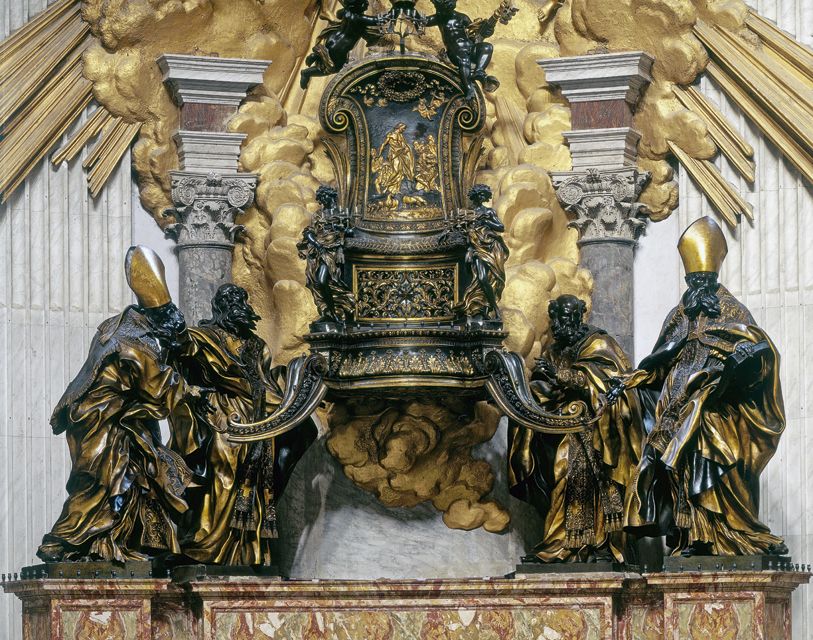
One of the Early Church Fathers, St. Cyprian of Carthage, clarified the role of the papacy and its significance for the Church. “Indeed, the others were that also which Peter was [i.e., apostles], but a primacy is given to Peter, whereby it is made clear that there is but one Church and one chair,” the Saint wrote in the third century. “If someone does not hold fast to this unity of Peter, can he imagine that he still holds the faith? If he desert the chair of Peter upon whom the Church was built, can he still be confident that he is in the Church?”
In rejecting the authority of the Second Vatican Council and openly, repeatedly defying the Holy Father, the SSPX has done exactly that which St. Cyprian warned not to: desert the chair of Peter upon whom the Church was built. Consequently, the order and its adherents find themselves outside the Church.
While it’s true that progressive priests likewise question the authority of the Church on particular issues, largely matters of sexual morality, their arguments are easily enough refuted. Furthermore, they rarely challenge the authority of the Church openly, but rather seek to subtly subvert that authority or else, as is more commonly the case in my years of careful observation, to use that authority to sanction particular sexual or political acts or ideologies. They have been threatened with schism, just as the SSPX has, but — unlike the SSPX — they have backed down at the last minute, preferring to remain inside the Church, begrudging and scheming, rather than following the SSPX out into the cold.
READ MORE from S.A. McCarthy:
America’s Bishops ‘Turn A Blind Eye’ to Abuse of American Generosity
Mass Deportations Are ‘The Christian Response’ to Mass Immigration