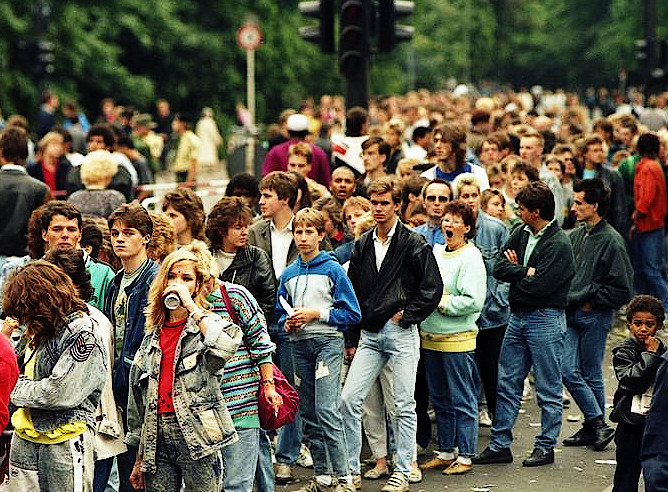


I was on A.J. Rice’s Dangerous Laughter podcast recently, and we got into a discussion about Generation X.
Actually, that’s not quite right. I’ll explain in a minute.
What brought on the subject was that “Right Here, Right Now” column I wrote after Callais v. Louisiana was decided at the Supreme Court, and state legislatures across the South started redrawing congressional districts. I opened that column with an aside, part of which was that as a proud member of Generation X, I’m ready to see the boomers and the leftovers of the “Greatest Generation” — as though Mitch McConnell and Bernie Sanders qualify for that — get out of the way and let my people run the country. (RELATED: ‘Right Here, Right Now’)
I didn’t expect that aside to be what generated so much of a reaction. I didn’t mean to insult anybody by saying it, and yet the boomers came out of the woodwork to vocalize their offense. I found that bizarre — most of the baby-boom generation are in their 70s, or at least their late 60s. That means retirement age. It means you aren’t generally running anything in the private sector anymore, though there are exceptions. And if younger, stronger, more stamina, more curiosity work in the real world, it’s not off the wall to think it also works in government.
Particularly when you look at the performance of those old farts in control in D.C., most of whom even the boomers don’t generally have much use for.
I just thought everybody would understand that point. But apparently I was wrong.
And that’s OK, because after I wrote it, I got calls to do a bunch of radio and podcast interviews about that subject. It was perplexing, because the column wasn’t really about the intergenerational conflict piece but rather the fantastic development that Southern Republican state legislators have been freed of the sins of discrimination their Democrat forebears committed all those decades ago.
I dunno. Maybe the generational thing is a bigger story. A.J. apparently thought so. And his was one of the podcasts I did after that column came out.
We started with Generation X, and then, as tends to happen when A.J. is involved, we wandered through Red Dawn, the Cold War, Steve Jobs, social media, helicopter parenting, cultural decline, and a whole host of other topics that all seemed unrelated until you started connecting the dots.
Here’s the whole thing. It’s an hour or so, but I thought it was a pretty fun watch. And A.J.’s guys went crazy with some of the AI imagery, of course. I don’t have a Scottish tartan suit. Though maybe I’ll have to get one soon.
What emerged from that conversation was something I’ve been thinking about for quite a while now: Generation X may be the last generation in American history that grew up before technology became the dominant force shaping everyday life.
We experienced reality before it was filtered through algorithms.
That’s not a complaint about technology. It isn’t nostalgia, either. I’m not interested in pretending the world was perfect in 1985. Of course it wasn’t. We had plenty of problems, plenty of bad ideas, and plenty of dysfunction. But there was one thing we had that has become increasingly rare: we experienced reality before it was filtered through algorithms.
Generation X grew up in a world where technology was present but not omnipresent. We watched television, played video games, listened to music, and eventually got access to computers. But those things occupied a place in life rather than becoming life itself. Nobody spent their teenage years building an online identity. Nobody curated a digital existence for public consumption. Most social interactions took place face-to-face, and if you embarrassed yourself in public, there was a reasonable chance the evidence wouldn’t exist forever.
Parents generally had a different attitude as well. Mine certainly did. If you’re a Gen Xer, most of yours probably did too.
When school ended, the kids went outside. You rode your bike around the neighborhood. You figured things out on your own. You got into trouble occasionally. You learned how to solve problems because there often wasn’t an adult standing three feet away ready to solve them for you. Looking back, some of that freedom probably made our parents nervous. They just didn’t organize their entire lives around that anxiety. And given some of the stuff the boomers were into in the 1970s and 1980s, that wasn’t surprising.
Today, the situation is dramatically different. Children are monitored constantly. Every activity is scheduled. Every risk is managed. Every moment is documented. And at the same time, the culture has become far more comfortable allowing corporations, social media platforms, and digital systems to exert influence over people’s thinking than it ever was when allowing children to ride a bicycle down the street unattended. (RELATED: Who’s Teaching Those AI Machines Your Kids Will Learn From?)
And people wonder how the surveillance state could ever have come about
As I discussed with A.J. on the podcast, technology for Generation X remains a tool. We use it because it’s useful. We appreciate what it can do. But we also remember a world where it wasn’t necessary. That’s a perspective younger generations simply don’t have.
For someone born after the internet became a permanent fixture of American life, social media isn’t an innovation. It’s normal. Smartphones aren’t revolutionary. They’re expected. The constant flow of information, commentary, outrage, entertainment, and manipulation is simply the environment.
That’s not a criticism. It’s an observation.
But it does create a meaningful difference between the generations.
Generation X possesses something increasingly valuable in modern America: a point of comparison.
We know what the country looked like before the digital revolution transformed everything. We remember when friendships were maintained without apps. We remember when news organizations had gatekeepers. We remember when political arguments happened in bars, living rooms, churches, and workplaces rather than being amplified by engagement-driven algorithms designed to maximize conflict.
That doesn’t mean everything was better. But it does mean we’re in a position to recognize what has been gained and what has been lost.
The same thing applies politically.
My generation spent its formative years during the final phase of the Cold War. We grew up with the understanding that there were competing systems in the world and that not all of them deserved equal moral consideration. We watched the Soviet Union collapse. We watched a failed ideology disintegrate under the weight of its own contradictions. And because of that experience, many Gen Xers developed a healthy skepticism toward utopian promises, fashionable political theories, and grand schemes to reinvent human nature.
Reality was always the final judge.
That mindset shaped a lot of people in my generation, whether they realized it or not.
It’s also one reason why Gen X often finds itself politically homeless. We tend to distrust centralized authority, but we also distrust cultural fads. We don’t automatically assume institutions are virtuous, but neither do we assume every institution deserves to be torn down. We generally prefer practical solutions to ideological purity because we’ve spent most of our lives watching ideological purity fail. And that’s why so many of us yawn when the Boomerific Bushie Republican crowd screeches about Donald Trump’s supposed apostasies from conservatism.
Bill Cassidy is a perfect example. Last week, when Trump signed that Memorandum of Understanding to put at least a temporary stop to the Iran war, Cassidy posted on X that “Reagan is turning over in his grave.” What a crock. Cassidy, who’s about as Boomer a Boomer as ever Boomed in politics, is a perfect example of a Bush Republican who tinkled all over Reagan’s legacy and now wants to pretend that’s who he is. Never mind that Reagan didn’t even bother to get a peace deal in Lebanon before pulling the Marines out once Hezbollah blew up the barracks in Beirut. He saw that military action there wasn’t serving his interests anymore, so he dumped out. Back then, Democrats weren’t so interested in making political hay out of the situation. Today, even Republicans are willing to do it. (RELATED: Bye, Bill)
And Cassidy wonders why my generation was so eager to get rid of him.
During my conversation on Dangerous Laughter, A.J. made the case that Generation X may be uniquely positioned for leadership because we’re the bridge generation. I think there’s something to that.
We’re old enough to understand the analog world and young enough to understand the digital one. We built much of the technological infrastructure that transformed modern life, but we weren’t raised by it. We understand innovation, but we also understand limits. We appreciate technology’s benefits because we remember what existed before those benefits arrived.
That’s a useful combination.
And frankly, it may become even more useful in the years ahead.
The biggest challenge facing America isn’t whether technology will continue advancing. That’s inevitable. Artificial intelligence, automation, digital communication, and technologies we haven’t even imagined yet are going to continue reshaping society at a breathtaking pace.
The real challenge is making sure human judgment keeps up.
A country can’t outsource wisdom to a machine. It can’t delegate citizenship to an algorithm. It can’t allow technology to become a substitute for culture, community, family, faith, or common sense. Those things still matter, and they always will.
Generation X doesn’t have all the answers. No generation does.
But we do have something worth contributing to the conversation.
We remember what life looked like before the machine arrived.
At a moment when more and more Americans seem content to let technology tell them what to buy, what to watch, what to think, and even who to be, that memory may turn out to be more valuable than most people realize.
READ MORE from Scott McKay:
Five Quick Things: Drones From Dreamers?
The Unfathomable Horror of Britain’s Rape-Gang Holocaust
‘Sanctuary’ Policy Is a Double-Edged Sword, As Virginia’s Dems Are Finding Out
Image licensed under Attribution-ShareAlike 3.0 Unported.