

Most Americans will proudly celebrate the 250th anniversary of our nation, but there are some — all smug left-wing “deep thinkers” — who delight in telling us that many of the stories about the Founding that we believe are true are actually false.
A closer look at their account often reveals that they resort to challenging the conventional wisdom by making unsupported claims. In other words, they are very good at asserting something isn’t true, without providing the evidence that discredits stories about the Founding. A classic example was recently published on the website of National Public Radio, the government-run media outlet that the “deep thinkers” adore.
The cynics don’t want us to believe this story. They love to poke fun at patriotic Americans, setting themselves up as experts who are much smarter than the masses.
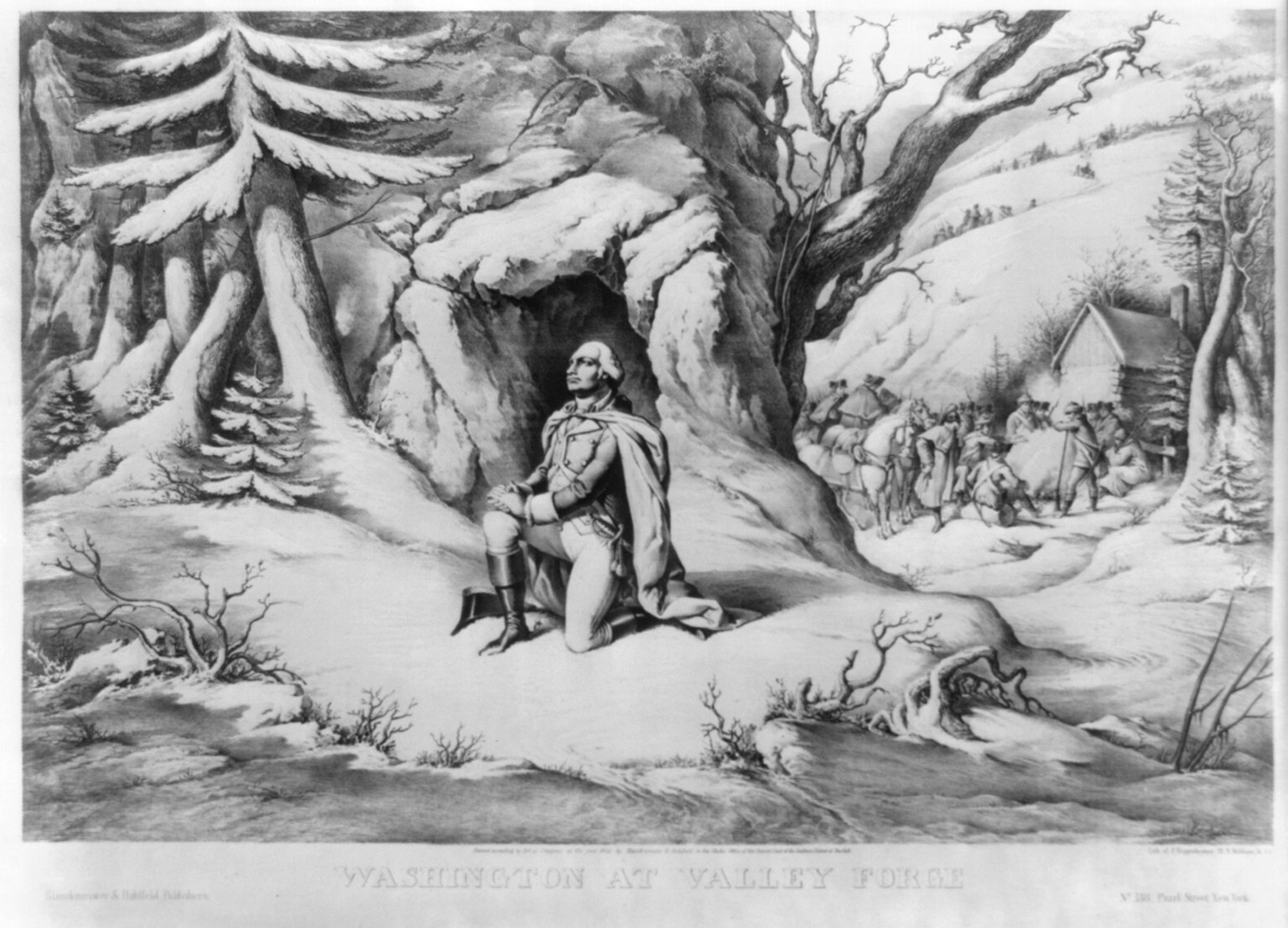
NPR focused on “The Prayer at Valley Forge,” a painting by Arnold Friberg that was done to celebrate America’s bicentennial in 1976; it shows Washington kneeling in prayer.
The painting is featured at the Museum of the Bible in Washington, D.C. The description on the wall reads “a poignant portrayal of George Washington during one of the most critical moments in the American Revolution … many believe Washington knelt in a moment of solitary prayer, seeking guidance and strength from God.”
The NPR article seeks to punch a hole in this popular rendering, saying “many historians do not believe there is much evidence to this story.” Many historians. How many of them are there? How many historians disagree with them? Moreover, to say there is not much evidence suggests there is some. Where is the evidence that those evidentiary claims are wrong?
The NPR story cites Thomas Tweed, professor emeritus at the University of Notre Dame, as its source. Tweed claims that Parson Weems, Washington’s early biographer, “concocted this story.” How does Tweed know this to be true? Conveniently, he cites an essay he wrote for Yale University Press. So I accessed it.
I looked in vain to see the evidence that Weems “concocted this story.” What I found, instead, was Tweed admitting that, “There is some truth in the claim, and in the images. Washington did pray, though perhaps not the way Weems described.”
Some truth. How much, and on what basis did Tweed come to this conclusion? Moreover, to say “perhaps not the way Weems described” is to admit that perhaps it is the way Weems described. So why is Tweed so cocksure that Weems “concocted this story”?
Tweed cites two books to support his claim. I accessed them both.
One book is by Sheila Brennan, Stamping American Memory, and the other is by Mary V. Thompson, In the Hands of a Good Providence. Neither offers the level of proof Tweed would have us believe.
Brennan argues that the image of Washington “was completely contrived.” How does she know that? She says it is “based on a tale first recanted by Parson Mason Weems in 1804.” In an endnote she cites as evidence, “Weems’s claims have never been proven and attempts to debunk this particular myth were published in 1926 during the sesquicentennial.” Now if the attempts succeeded, she would have told us. But she didn’t.
Just as important, if Weems’ claims have never been proven, it is also true that no one has disproven them. To put it differently, why should we believe someone writing in the 21st century about an event that took place in the late 18th century, but not someone who wrote about an eyewitness account in the early 19th century?
Thompson is no better. She recounts the story told by Weems about a Quaker farmer named Potts. In the sixth edition of Weems’ biography, published in 1808, he tells the story of how Potts came across Washington praying on his knees in the woods near his Valley Forge headquarters. Thompson is free to believe that this is a “highly suspect” story, but she offers zero evidence that disproves the Potts-Weems account.
On the website of “Historic Valley Forge” there is a examination of the evidence regarding this event. It says that the “nearest to an authentication of the Potts story of Washington’s prayer in the woods seems to be supplied by the ‘Diary and Remembrances’ of the Rev. Nathaniel Randolph Snowden, an ordained Presbyterian minister, graduate of Princeton with a degree from Dickinson College.”
Snowden handwrote, “I knew personally the celebrated Quaker Potts who saw Gen’l Washington alone in the woods at prayer. I got it from himself, myself.” He then elaborated on what he heard, which supports the conventional wisdom.
The document ends by saying, “Is it not reasonable to believe that a man who had, on frequent occasions, paid homage publicly to the God of all nations and earnestly exhorted his soldiers and his fellow countrymen to ‘express our grateful acknowledgement to God, for the manifold blessings he has granted to us,’ may have sought seclusion for his own private communication with the Father.”
The cynics don’t want us to believe this story. They love to poke fun at patriotic Americans, setting themselves up as experts who are much smarter than the masses. Yet in the end all they have is conjecture. Their hubris is appalling.
READ MORE from Bill Donohue: