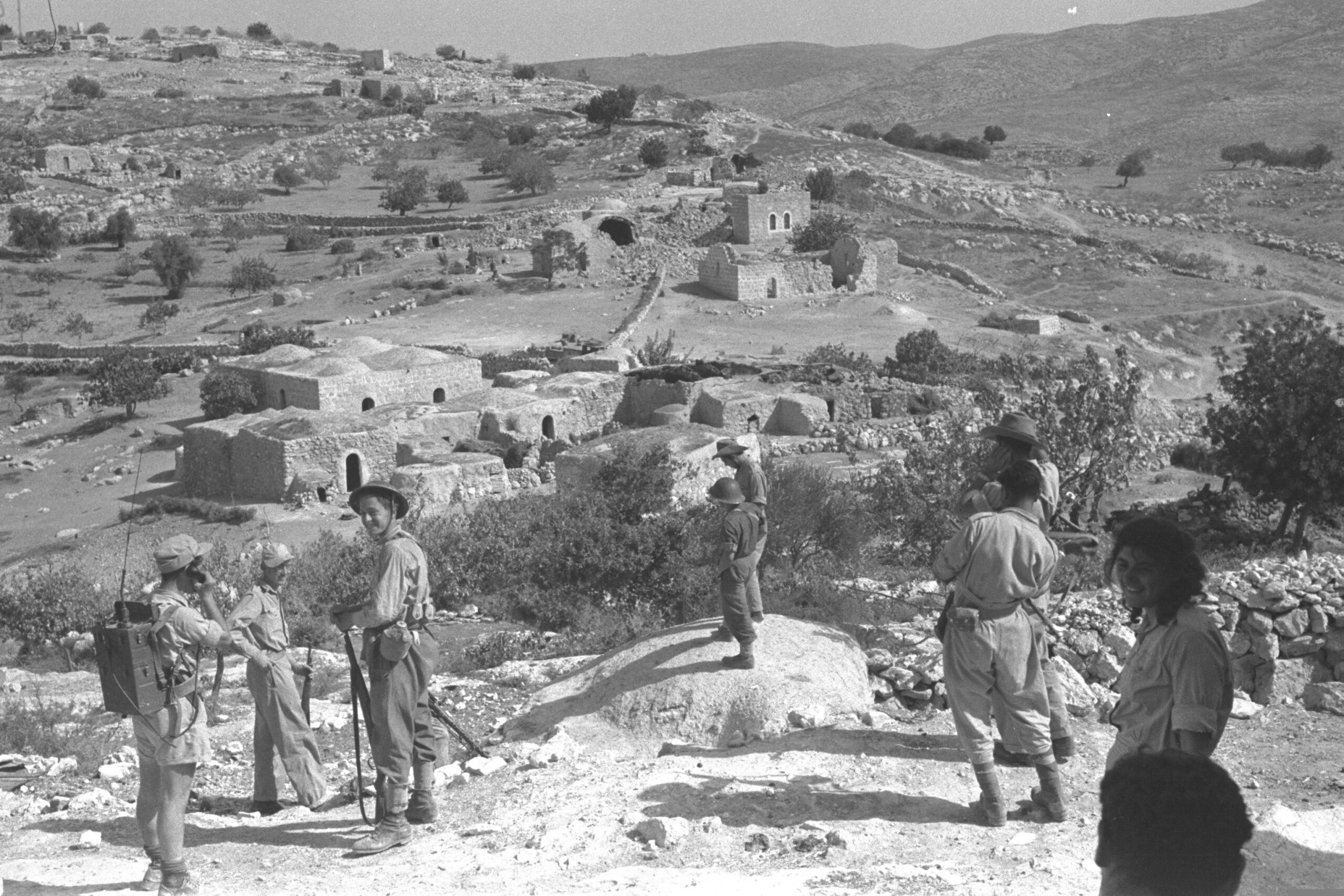


The Canadian Museum of Human Rights has recently unveiled an exhibit titled Palestine Uprooted: Nakba Past and Present, with the stated goal of educating the Canadian public on the 1948 displacement of Palestinians.
By presenting a curated, one-sided narrative that strips the 1948 war of its essential historical context, the museum has abandoned its mandate for balanced historical inquiry, producing instead a piece of political activism that masquerades as a historical record.
By framing the Nakba as an isolated, unprovoked humanitarian catastrophe, the CMHR ignores the reality that this displacement was the direct consequence of a regional Arab war of aggression, a conflict launched by those who sought to prevent the birth of a Jewish state and eradicate its inhabitants.
The term “Nakba,” Arabic for “the catastrophe,” is not a neutral descriptor of civilian suffering; it was codified by the Syrian nationalist Constantine Zurayq in his 1948 book, Ma’na an-Nakba. Zurayq’s work was not a humanitarian treatise, but a political and military post-mortem on the failure of seven Arab armies and various local militias to destroy the newly formed Jewish state.
By ignoring the Jewish struggle for self-determination … and the aggressive role of the Arab League in 1948, the CMHR has failed to serve the Canadian public.
When we examine the source material, we find a cold admission of original intent. Zurayq famously wrote that the defeat of the Arabs in Palestine was no simple setback, but a disaster, noting that seven Arab states had declared war on Zionism only to return “impotent” on their heels. To frame this history as a narrative of purely innocent, victimized civilians is to ignore the historical record: it was a coalition-led offensive against a nascent democracy that ended in a military defeat for the aggressors.
The museum’s exhibit further fails the test of historical rigor by omitting the reality of Arab-Israeli citizens. If the creation of Israel were truly an act of genocidal ethnic cleansing, it would be impossible to explain the existence of two million Arab citizens living within Israel today.
These individuals are the descendants of those who chose to remain in their homes in 1948; they were neither expelled nor did they participate in the war of aggression against the Jewish state. They stand as a living testament to the fact that the 1948 conflict was not a race-based expulsion, but a war of political and territorial survival.
Furthermore, the exhibit conveniently overlooks the role of the Hashemite Kingdom of Jordan. In 1948, the Arab Legion (the Kingdom’s army), commanded by more than 50 top-flight British officers, defeated the Jewish Defense Forces and occupied Judea and Samaria, now known as the West Bank.
Jordanian leadership at the time famously declared that “Palestine is Jordan and Jordan is Palestine.” Many local Arabs were granted Jordanian citizenship. Millions of Palestinians reside there today under their own political leadership.
The demographic and political reality of that part of the territory, West of the Jordan River, which was part of the Mandate for Palestine (after 1920) is a complex byproduct of borders drawn by British and French mandates, yet the CMHR presents it as a simplistic, binary narrative of “uprooted” versus “occupier.”
Crucially, the exhibit also fails to acknowledge that the years surrounding Israel’s creation produced another massive refugee crisis. Approximately 850,000 Jews left or were expelled from Arab countries, where many of their communities had lived for centuries. These populations were stripped of their homes, their businesses, and their history, often under duress and state-sponsored violence. Most of these Jewish refugees were resettled in Israel and elsewhere, integrating into new societies rather than remaining refugees for generations.
Whether one views these two refugee experiences as equivalent or not, any exhibition claiming to explain the human rights consequences of 1948 should acknowledge both. By ignoring this mass displacement of Jews, the museum presents a distorted view of the regional upheaval that followed 1948.
This sanitized history ignores the long, painful narrative of Jewish persecution in the region that predates the modern Zionist movement. For centuries, Jews were marginalized, taxed as second-class citizens, and subjected to recurring pogroms.
One need only look to the 1834 Safad insurrection, where, as the British traveler Alexander William Kinglake documented, the local Muslim population engaged in a systematic campaign of murder and theft against their Jewish neighbors. Such events remind us that the struggle for Jewish safety in the Levant is not a product of the 20th century, but a fight against a history of exclusion that the museum chooses to ignore.
As an anthropologist who has lived and worked among the Sinai Bedouin and in Morocco, I find the exhibit’s most insidious element to be its attempt to erase Jewish indigeneity.
Zurayq’s “Nakba” ideology relied heavily on the “Khazar myth,” a debunked claim that modern Jews are descendants of medieval Turkish converts, rather than a Semitic people returning to their ancestral homeland. By centering an exhibit on a narrative that fundamentally rejects the historical legitimacy of the Jewish people in the Levant, the CMHR is not documenting human rights; it is participating in the delegitimization of a people.
The exhibit also fails to discuss the writings of figures such as Mudar Zahran, an Arab, Muslim, self-identifying Jordanian, Palestinian, and leader of the Jordanian Opposition in Exile.
Zahran has argued that the demographic reality of the region is far more complex than the “uprooted” narrative allows, suggesting that Jordan, a state carved out of 80 percent of the original Mandate territory (initially set aside at the time for the Jewish people and then given to the Hashemite tribe from the Hedjaz by none other than T.E. Lawrence and Winston Churchill at the “Cairo Conference”), remains the demographic center of the Palestinian people.
The museum’s failure to include such voices suggests a preference for a specific political agenda rather than a comprehensive, scholarly examination of the conflict.
The CMHR exists to uphold the truth, even when that truth is complex. By ignoring the Jewish struggle for self-determination, the expulsion of Jewish populations from the Arab world, and the aggressive role of the Arab League in 1948, the CMHR has failed to serve the Canadian public.
For the last year, my colleague, noted film director Igal Hecht, and I have conducted extensive research on these issues for an upcoming film and book regarding the post-WWI history of Israel and its neighbors. We are unearthing a reality that is far more nuanced, tragic, and historically complex than the museum’s current exhibit suggests.
We hope the CMHR will choose to evolve. We look forward to the possibility of screening our findings, which will be released in the spring of 2027, to ensure that the Canadian public is provided with a complete and accurate picture.
Here is a short clip from a much longer film: Beyond The River (work in progress)
READ MORE from Geoffrey Clarfield:
The Two Faces of the Wren Library at Cambridge University
‘Everything is Personal’ — Remembering Jane Goodall
Geoffrey Clarfield is Canada’s only conservative anthropologist.