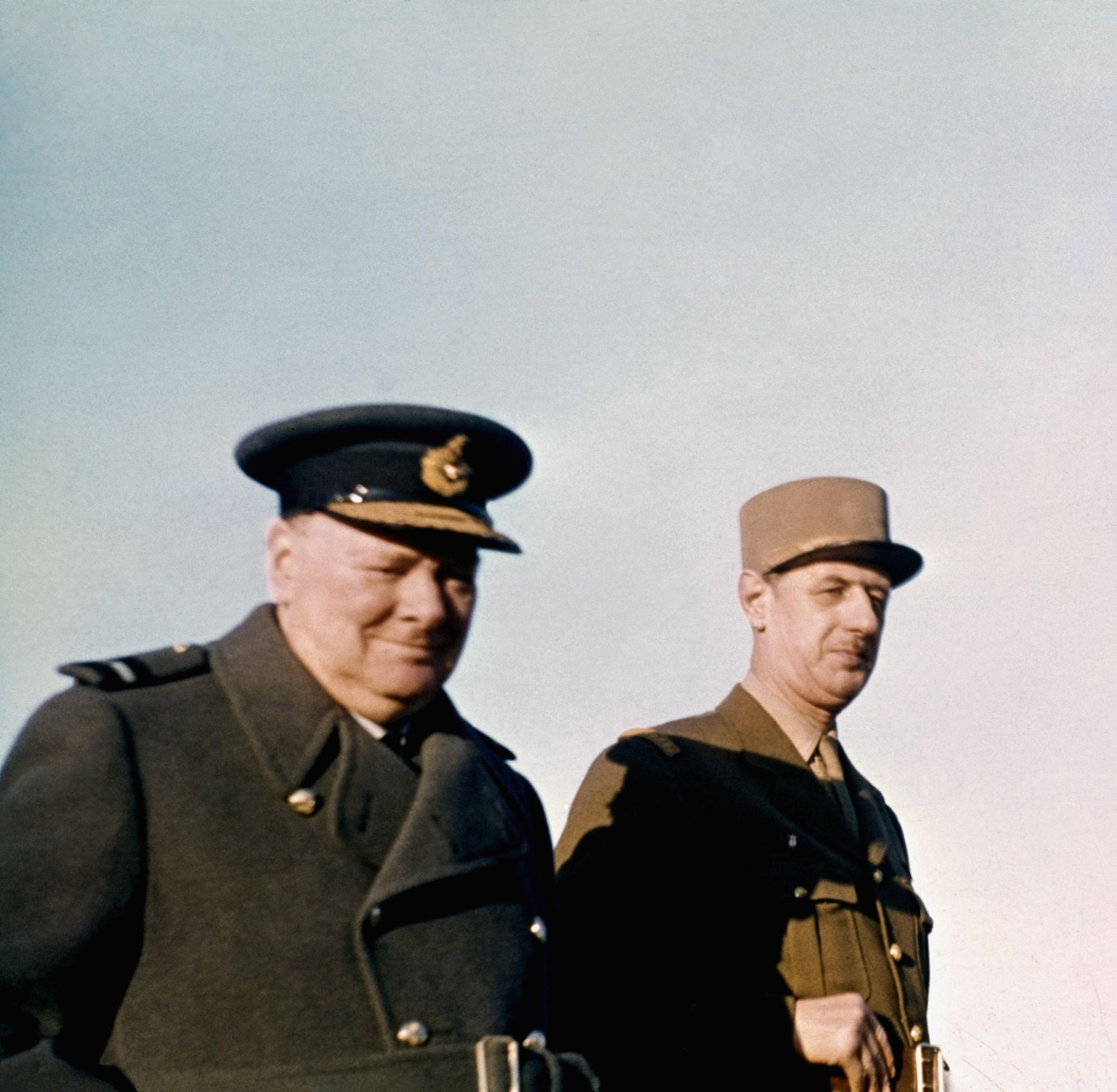


The Last Titans: How Churchill and de Gaulle Saved Their Nations and Transformed the World
By Richard Vinen
Simon & Schuster, 2026, 388 pages, $30
Americans know a great deal about Winston Churchill but very little of Charles de Gaulle. Richard Vinen, a Professor of History at Kings College, London, seeks to change that. He claims that he set out to show that it is easier to make sense of Churchill’s complex career if seen alongside de Gaulle’s. But what he has really done is write a dual biography of two of the most fascinating and significant characters of the twentieth century. Most Americans know more about Churchill than de Gaulle. This book is a fascinating way to help close that gap.
It is said that there are more statues to Churchill in America than in his own nation.
Vinen labels both men “artists of history” and sees parallels in their lives. Both had military careers, were brilliant memorialists, loyal husbands, and both were creators of their own myths. Also, they were master stylists whose speeches on the same day, June 18, 1940, helped define their role in history: Churchill’s “Finest Hour” and de Gaulle “Rally to me” address. The two speeches were made on the anniversary of Waterloo no less.
Churchill and de Gaulle were “made” by World War II. The outbreak of war brought Churchill back to political office as First Lord of the Admiralty after a decade in the political wilderness. Eight months later he was named Prime Minister. De Gaulle’s climb to power was different. He spent most of his life in the Army, was captured in World War I, and became something of a military intellectual in the inter-war years. For a time, he served as an aide to the most popular of France’s military heroes, Marshall Petain. He served as speech writer for Petain and in an act that foreshadowed his determination to see France in himself, resigned rather than agree that what he had written be published under Petain’s name. “The book is a biography,” he wrote, “the subject is France.”
The German sweeping victory in the summer of 1940 brought Churchill and de Gaulle together. Churchill admired de Gaulle’s courage but at first neglected him while the British tried to devise a policy to keep the new French government at Vichy from cooperating too closely with the Germans. De Gaulle bitterly resented this but recognized that while he claimed he spoke for France, he was fully dependent on British support. The dependence and weakness created the tension that existed between the two men during the war.
Out of a collection of former supporters of the Third Republic, monarchists, communists, humiliated French military, de Gaulle gradually created a movement: The Free French. There was in Churchill’s romantic view a kind ‘Scarlet Pimpernel’ quality about French resistance to Germany which helps explain support for de Gaulle despite bitter differences. They saw the enemy differently. For Churchill it was Nazism and all the evil it represented. De Gaulle rarely spoke about Nazism. For him the enemy was simple: the Germany that had invaded his beloved France three times in less than a century.
Franklin Roosevelt, unlike Churchill, took a dim view of de Gaulle and kept a representative at Vichy for two years until the Allied invasion of North Africa in November 1942. American recognition of de Gaulle was reluctant which helps explain his cool attitude toward her for the rest of his life. Interestingly, General Eisenhower took a more pragmatic view, for example allowing de Gaulle’s forces to enter Paris before the American Army arrived.
The postwar careers of Churchill and de Gaulle is the focus of the second half of the book. Churchill’s postwar career saw a slow decline; for de Gaulle he reached new levels of greatness. Churchill was overwhelmingly defeated in the general election of 1945 while de Gaulle gradually took power in France only to leave office after a year when the new Fourth Republic began replicating the squabbling of the Third.
De Gaulle was disgusted and retired to his home, Colombey les Deux Eglises, confidently awaiting a call to power. While Churchill returned to office in 1951, he was in Vinen’s view, worn out and sick. His only hope was for a new “Meeting at the Summit,” where he could soften the Cold War that he had foretold in his famous Iron Curtain speech in 1946, a call which never came.
For a time, it looked as if de Gaulle wouldn’t get a second chance. It came as the Forth Republic collapsed when the wars to keep an empire first in Viet Nam and then most disastrously, in Algeria, destroyed the regime. Amid cries to “Appelez de Gaulle” he returned power in May 1958. He was 68 years old.
His second career showed he understood the modern world. He created a Fifth Republic but with a strong chief executive so that France wouldn’t suffer from the embarrassment of constant changes of government. He presided over the modernization of France and placed her once again at the center of Europe. When his regime was challenged by a revolt of the younger generation born after World War II, one whose ideas and aims he didn’t understand, he stood down, retired to his home and died a year later while writing his memoirs.
Vinen’s book is brilliantly written and based, as far as I can see, on a thorough examination of key sources. Still, it is designed for the reader with little knowledge of either man. The average reader will enjoy discovering what genuine characters these two men were and will find the material on de Gaulle of particular value, as Churchill has deeper roots in America. It is said that there are more statues to Churchill in America than in his own nation. American Presidents have honored him with busts in the President’s office. President Obama claimed that he was an admirer of Churchill, although he replaced his bust with that of Martin Luther King. President Trump has returned it. Maybe he should add one of de Gaulle.
READ MORE from John P. Rossi:
George Orwell’s Breakthrough in America: Dickens, Dali and Others
Churchill as Hero of World War II
Graham Greene’s The End of the Affair: A Reflection
John P. Rossi is professor emeritus of history at LaSalle University in Philadelphia.