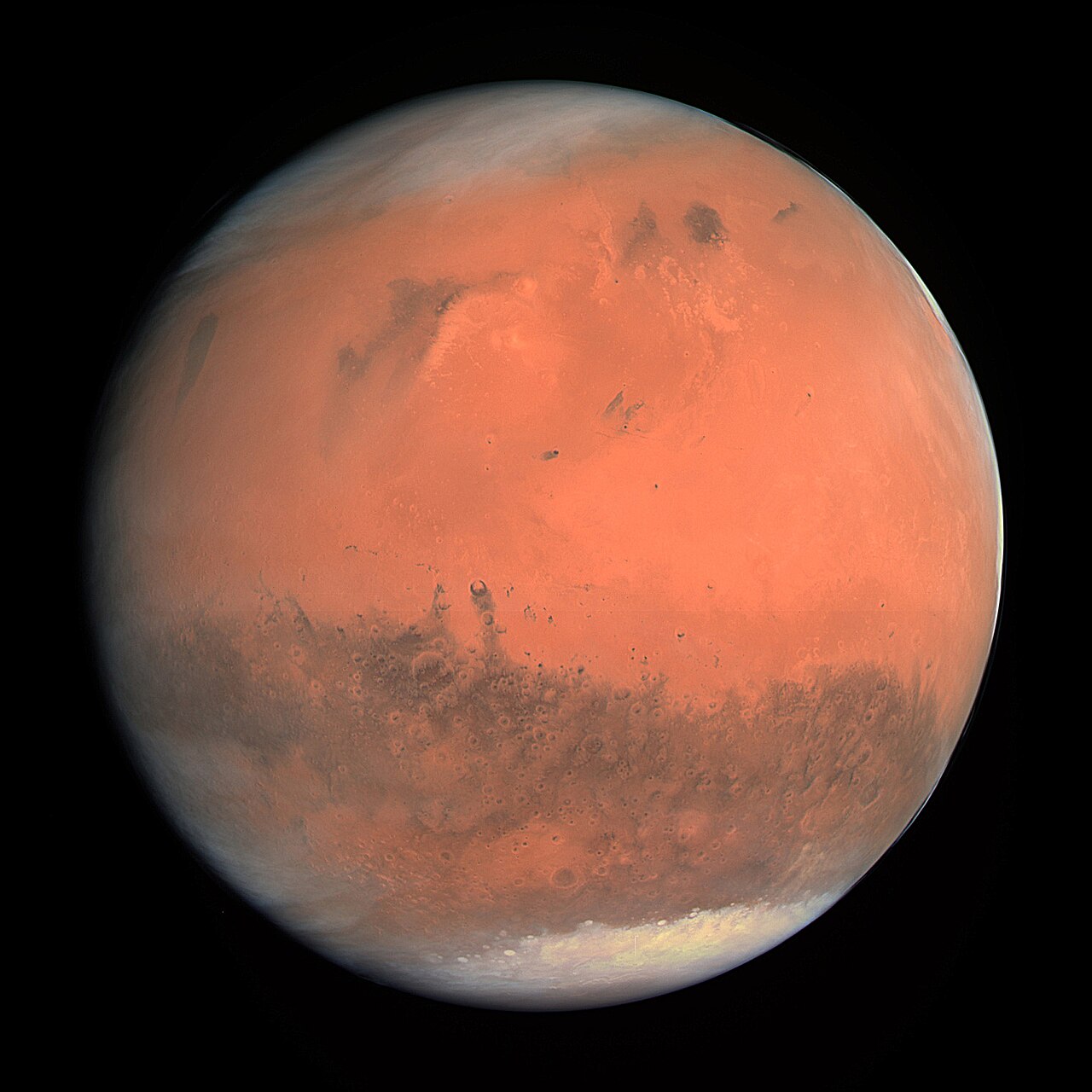


We at The American Spectator recently published an essay titled “Going and Coming to Mars: What Could Possibly Go Wrong?” by Armando Simón, which argues sending humans to the red planet would be a foolhardy endeavor. As our magazine’s resident space exploration enthusiast, I wanted to explain why I disagree.
The first issue is that the first and best argument, while raised, is never addressed. That being, George Mallory’s reasoning for climbing Mount Everest: “Because it’s there!”
To not address that point head-on is the rhetorical equivalent of “Aside from that, Mrs. Lincoln, how was the play?” Seeking the next danger, the next high, the next horizon, is what makes us human beings. It’s what’s propelled us from the Stone Age to the space age in the first place. To shirk the next challenge staring us in the face — becoming interplanetary — would be a betrayal of everything that makes humanity special.
Still, that’s only the case for why we should send Americans to take one small step on the red planet, not for colonization. So, why settle Mars?
The primary reason is commerce and transportation. Consider that, especially before the modern era, most large cities were ports. Why? Because sea transportation has historically been much more efficient than land transportation. When it’s easier to get goods and services from where they’re produced to where they’re needed, costs go down.
What’s the applicability to Mars? It’s twofold. Firstly, Mars has just 38 percent of the gravity of Earth. If you weigh 100 pounds on Earth, you’d weigh just 38 pounds on Mars. Or, put another way, if you’re trying to put 100 Earth tons of supplies into space, they would weigh just 38 tons on Mars. See what I’m getting at? The lower gravity means that more and bigger payloads can be put into space using significantly less fuel. That means that shipping costs for Mars-produced goods would be far, far lower than they ever could be from Earth.
But what would you ship? Simón is not wrong to describe Mars as “a wasteland.” But there’s a sound reason behind the adage that books ought not be judged by their covers. Mars has largely the same geologic history as the Earth, and therefore has all of the same raw materials that the Earth does. Carbon Dioxide? Check. Nitrogen? Check. Methane? Check. Water, and therefore hydrogen and oxygen? Check. Ores like iron and silicon? Check. It also possesses strong enough sunlight to sustain agriculture. In other words, Mars has the right building blocks to produce everything we have here on Earth.
Of course, current-day Mars is inhospitable. But that does not mean that it’s uninhabitable. It’s uninhabitable in the absence of technology, certainly… but the same could be said of many parts of Earth. No human could survive a year in, say, Minnesota, without technological innovations like clothing and shelter and fire. Mars is different in degree — that is, the level of technology needed to make human habitation feasible — but not in kind.
Putting all of that together, Mars is large and resource-rich enough that goods such as food, clothing, rocket fuel, etc could be produced there. It’s also small enough to ship those products throughout the solar system, say, to asteroid miners seeking rare-earth metals, at significantly lower cost than would be possible from Earth. Rather than just a vanity project in a freeze-dried desert, the red planet has the potential to be a space port and a gateway to the outer solar system.
Every argument against colonizing Mars could, in fact, have been even more fairly applied to the Americas centuries ago. Invasive species? We did far worse when the old world and the new collided. Furthermore, any Martian life would be optimized for Martian conditions — there’s no reason to think they would thrive on Earth, any more than Earth life would thrive on Mars. As to the trip there, the explorers of the Americas no doubt also knew they were embarking on long journeys that carried mortal danger. They persisted anyway, and it’s to them that we owe the modern world. Future generations, if we dare, will think of us the same way. We ought not let them down.
READ MORE from Stephan Kapustka:
Why JD Vance Told Me to Run for President
Meet the Mamdani Acolyte Leading the Race to Be DC’s Next Mayor
The Valvoline Incident: Romance in the Age of Public Shaming