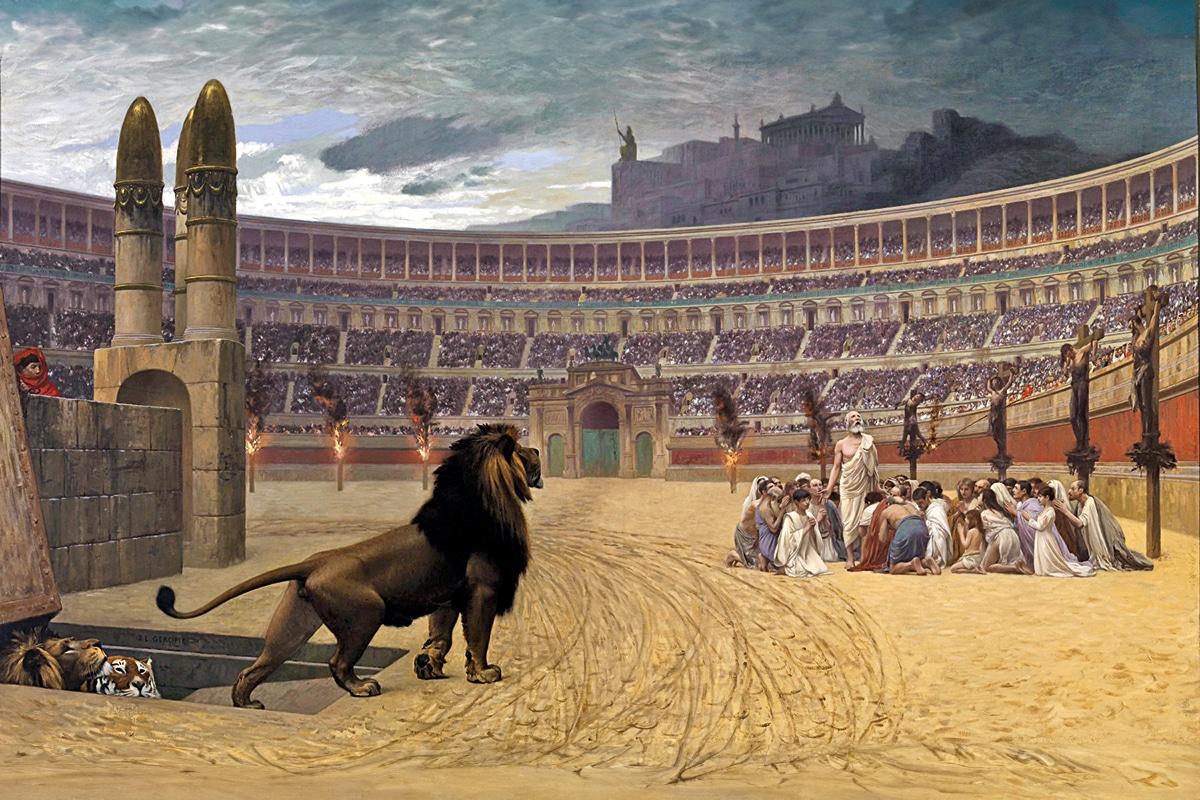


Since its inception nearly 2,000 years ago, the Catholic Church has faced persecution. While violence and oppression are unfortunately commonplace in regions of the Third World, such offenses are often a shock in the pluralistic, supposedly tolerant civilized world of the West. Yet to Catholics, persecution should be both expected and embraced. After all, the gates of Hell are just as present in the West as in godless, barbaric countries.
It may be that God intends to bring good from the resurgent persecution of Catholics, reminding us that we ought always be prepared for martyrdom.
A recent illustration comes from — of all places — Nebraska. Thirty-two-year-old Ean Halstead was arrested in Omaha after threatening to “shoot up” Columbus Catholic Schools, kill the children of Governor Jim Pillen (R), and kill “a few nuns for f***ing funsies.” According to Nebraska State Police, Halstead made the threats through the school’s website and has been charged with terroristic threats and destruction of evidence.
This is far from the only recent example of Catholics in the U.S. being targeted for violence. Last year, a transgender-identifying 23-year-old opened fire on Annunciation Catholic Church in Minneapolis during a Mass for the connected parochial school, killing two children and injuring as many as 30 others. In his Marxist-influenced manifestoes, the shooter compared himself to a demon, and his bullet casings were engraved with anti-Catholic messaging. Just the day before the shooting at Annunciation Catholic Church and School, there was another mass shooting outside Cristo Rey Jesuit High School in Minneapolis, injuring six and killing one.
A few months before that, a Catholic priest was assaulted in Michigan, and another priest was attacked while celebrating Mass in Spokane, Washington. According to CatholicVote, there have been more than 560 attacks on Catholic churches since May of 2020, when the Black Lives Matter riots began; nearly 400 of those attacks have taken place since the U.S. Supreme Court’s 2022 decision overturning Roe v. Wade was leaked to the public.
These incidents of violence and hatred are, of course, unfortunate and, especially where lives are taken or souls are lost, tragic. But they ought not be thoroughly surprising to Catholics. Our very first pope, St. Peter the Apostle, was executed. In fact, tradition holds that all of the Apostles, save St. John the Evengelist, were martyred. The first centuries of the Church’s existence were riddled with death and murder. The Roman Emperor Diocletian was known for his brutal persecution of Christians, while the Emperor Nero was reputed to spit Christians atop poles and burn them alive on the side of the road as screaming lampposts.
The Catholic lifestyle is designed and intended to prepare the soul for Heaven and the will for martyrdom. Many Saints are depicted in artwork carrying skulls or keeping skulls on their desks: the practice is known as memento mori, a constant reminder that one will die and face judgement, in the hopes of keeping the fate of one’s immortal soul always at the forefront of one’s mind.
In today’s age, the practice of that Catholic lifestyle has waned and weakened. Many Catholics have grown soft. The same devotion and resolution of belief which led early Christians into the Colosseum to face lions or resulted in their being mounted atop spikes and burned alive is now scarce among the Catholics of today, who have grown soft and complacent, cherishing comfort and safety over the bold proclamation of the Faith. It may be that God intends to bring good from the resurgent persecution of Catholics, reminding us that we ought always be prepared for martyrdom.
READ MORE from S.A. McCarthy:
The Death of a Woman of Principle