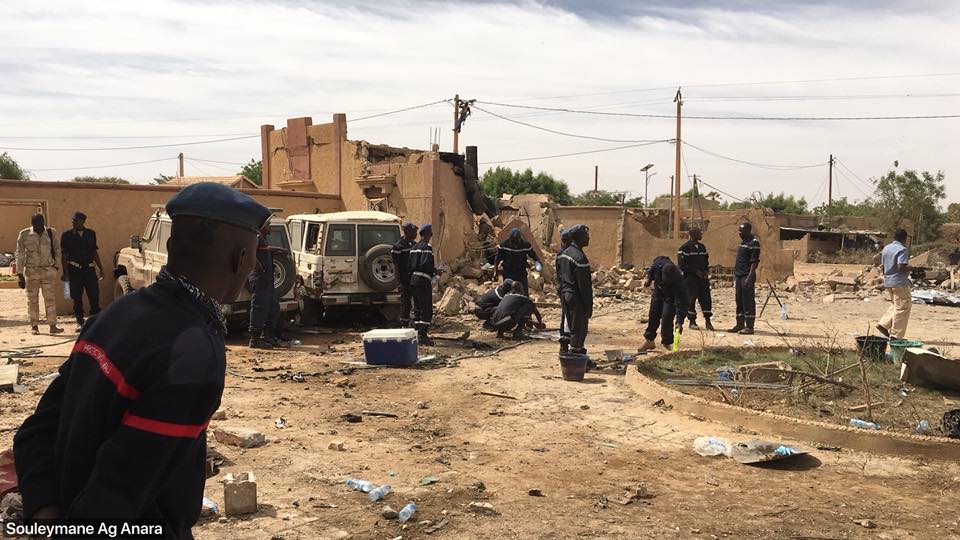


Africa has a way of disappearing from our radar screens. It’s scarcely surprising, then, that the ongoing slaughter of African Christians fails to capture the attention it deserves. Partly this reflects a simple unfamiliarity — most Americans, even “African” Americans just don’t know much about Africa. Moreover, the narrative is, to say the least, “inconvenient.” Despite the many thousands of black lives snuffed out across Africa, “Black Lives Matter” has never seemed to care. The fact that the victims are overwhelmingly Christian and the perpetrators overwhelmingly Muslim represents another “inconvenient truth.”
Nigeria continues to be the epicenter of this rolling holocaust. On June 22, Fulani “herdsmen” — in fact, Islamist terrorists — raided a Christian village in Nigeria’s Plateau State, murdering 28 people, including the village’s pastor. As has become common, the Fulani raiders arrived in the middle of the night, shooting anyone who came out of their houses and then shooting their way into targeted homes.
Do we wish to see the emergence of terrorist “homelands” that will make our experience with Afghanistan or Syria pale in comparison?
One survivor noted that the attackers called out the names of local Christian leaders, clearly being guided by Fulani from neighboring villages. For example, the community’s spiritual leader, the Reverend Markus Nyam, appears to have been specifically targeted. As if this poor community hadn’t suffered enough, just one week later, on June 29th, gunmen stormed a high school where students were taking final exams, kidnapping 36 students and three teachers in an attack attributed to either the Islamist group Boko Haram or one of its affiliates.
On this latest occasion, Nigerian security authorities responded quickly enough to rescue a handful of students, a surpassingly rare event. More often than not, this kind of rapid response has been notable only by its absence. After previous massacres, Christian leaders pleaded with the government to provide protection against “marauding Fulani terrorists,” a plea, obviously, that fell on deaf ears.
Such pleas have been offered up repeatedly after every massacre, and the government, beholden to Muslim political influencers, does nothing. In one particularly notorious case, a Christian farmer who killed a Fulani attacker while defending his family — killed the attacker with the assailant’s own knife after having been stabbed himself — was sentenced to death by a Nigerian court presided over by a Muslim judge.
Customarily, the only time any action is taken is when a monstrosity gains a level of international attention too embarrassing to ignore. This was the case in 2014, when Boko Haram, another Muslim terrorist group, kidnapped 276 schoolgirls. But the everyday reality is quite different. Regardless of international condemnation, the killings continue, and the response of the Nigerian government is typically either hapless incompetence or calculated indifference, and often both.
Nigeria’s leaders get away with it because any such outside pressure inevitably proves transitory as the world moves on to other crises. Since 2014, an estimated 50,000 Christians have been massacred in Nigeria, and the number driven from their homes into refugee camps is even more staggering. To repeat — the killings continue, and continue, and, as we’ve seen again this week, they continue to continue.
But it isn’t just Nigeria, which speaks to a larger issue. Just weeks ago a Catholic priest in Sudan was murdered by one of that country’s warring factions. While Catholic Church authorities, predictably, have tiptoed around the question of a religious motive, the simple fact that this was a priest speaks volumes. Sadly, one can find similar events across much of sub-Saharan Africa. By one quite likely conservative estimate, a Christian is killed somewhere in Africa every two hours, a figure that doesn’t even begin to encompass the rapes, tortures, and other violence meted out on an agonizingly regular basis.
Furthermore, Islamist violence continues to spread, threatening to destabilize a much broader swathe of sub-Saharan Africa. Burkina Faso, Mali, and Niger are also under attack on an ever-expanding scale. New Islamist groups, some closely aligned, some loosely affiliated, emerge on a regular basis in pursuit of an African caliphate, and the threat increasingly crosses borders. For example, the Lakurawa group in Nigeria, avowedly jihadist and armed with advance weaponry, is an affiliate of an al-Qaeda offshoot, the JNIM, which originated in Mali.
Even as I finished the first draft of this article, news circulated of the murder of another Catholic priest, Father Crepin Martial Monga of the Bangassou diocese in the Central African Republic. While traveling with a parishioner his car was stopped and he was shot in the head, dying instantly. The parishioner remains in critical condition. In describing the murder, the local bishop explained that details were scant because the area remained subject to heavy gunfire.
Father Crepin had made a name for himself as a mediator during the ongoing conflict. As of this writing, no group has claimed responsibility for the murder. However, violence involving “armed militias and ethnic tension over land and resources” has become widespread in the region. Anyone familiar with the conflict in Nigeria and its neighbors will recognize this as a “tell,” similar to the characterization of the depredations of the Fulani jihadists and related Islamist terrorists. Once again, the fact that the victim was a Catholic priest is, at the very least, highly suggestive, and further evidence of the widespread nature of the current crisis.
The American Spectator, unlike many news outlets, even conservative ones, has been very good about publicizing the plight of African Christians. Going back now for years, we’ve highlighted the succession of tragic events and the West’s failure to respond or even pay attention. Too often, the response has been to minimize the horror or to “contextualize” it by suggesting, ludicrously, that these are resource-driven conflicts driven by “climate change” rather than acknowledging their plainly anti-Christian nature.
The coming of the Trump administration has witnessed improvement in our overall approach to both the Islamist assault on Christian communities and the destabilization of sub-Saharan countries. Several months ago, after some backchannel wrangling with the Nigerian government, the U.S. fired cruise missiles targeting the Lakurawa and Boko Haram terrorists, sending a signal that we were starting to pay attention, evidence of how AFRICOM has stepped up its game. President Trump has restored the designation of Nigeria as a “country of particular concern,” a designation lifted by the Biden administration.
But the Iran war has soaked up the largest portion of our national security bandwidth, understandable, justifiable even, but unfortunate for the situation in Africa. “Unfortunate” because the opportunities are greater than ever, while the pitfalls are becoming deeper. After more than a decade of watching China cut a swathe through the African sources of rare earths and critical materials, a U.S. company, supported by the administration, has just closed a deal to develop two major mines in the Congo.
At the same time, and despite the pressures of the war in Ukraine, the Russian “Africa Corps,” the successor to the notorious “Wagner Group,” is making inroads across west Africa, using precisely the fear of Islamist insurgency to insinuate itself into the security forces of various governments. This, of course, exploits an opening left during the Biden years, where pious lectures took the place of serious engagement with local security concerns.
The stakes are massive. Do we stand aside and watch the mineral rich portions of Africa converted into an Islamist caliphate? Do we watch a Christian genocide that seemingly expands every day? Do we wish to see the emergence of terrorist “homelands” that will make our experience with Afghanistan or Syria pale in comparison? Do we accept a level of destabilization that drives an international refugee crisis more massive than anything currently taking place?
This last point matters enormously. To take Nigeria as an example once again, in addition to the massacres, many thousands of Christian farmers have been driven off their lands and into refugee camps. But this is in no way a stable long-term solution, and, sooner or later, if things don’t change, they will either be slaughtered or driven out of the country altogether, and ending up, well, where, exactly? Think about it. Better that they be safe at home rather than contributing to yet another international tidal wave of refugees.
The sad truth is that the Christians of Nigeria want to remain in Nigeria, want to live in peace and build their communities on their native soil, not be cast adrift to beg for admission to the European countries or the U.S. The same is true of other Christian communities. Unlike the immigration grifters that have flooded the west, they want above all else to stay home — this is a constant refrain. This is something we should encourage, not out of charity, but to serve our own best interests.
If the solutions were easy, they would have already been found. But no solutions will ever be found if we fail to try or even give the problem the hard and consistent thought that it deserves. It’s time — way past time, in fact — to make a start.
READ MORE from James H. McGee:
‘We Have Only To Be Lucky Once’
Society’s Right to a Speedy Trial
James H. McGee is a retired nuclear security and counter-terrorism professional. His most recent novel, The Zebras from Minsk, was featured among National Review’s favorite books in 2025. His next novel, The Cathedral of Sorrows, will directly focus on the plight of Africa’s Christians. You can find The Zebras from Minsk and his previous thriller, Letter of Reprisal in paperback and Kindle editions at Amazon. The Cathedral of Sorrows will appear this fall.