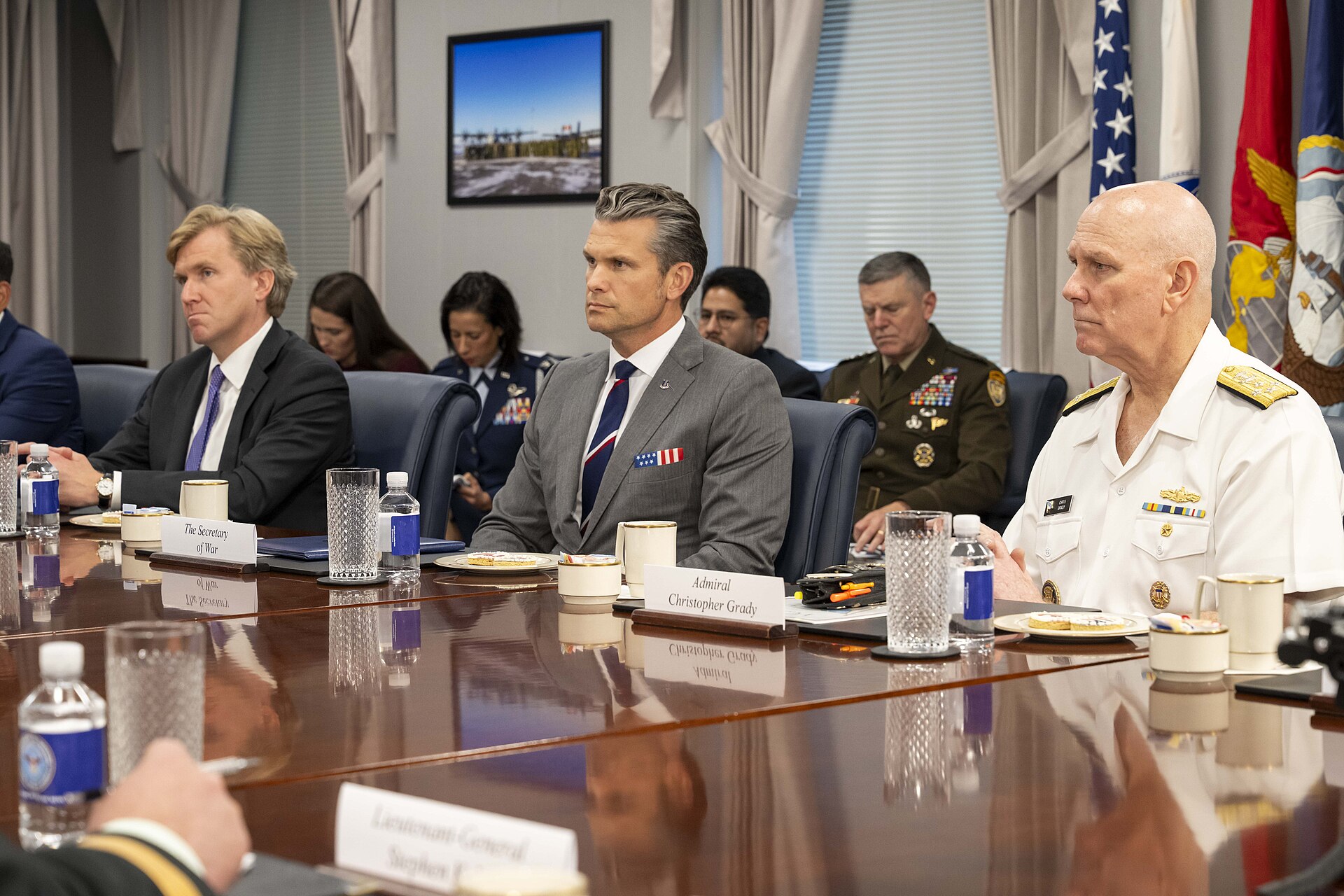


On Thursday, U.S. Secretary of War Pete Hegseth announced in a meeting with NATO allies in Brussels that the Pentagon would begin a six-month review of U.S. military involvement in Europe. This review, he asserted, “will be designed to ensure that NATO is moving fast and irreversibly toward Europe leading, stepping up to take primary responsibility for the defence of Europe.”
Hegseth lamented that the spirit of NATO 1.o had faded after the Cold War. According to him, this phase of NATO was a time when Europe fearlessly defended itself with strong and courageous fighters, instead of dry leadership boards. He confronted the European leaders in the room, saying that what came after, what he calls NATO 2.0, failed to deliver: “NATO lost its way. NATO 2.o was an era of distraction, de-industrialization, and demilitarization. It was an era of free-riding, and those were lost years that we’re not going back to.”
According to Hegseth, issues surrounding the war in Iran have played an instrumental role in causing the U.S. to decrease its military presence in Europe. He specifically called out the failure of many allies to assist the U.S. in the war, saying, “The United States has defended Europe for generations, and the President said- all he said was that our jets would need to take off from bases in Europe or our ships from ports to strike targets in the Middle East.”
In May, plans were announced from Washington to withdraw 5,000 troops from Germany. U.S. long-range bombers such as the B-2 and B-52 will be relocated, along with other weapons with deep-strike capabilities. Other military resources to be deployed elsewhere include naval assets, missile-launching submarines, and aircraft carriers.
The U.S. intends to decrease the number of F-16 and F-15E fighter jets available for NATO’s use, bringing the count from 150 to 100. The number of maritime reconnaissance aircraft will also be cut to 15, down from 26, according to the New York Times.
Hegseth said he wants to see allies take more ownership of their own defense: “We’ve been so clear and so candid to restore NATO’s core military role and character … Instead of tanks and fighters and air defenses, the focus has been on gender equity and climate change and defense austerity…. Europe’s borders flew wide open, welfare states expanded, defense budgets cratered, along with Europe’s belief in itself and its civilization.”
One of the reasons Europe finds itself in the position of needing to catch up militarily is its compounded lack of investment in this area over time. Trump and past presidents have urged NATO allies to spend more on the military.
Because allies remain dependent upon Washington for critical weaponry, concerns have been raised that this move to reduce U.S. military presence in Europe could potentially leave Europe vulnerable to attacks from Russia. Mark Rutte, the secretary general of NATO, said that Washington would be willing to step in if a threat were to arise against NATO despite the “immediate” U.S. military withdrawals.
However, Hegseth made it clear that the sum of around $790 million in 2026 that Washington has paid to help cover the organizational fees of NATO would be dependent upon allies following through on their spending goals.
German Chancellor Friedrich Merz disclosed that the country had known of the U.S.’s intention to withdraw military presence from Europe. “We know that we must do more and we are doing it,” he said.