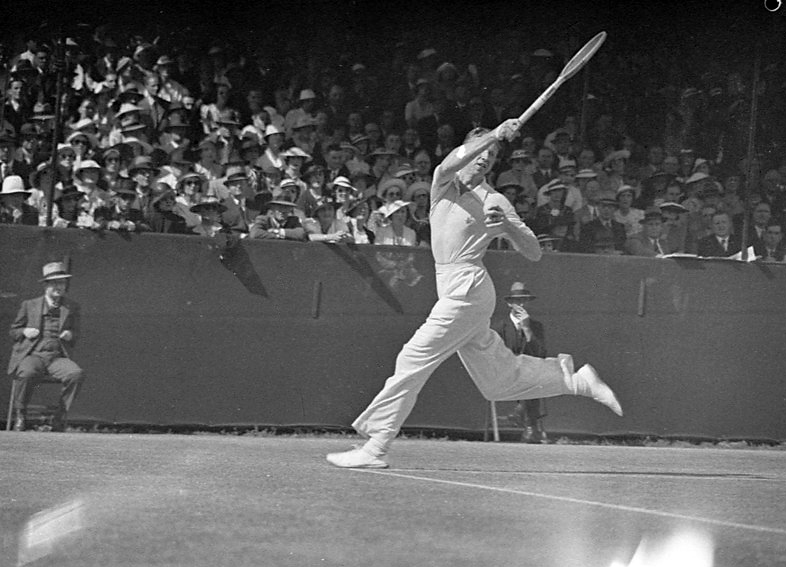


At the final of the men’s draw at the 1937 Championships — the tournament at the All England Tennis and Lawn Club — America’s Don Budge beat Gottfried von Cramm, Germany’s no. 1 player, in straight sets. Budge, his fellow Californian Ellsworth Vines, von Cramm, and England’s Fred Perry were the top players of the decade. Budge and Perry were working-class boys, the German a scion of one of the great houses of Saxony.
Budge learned his tennis hitting against the walls and on the public park courts in San Francisco, where his father was a truck driver and park maintenance worker. Perry, who grew up near Manchester and whose father was a cotton spinner, learned the sport on public courts as well. Von Cramm was a member of Berlin’s elite Rot-Weiss club, the equivalent, if there was one, of Wimbledon.
Von Gramm, a handsome and elegant player who had won twice at Roland-Garros, was an avowed anti-Nazi. He was known to have certain inclinations of which he did not make an issue, and he had spirited his Jewish wife out of the Reich. He was hated by the fascist socialist thugs who had hijacked Germany and were about to plunge the world into war.
They had already demonstrated their awareness of sports as a propaganda tool at the Berlin Olympics the previous year, where they had barred Jewish athletes and tried to block the American track star Jesse Owens due to his color. They were supported in this effort — which famously backfired — by the American Olympic Committee headed by Avery Brundage, himself a track star in college and certainly not a Nazi, but self-serving and overeager to cut deals, as successful businessmen sometimes are (he made a fortune in construction).
The Nazis were determined to use the Davis Cup inter-zonal between Germany and the U.S. to get their revenge. The inter-zonals were the equivalent of semi-finals; the winner would play what was called the Challenge Round against defending champion England. Without Fred Perry, who had turned pro, Germany-U.S. was the main contest.
This was not Argentina-England in soccer; in fact, with the hindsight of history, we can recognize that it was much bigger.
The last singles rubber of the fateful tie took place a few weeks after the final at the AELTC, on the same Centre Court. This time, von Cramm, a handsome and elegant player who had won twice at Roland-Garros, got ahead two sets to love. (Among its other eccentricities, it uses “tie” to designate a meet, “rubber” for a match.) Just before the match, the story has it — it has been confirmed by reliable sources, including Budge, but exactly what was said is not known — Hitler called von Cramm, and whatever was said, the implication was clear enough.
In a tennis match, and especially a match like this one, being better is never enough; there are always other factors, including, of course, the mental state of the players.
There is a book on this drama, Marshall Jon Fisher’s A Terrible Splendor; I may have reviewed it in these pages years ago, but I cannot locate either the book or the review, so nuts to that. It is a fine, extremely interesting book, and it shows how von Cramm, a man of honor and rigid respect for tradition and authority, faltered under the pressure and let Budge back into the match, which the tall, good-natured Californian went on to win in a five-set classic, which included a clutch fifth set comeback from 1-4. Note that von Cramm and Budge were friends, and it was fairly clear by then that Budge, who, among other things, developed the backhand shot into an offensive tactic, was the better player. In a tennis match, and especially a match like this one, being better is never enough; there are always other factors, including, of course, the mental state of the players.
You cannot apply psychology to people you have never met, but one can imagine the pressure von Cramm was under. He respected authority, even when he knew it was being applied toward wicked ends. He was a patriot. Even after being arrested and nearly murdered by the Gestapo, he put on his uniform as soon as he was released and volunteered for the Eastern Front, which was the closest thing to writing a suicide note a Wehrmacht officer could do. He survived, however, and after the war, the U.S. State Department refused him a visa to the U.S. on the grounds that he had a criminal and incarceration record.
Great Britain, apart from having initiated the Davis Cup with the U.S. in 1900, was in a period of retreat and appeasement, due to the appalling bloodletting of the recent war and the economic and social difficulties that followed. There were currents of pro-German, at times pro-Nazi, sympathy among the upper classes; Winston Churchill was considered a troublemaker for his calls for an intense defense buildup as a deterrent to another war. When this failed, he became prime minister and led England from the brink of defeat to victory.
Don Budge joined the Army Air Force; an accident to his shoulder hurt his tennis after the war, but he achieved successes on the pro tour, competing against such greats as Bobby Riggs and Pancho Gonzalez. Like the man who might have kept the Cup in England, Fred Perry, he had turned pro just before the war, and would not have been eligible for more Davis Cup play anyway.
Budge and Perry both make strong cases for the title of best players ever, but these rankings cannot factor in economic, social, and technical changes, are tentative, and often trivial. The Davis Cup itself, once as prestigious and popular a competition as the World Series or the World Cup, gradually lost its prominence in the Open era, as the Slam circuit and new international competitions like the Hopman and Laver cups, competed for fans’ and sportswriters’ attention. Money may have had something to do with this, but who knows.
Perry himself had not only turned pro, but he had also left England for the U.S. and, like Budge, joined the Air Force. A working class lad, he was disappointed at the snobbery he encountered as he made his way — most notably, though he won the Challenge Cub at the Championships three years in a row in the mid-1930s, (and five other times at the other majors, plus several doubles and mixed doubles) he was denied membership at Wimbledon (a private club), which unofficially is a perk for winners.
He was judged by Bud Collins, years later, to be the all-time greatest, and in America, he developed a successful haberdashery line whose classic polos, like his French rival Rene Lacoste’s, remain as popular today as they were then.
In this regard, it is odd that the AELTC uses the Ralph Lauren imitations to dress its ball boys and girls, or maybe it is only business. I did notice (maybe this is not new, I only see this tournament from afar) that the players’ kits at the AELTC allow them to bear a little insignia representing brands. Maybe it is another sign of the decline of everything, but then again, the history of Britain between the great wars, not to mention in recent years, demonstrates that bad stuff happens, but it does not mean it is irreversible.
Maybe some things are irreversible, but the aim of life is to disprove it or die in the effort, knowing that if you walk the narrow path, you are bound for glory, so you might as well give it the old college try.
Novak Djokovic, the indestructible man of Belgrade, seven times winner here — not a record, but does it matter? — played a sensational quarter final against the young Canadian star Felix Auger-Aliassine, winning in the fifth set tiebreak. He then lost to defending champion Janik Sinner, who went on to beat this year’s Roland-Garros winner Alexander Zverev in a service and baseline slugfest, the straight set score not reflective of how close most games were, nor of the thrilling dashes in rallies, the breathtaking net volley duels, the impossible retrievals. Both players slipped and tumbled on the grass, Zverev apparently hurting himself and losing the point, while Sinner was able to scramble back up and finish his. He closed out with a textbook serve-plus-winner, hitting Zverev’s return of serve far to the deuce alley and following with a straightforward winner to the other side of the court.
The host country could find some joy in the fact that Arthur Fery — a qualifier! — made it all the way to the semis where he was stopped in a straight set by the same Zverev; it was the best show in a long time in the gentlemen’s singles draw by an Englishman (though born in France of French parents, but you know, England, France, together in love and war); Sir Andy Murray is British, but from Scotland. In doubles, Henry Patten won a second time. And attendance, at about half a million, was pretty strong, notwithstanding the heat wave.
In the ladies draw — Wimbledon, at least, insists on still referring to ladies and gentlemen even if they now allow fans to show up not wearing suits and ties and dresses and hats — there was a heartbreak of a mistake by Coco Gauff in her semi against Karolina Muchova, who then had a heartbreak of her own in the final against her compatriot and friend Linda Noskova (“ex-friend” she tearfully and wittily conceded during the trophy presentations) and it was all very moving and heartbreaking and girls will be girls and boys will be boys, I mean ladies and gentlemen.
READ MORE from Roger Kaplan: