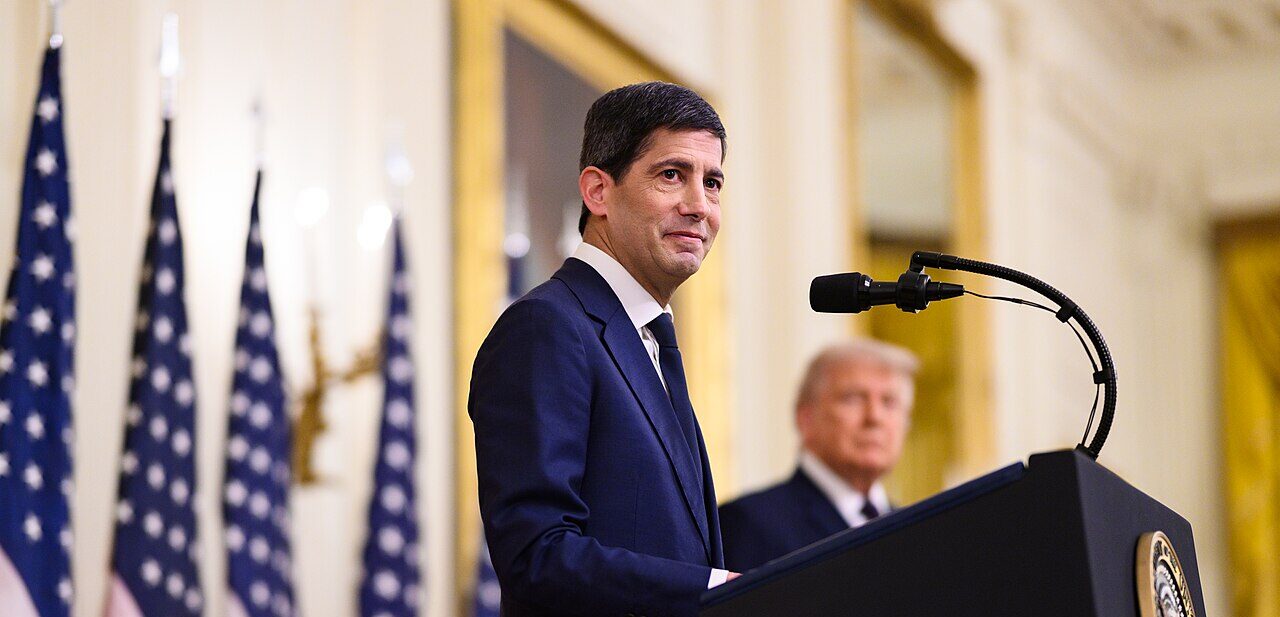


Recent events suggest there may be reason for optimism about the U.S. dollar under new Federal Reserve Chair Kevin Warsh. The pitfalls, however, are large and frightening. Avoiding a currency collapse over the long term is becoming increasingly doubtful, all because the federal government and central bank ignored Warsh’s warnings for nearly two decades.
Markets are indicating optimism about the U.S. dollar now that Warsh has arrived. The Fed’s Five-Year Breakeven Inflation Rate, which measures inflation expectations by looking at real numbers derived from investment choices by market participants, is down to 2.2 percent. That “is lower than before the Iran conflict began when gas prices were well below $3 a gallon,” Unleash Prosperity’s Hotline notes.
Contrary to the presumptions of Warsh’s predecessors, managing the economy is not the Fed’s job. Nor is it a duty of the federal government.
Another sign of optimism about the dollar is the price of gold, which dipped below $4,000 an ounce last week ($3,998.9), far below its high of $5,300 per ounce in February. These figures suggest the markets believe Warsh is serious about stabilizing the dollar.
Warsh has long been an inflation hawk. In a June 2009 Federal Reserve paper, he firmly stated price stability is central to the Fed’s mission, in addition to the mandate to pursue maximum employment.
“The Federal Reserve should not — and will not — compromise another kind of stability — price stability — to help achieve other government policy objectives,” Warsh wrote, meaning the central bank’s attempts to boost employment, the stock market, homeownership, climate change mitigation, and other such factors. Disappointed with the Fed’s continued economic manipulation, Warsh left the Fed two years later.
Addressing the press after his first Open Market Committee Meeting a few weeks ago, Warsh made it clear his main concern is to reestablish price stability: “The commitment to deliver [price stability] is strong, unanimous, and unambiguous,” Warsh said. “And that’s an important message we’ve missed for five years. And we’re going to fix that.”
Warsh’s predecessors benefited the big spenders in the federal government by perpetually expanding the money supply to keep the government and stock markets flush with cash over the previous four decades. Cheap money introduced wasteful distortions into the economy, especially visible in inflated equity values and commodity prices, which increased inequality and foisted severe inflation on the country during the Biden administration. (RELATED: Remembering Alan Greenspan)
Although inflation generally stayed below 3 percent from 2008 to 2022, that is not price stability: 2 percent inflation per year means the value of the currency is cut in half every 36 years.
Even more damaging is the fact that the monetary excess was hidden in skyrocketing values of stocks for the rich and housing for working Americans, instead of being immediately visible in the Consumer Price Index.
Employment has not grown as rapidly as it should, especially among native-born Americans, until this past year, and the main reason for low unemployment has been the Baby Boomers leaving the workforce and the federal government flooding the labor market with lower-wage immigrants to replace them.
The record suggests the Fed has been acting as if its real duty were to enrich the government, bankers, stockholders, and owners of large homes, at which it has succeeded spectacularly. (RELATED: Stock Market Wisdom, and Its Limits)
“The end result was a crippled crony capitalist economy saturated with debt, intrusive Big Government intervention and meddling, relentless speculation and systemic malinvestment,” former Office of Management and Budget Director David Stockman argued in a multipart article last week.
It should hardly surprise us, then, that nearly everyone hates the current economic system and rightly considers it to be rigged. Increasing numbers of people are blaming capitalism and expressing support for socialism and even communism.
That is a big mistake. The current economic system bears very little resemblance to a free market. It is crony capitalism, full of distortions and obvious corruption, as the government that has become fatally parasitic on the people has developed a massive scheme of economic control that forcibly transfers gargantuan quantities of money from productive people to … others.
The biggest beneficiary, however, has been the government. The massive deficit spending financed by the Fed’s corruption of the U.S. dollar and American economy has become a crisis, with the federal deficit now more than $1 trillion dollars annually.
Interest payments on that debt raise the deficit further, creating a devastating fiscal feedback loop. Absent major changes soon, the only plausible outcomes are unprecedented inflation or an unusually brutal recession within the next five or six years. A tough recession would almost certainly lead to severe inflation as the government and the Fed step in to “stimulate” the economy.
That is the situation Warsh is inheriting. The only way out of the impending doom spiral is for the Fed to restore full weight to its legal mandate to maintain price stability in addition to fostering maximum employment, just as Warsh recommends.
Stabilizing the value of the dollar would force the federal government to make some very tough choices about taxes and spending. While the wrong decisions will lead straight to disaster, the right choices will necessarily result in a good deal of pain for millions of people as the system readjusts to real market signals and realities.
The Fed, however, has neither the responsibility nor the authority to prevent that pain. Contrary to the presumptions of Warsh’s predecessors, managing the economy is not the Fed’s job. Nor is it a duty of the federal government. Management of the nation’s economy belongs solely to the invisible hand of the market, as it always has and always will.
The Fed could make its much-ballyhooed independence a real benefit to the American people — or at least less of a force of destruction — by fulfilling the price-stability element of its mandate and forcing the federal government to make the decisions the central bank has allowed it to put off for decades. The markets are indicating they believe that Warsh may be the one to do that.
Let’s hope they are right.
READ MORE from S.T. Karnick:
Trump’s Pivot Could Make Health Care Affordable Again
Florida’s New Tech Censorship Law: A Big Win for Freedom of Speech
America’s Decline and the Neglect of Luther’s Principles of Liberty
S.T. Karnick is a senior fellow at The Heartland Institute and author of the Life, Liberty, Property weekly e-newsletter.