


The waves of tension and expectation over Iran and the U.S.’s month-long muscle flexing and rhetoric of military conflict spiked at the end of last week before settling into a stable impasse after indirect talks between the two parties in Oman over the weekend.
On Feb. 3, an F-35C fighter jet took off from the decks of the USS Abraham Lincoln in the Arabian Sea and shot down an approaching Iranian drone “aggressively” approaching the aircraft carrier strike group, according to Capt. Tim Hawkins, spokesperson at the US CENTCOM.
Later that afternoon, the Arleigh Burke-class guided missile destroyer, USS McFaul, was radioed by the U.S.-flagged oil tanker Stena Imperative requesting an escort as two Iranian Revolutionary Guard Corps (IRGC) military vessels tried to board the tanker in the Strait of Hormuz. “Two IRGC boats and an Iranian Mohajer drone approached the MV Stena Imperative at high speeds and threatened to board and seize the tanker,” Hawkins said. The Iranian boats ordered the ship to stop its engine and prepare to be boarded, but the tanker sped up and radioed the U.S. military instead.
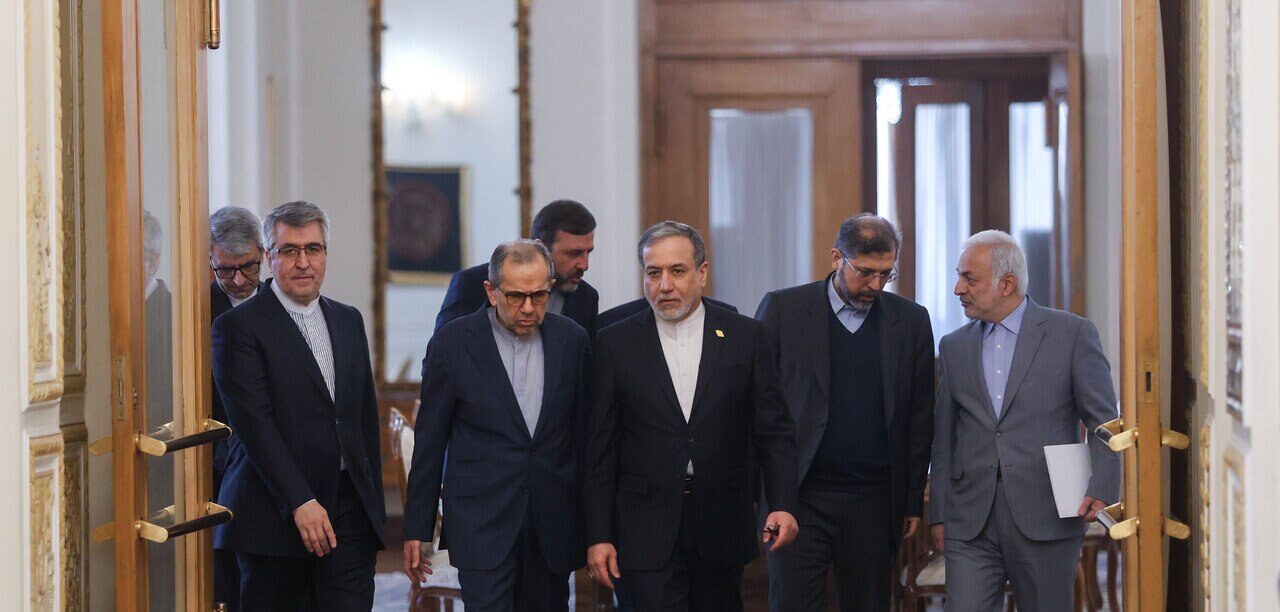
Despite these incidents, President Donald Trump signaled that talks scheduled with Iran on Feb. 6 would go on as planned. Initially scheduled to be held in Turkey, the talks were moved late last week to Oman at the request of the Iranian delegation. (RELATED: Iran Has Already Doomed Talks)
On Friday afternoon, in the Omani capital of Muscat, U.S. special envoys Steve Witkoff and Jared Kushner met Iranian Foreign Minister Abbas Araghchi briefly enough to shake hands and share a few passing words before they were led by their Omani hosts to their respective rooms.
The indirect talks, mediated by Omani officials shuffling between the rooms, were supposed to de-escalate the tension built from Trump’s vows to attack Iran over the regime’s deadly handling of protests. What resulted was the resumption of the nuclear deal talks that had stalled out last June, leading to Israel’s pre-emptive strikes on Iran’s nuclear facilities and the so-called 12 Day War. (RELATED: Two Regimes, One Reality)
Araghchi came to Oman ready to discuss nuclear issues alone, and particularly uranium enrichment, but the deal presented to him by Witkoff and Kushner was more encompassing. Iran must stop its nuclear program altogether, limit ballistic missile capabilities to 500 km, and sever ties with the proxy terrorist groups Hezbollah in Lebanon and the Houthis in Yemen.
Araghchi responded that the ballistic missile program was “never negotiable” and that all other issues are off the table. A diplomat from Tehran told Reuters on Friday that the regime would not budge on its right to enrich uranium but would be willing to negotiate on “level and purity” of enrichment.
Al Jazeera reported that diplomats from Egypt, Turkey, and Qatar offered Iran proposals to halt enrichment for three years and send its enriched uranium abroad. Russia indicated a willingness to receive the uranium, but Iran said this was a nonstarter.
Later, CENTCOM commander Adm. Brad Cooper joined the U.S. delegation in Muscat unexpectedly, and much to the Iranian’s chagrin, who reportedly likened it to “conducting negotiations with a gun on the table.”
The following day, Witkoff and Kushner visited the Lincoln in the Arabian Sea at the invitation of Cooper, and the U.S. delegation’s visit was seen as a message to Iran that other plans are in the making if talks fail.
The only thing that Friday’s talks in Muscat managed to achieve was that the delegations would meet again, soon.
The only thing that Friday’s talks in Muscat managed to achieve was that the delegations would meet again, soon. Trump told reporters on Air Force One that the talks went “very good,” and that “Iran looks like it wants to make a deal very badly.” To increase the pressure, Washington announced a second round of 25 percent tariffs on all countries trading with Iran. On Sunday, the Trump administration told its Iranian counterparts to arrive at the next meeting “with meaningful substance.”
The Iranians, on the other hand, left Muscat feeling emboldened for not backing down on their stated red lines. “It is these Americans who, after the failure of their other options (military, economic, terrorist, and so on), now have no choice but to accept the frameworks and the rights of the Iranian nation,” said Ebrahim Rezaei, spokesperson for the parliament’s National Security Committee. (RELATED: Is a Red Line Still a Red Line?)
Speaking to Al Jazeera on Saturday, Araghchi doubled down on his threat that U.S. bases in the Middle East would be attacked if the U.S. strikes Iran. He further clarified that “it would not be possible to attack American soil, but we will target their bases in the region… We will not attack neighboring countries; rather, we will target U.S. bases stationed in them. There is a big difference between the two.”
There are 19 U.S. military bases in the region and within range of Iran’s firepower, including the Al Udeid Air Base in Qatar, the U.S. Fifth Fleet headquarters in Bahrain, Camp Arifjan in Kuwait, and additional bases in Syria, Jordan, Iraq, and the Gulf states. Not all of these bases have air defense systems, and those that do are mostly short-range defenses.
Over the past four weeks, Washington has bolstered its military posture in the region in anticipation of conflict with Iran. Over the weekend, additional measures were taken, including the large-scale deployment of THAAD and Patriot systems to the region and the arrival of additional U.K. and U.S. fighter jets to Cyprus and Jordan.
Although not involved in the talks, Israel has much skin in the game because of their tense relationship with Iran, and Israeli officials are pressing the U.S. envoy not to agree to anything less than the red line stipulations at hand. Israel’s position on Iran calls for the complete dismantling of its nuclear program, zero uranium enrichment, no enrichment capabilities, removal of all enriched material from Iran, limitation on ballistic missile range to 300 km, and the dismantling of the Shiite axis. Israeli commentators, however, speculate that the U.S.–Iran talks will not lead to an agreement because the gaps between the sides are too large. They also speculated that Iran’s willingness to entertain negotiations is all a ploy to buy Iran time to reposition its nuclear assets and prepare missiles.
According to Dr. Raz Zimmit, director of Iran and Shiite Axis program at the Institute for National Security Studies, Iran’s ballistic missiles are its “last credible pillar of deterrence and a hedge against what it sees as unreliable U.S. guarantees.” Iran is not seeking a full-scale confrontation, and probably knows its enriched uranium is on the way out, but maintaining its capabilities to instill fear in Tel Aviv or the 19 U.S. bases in the region is its last pillar of deterrence, and Tehran will undoubtedly not give this up without a fight.
READ MORE from Bennett Tucker:
Trump’s ‘Board of Peace’ May Actually Hinder the Gaza Peace Plan
Image licensed under Creative Commons Attribution 4.0 International.



















