The title of this article is a nod to country singer Chris Janson and his clever hit, “Me & A Beer.” The song begins:
Prettiest girl I’d ever seen
Look at her, man, look at me
I thought “I can’t just walk up and ask her to dance”
But me and a beer can.
Inspired words, indeed. Many a man can relate — with a beer can.
In Janson’s lyrics, the “can” is a verb, not the noun I’m going for in this article. I’m 59 years old and have been married to the lovely Susan for 33 years, plus I’m a good Catholic boy (or at least try to be). I’m not hitting the clubs, summoning up beer courage to ask pretty girls to dance. That would be fun, sure, but those days are long gone.
Anyway, I’m invoking beer cans. The noun — a beer can.
I love beer cans — more than I like beer, actually. Like many boys of the 1980s, I collected them. I had less interest in consuming their contents (that would come in college) than collecting them for fun and their value. Back then, collecting beer cans was all the rage. How that happened, I’m not exactly sure. No doubt, beer producers had a lot to do with it. They created handsome-looking products that just screamed: “collectible.”
One example was the beautiful Schmidt Beer series of cans adorned with colorful wildlife images. You bought that beer for the artwork — to keep and display. They were too nice to toss in the trash.
Less attractive were the famous Miss Olde Frothingslosh cans, which featured a very large but happy, beaming woman in a bathing suit. That image was quite the opposite of, say, the St. Pauli Girl cans. Still, Olde Frothingslosh was fun. Here, too, you weren’t buying for the beer. These were collectibles.
In my neck of the woods, Iron City Brewing produced splendid cans sporting team photos of the Super Bowl champion Pittsburgh Steelers of the era. Those items were enormously popular in these parts. And I must say that, like the iconic Terrible Towel created by legendary Steelers announcer Myron Cope, these cans seem to possess mysterious powers. On certain key occasions over the decades, when the Steelers are in a major game, I pull out the cans as heavy artillery, positioning them in front of the TV set, resting on a Terrible Towel. Akin to sacred relics, they seem to exude some sort of mystical property — tapping into unseen forces — that prod the team to victory. Proof?
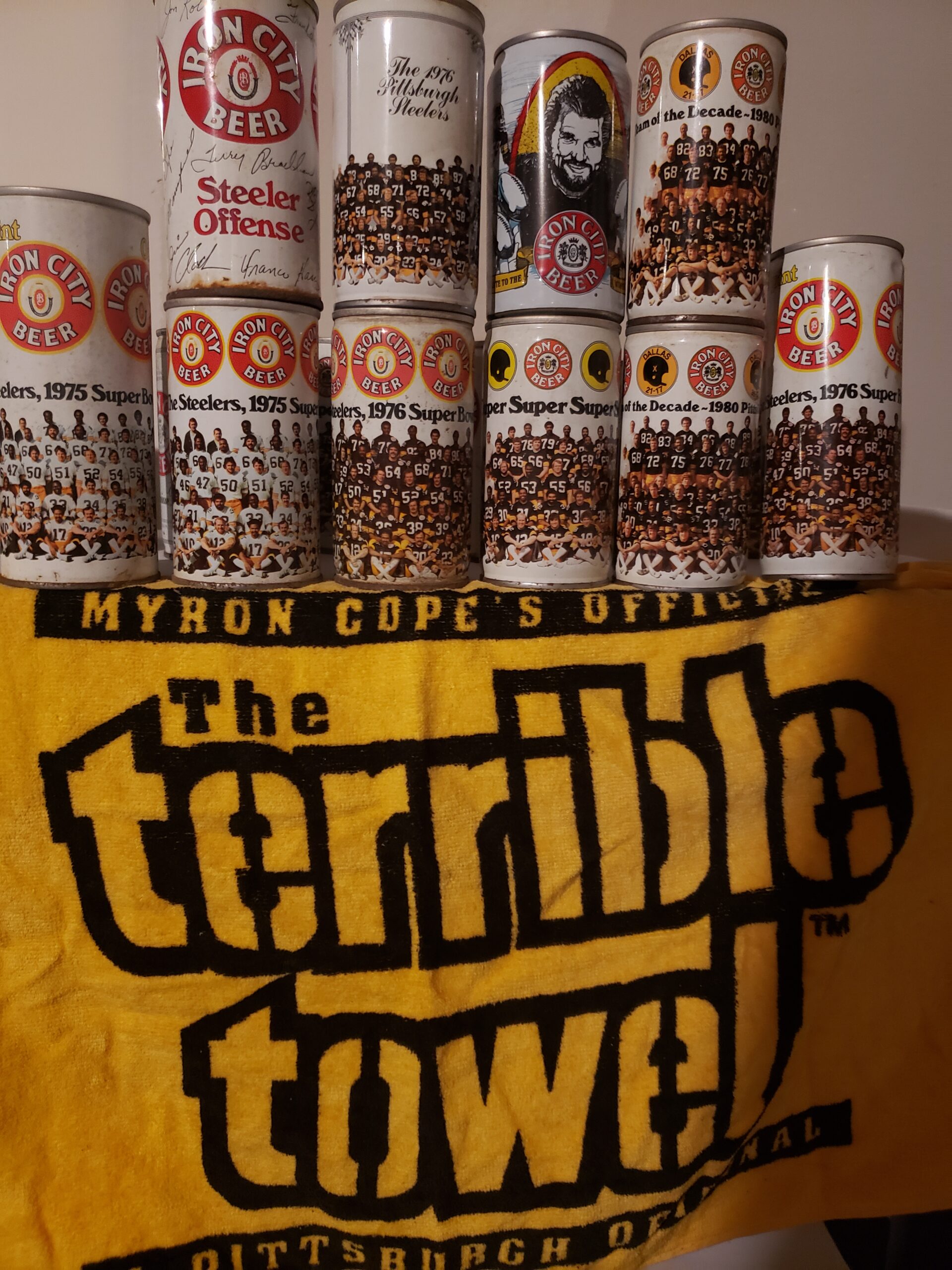
Photo Credit: Paul Kengor
Well, the Steelers have the most Super Bowl victories of all time (tied), plus dozens of playoff wins and division titles, and the record (still ongoing) for most consecutive non-losing seasons (22) — actually a record among the four major sports. Surely my display, my reliquary marshaling the powers of the Iron City cans, accounts for this success.
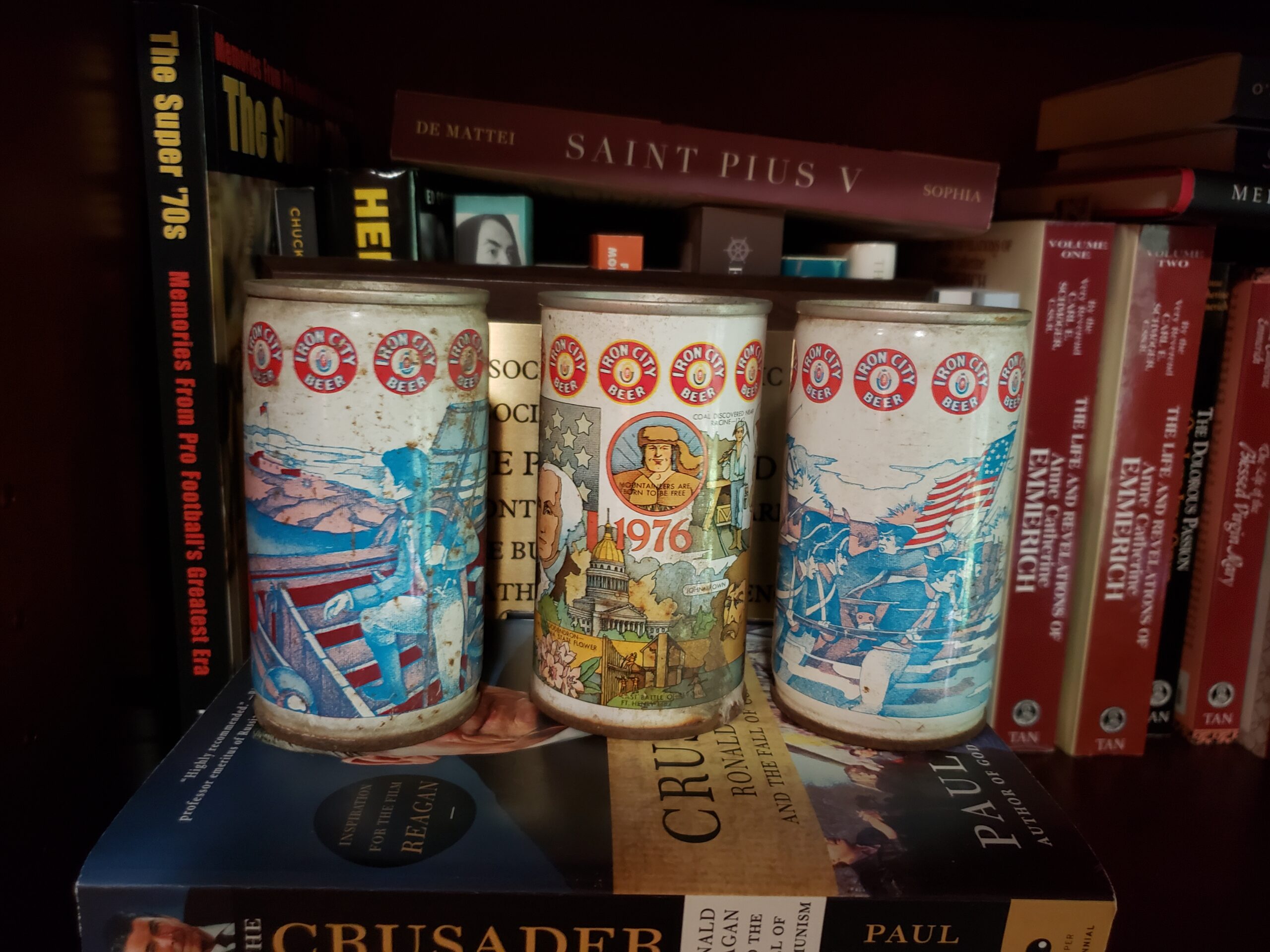
Photo Credit: Paul Kengor
But I digress! Back to beer cans.
In my day, there was nothing more exciting to a roving band of scavenging boys than rummaging around a junkyard searching for rare cans and other buried treasures. We spent hours at the task as if digging for gold. We would bring home dirty cans, shock our mothers with the smell (of the cans and ourselves), and clean them up. It’s almost indescribable the joy of a 12-year-old boy finding a rare cone top can in an old junkyard.
Speaking of cone tops, our biggest thrill — me and my brother and two cousins — came at our Aunt Emma’s house in Emporium, Pennsylvania. My aunt’s husband, Uncle Rich, had used a sledgehammer to breach a basement wall to create a fruit cellar under the front porch. What they found in the rubble was utterly unexpected: piles of perfect-condition Iroquois Indian Head and Stegmaier’s Gold Medal cone tops. Evidently, the crew that built the house decades earlier would finish the day with a few brewskis, tossing the empties into a pit they never thought would see the light of day — until Uncle Rich busted open the wall. Each can was worth $40 minimum in the ‘80s — thousands of dollars in beer cans preserved in near-mint condition under that porch. I keep two of those cans in my bookcase. My brother and cousins likewise retain a few as mementos.
Back in my hometown of Butler, we boys displayed the cans on shelves in garages, beams in basements, in stacks in family rooms, or wherever. My friend “Duck” turned a small barn into a house of beer cans. It was the coolest thing. My friend “Flem” happened upon a treasure trove: an old lady on his paper route who guzzled so much beer that her outdoor garbage was always full of gems for our picking. Uncles who drank beer would save us choice cans. My buddies had hundreds. We would trade and sell them.
Today, I retain only a few dozen favorites. That includes old Billy Beer cans never tapped and with liquid (in some form) still inside. Some readers will remember that this was an amusing novelty beer invoking President Jimmy Carter’s drunk of a brother — somehow even more of a geek than “Jimma” himself, though Billy no doubt would have made a better president. Hell, Miss Olde Frothingslosh would have made a better president. Billy was part of what our venerable founder, R. Emmett Tyrrell Jr., characterized as the “coterie of yokels” and “Peanut Brigade” who occupied 1600 Pennsylvania Avenue in the late ‘70s.
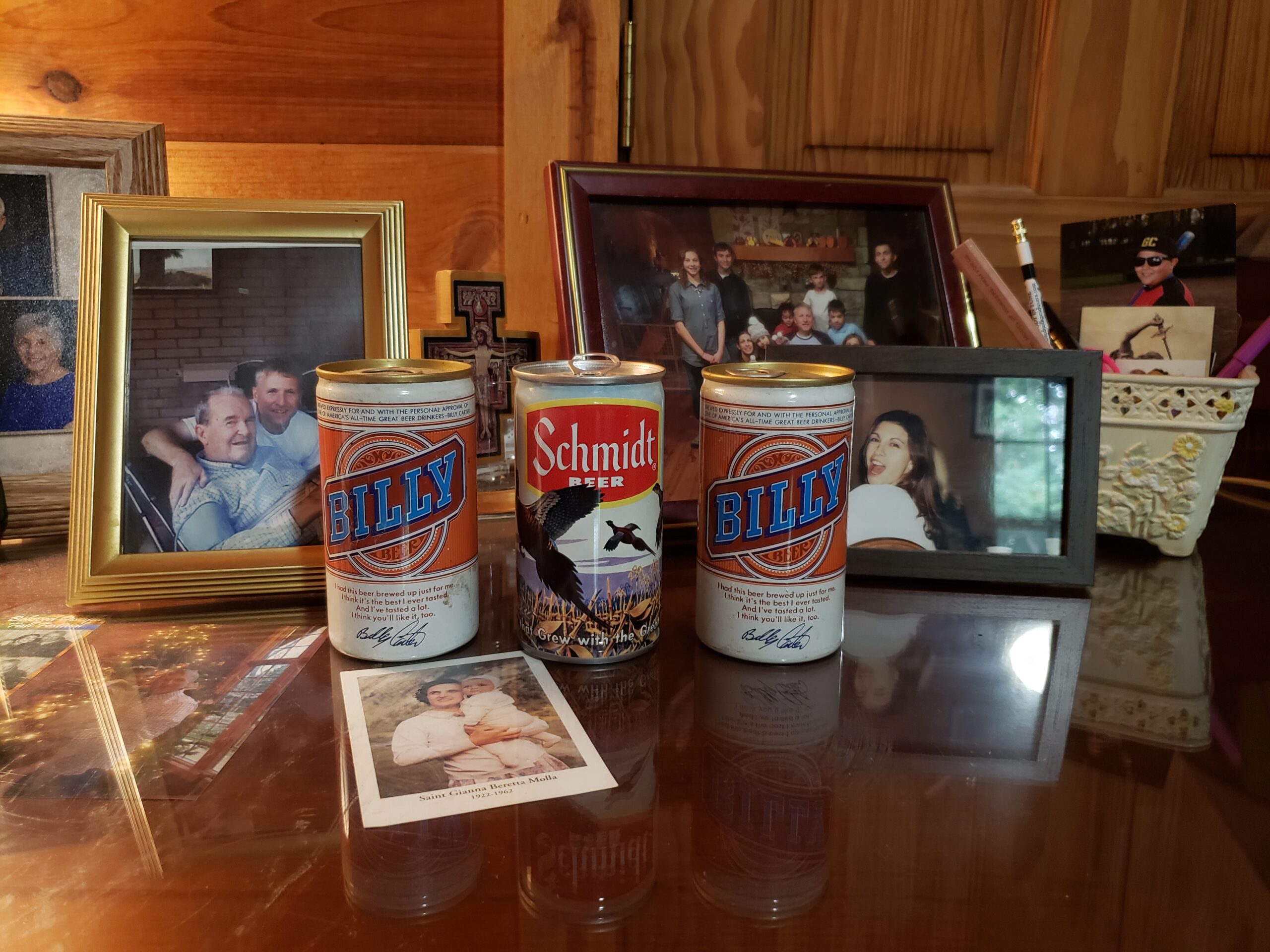
Photo Credit: Paul Kengor
Regrettably, boys don’t seem to be collecting beer cans today. The junkyards are probably condemned as environmental hazards by state bureaus of natural resources or prohibited by federal menaces from the Department of the Interior as protected habitats for mangy rats or rattlesnakes. CYS would descend on the scene to arrest the boys’ parents for permitting youngsters to search for “beer.”
But I can attest to the interest, if not excitement, that never goes away in the mind of a boy. A few weeks ago, me and two of my sons were wading in a creek in an isolated spot in the woods behind our house. My 12-year-old found a bottle buried in a sandy-muddy spot. He reacted as if he had just discovered Aladdin’s lamp. At first glance, one would dismiss it as just “some bottle.” But little Ben had high hopes. He brought it home and commenced cleaning it, certain it would fetch him a small fortune. A lady at a local antique shop told him to use denture-cleaning tablets to clean it up. The tablets worked like a charm. We learned that Ben had found a 1940s Pepsi Cola bottle, resting there in the creek for some eight decades. It isn’t worth a pile of cash, but it is worth something like $15. That’s a big score for a boy.
Now, Ben and his brother are fired up to find forgotten junkyards in the woods to search for bottles and cans. Who knows? Maybe we’ll find some cone tops. And even if they’re rusty, who cares? We’ll find some treasures together if we can.
Me and them and a beer can.
READ MORE from Paul Kengor:
MLB’s Pitching Craziness Continues