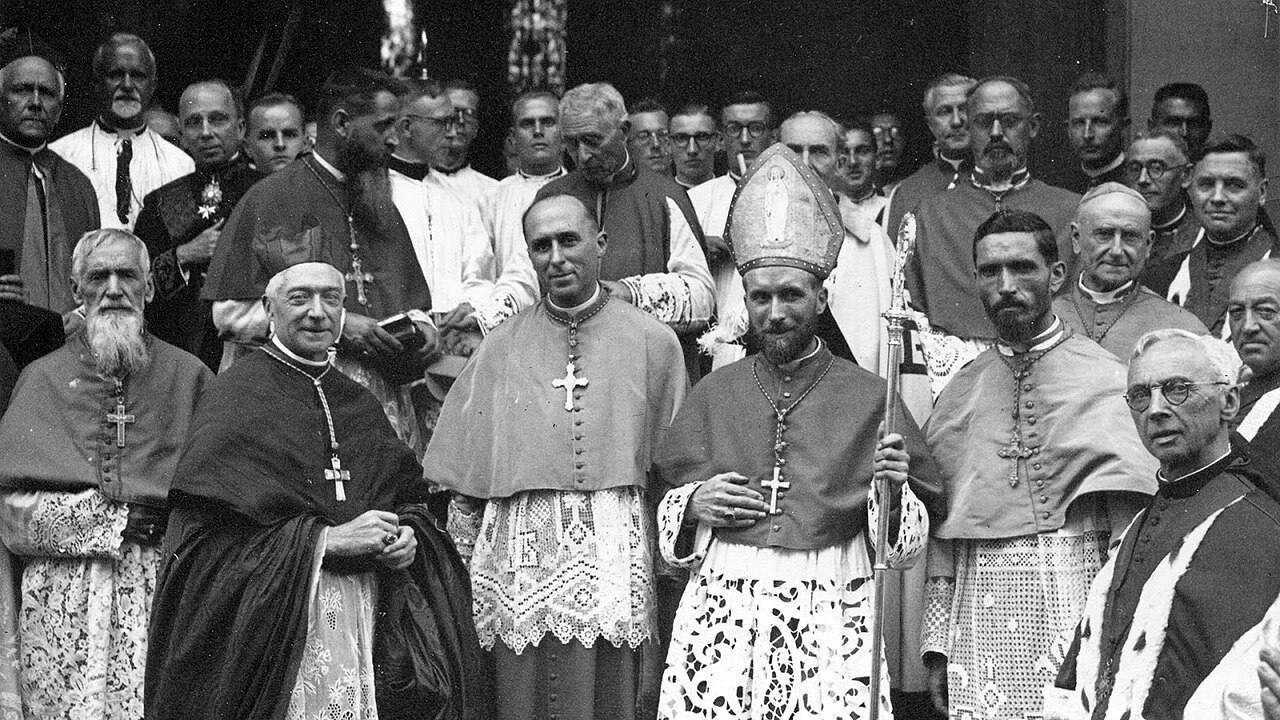


Recently in these pages, S. A. McCarthy gave an elegant summary of “The Tragedy of the SSPX,” a tragedy that is about to reach its climax with the Society of Saint Pius X’s consecration of four bishops on 1 July in direct disobedience of the pope.
But left unaddressed in McCarthy’s essay was the question I hear most often from the Catholic faithful: Is there an amusing book — a World War II thriller perhaps — that features Marcel Lefebvre, the SSPX founder, as a sympathetic character? I have an answer: yes. (RELATED: The Tragedy of the SSPX)
As the SSPX hurtles, like a traditionalist cassock-clad Icarus, into a fiery papal sun of schism and excommunication, it might very well be an appropriate time to step back and see Marcel Lefebvre as he once was, as a missionary priest in Africa. He was there during World War II, and his father, arrested by the Nazis as a spy, died in a German concentration camp.
This is one of the subplots of my novel Kruger’s Korps, which includes speculation, based purely on whimsy, that then-missionary Fr. Marcel Lefebvre might have encountered Mokele-mbembe, a dinosaur rumored to lurk in the Congo River Basin, and that he might, additionally, have aided American secret agents to foil a massive conspiracy involving Nazis, Communists, and international criminals.
What does this tell us about the current controversies of the SSPX? Practically nothing, but that might be just as well. We need, in my opinion, far fewer heated arguments about liturgy and doctrine, Church discipline and law. We’ve had quite enough of that. Pax should be our byword. Reading more entertaining novels and avoiding intemperate theological squabbles should be our habit.
One consolation of Catholic philosophy is that the truth is settled; the magisterium is there to guide us; the catechism and canon law can provide answers. Yes, doctrine can develop, the liturgy can be modified, and different rites can be accommodated (as they have been throughout history), but the Church remains the Church, the sacraments remain the sacraments, and the faithful should remain faithful, even while the Church careens through history, from one calamity to another, as is the way of the world.
Within the boundaries of the universal Church, there is room for every Catholic of goodwill. That includes those who express the faith charismatically (not for me, thanks, but it appeals to plenty of theologically conservative Africans, among others), traditionally (with the Traditional Latin Mass or in other traditional, recognized rites), or in the Church’s Ordinary Form of the Mass (the Novus Ordo, done reverently, as it should be).
Again, while the deposit of faith is unchanging, doctrine develops, and so does the liturgy. It is historically wrong, for instance, to say that the Tridentine Mass, for all its virtues, is “the Mass of the Ages.” It is more accurately “the Mass that had a good, long run.” (The distance between the Council of Trent, it should be remembered, and the Second Vatican Council is roughly 400 years.) Greek, not Latin, was the liturgical language of the early church, and during the first eight centuries of the Church, it was common practice to receive communion standing up and in the hand. That does not mean that the early Church was right and that the Tridentine establishment was wrong, but only that the Council of Trent codified and made standard liturgical developments since the Middle Ages. The new liturgy that emerged from the Second Vatican Council was another development, the result, as Evelyn Waugh complained, of “a strange alliance between archeologists absorbed in their speculations on the rites of the second century, and modernists…. In combination they call themselves ‘liturgists.’” There were also parochial concerns about encouraging greater comprehension, participation, and biblical literacy among the laity. Granted, some of these concerns, or the solutions to them, may have been ill-founded. As Evelyn Waugh’s son Auberon (a Lefebvrite sympathizer) pointed out in 1976, to many of the faithful, “the new services [in the vernacular] are seen as shoddy and banal, which would be bad enough, but also lacking the historical authority which, aided by awesome incomprehension, has served Catholics so well through the ages in suspending their disbelief.”
Be that as it may, most laymen are best advised to avoid liturgical disputes. They can become an unhappy distraction or — for some — an uncharitable and even faith-destroying obsession. Maybe I have been lucky, but the overwhelming majority of Novus Ordo Masses that I have attended have been perfectly reverent, even if that has sometimes required an indulgent, non-pharisaical temperament.
Evelyn Waugh was a traditionalist. But his affirmation of the common churchgoer could today be applied, with a few reservations, to the hundreds upon hundreds of millions, out of a global Catholic population of 1.4 billion, who attend an Ordinary Form of the Mass on any given Sunday:
I believe that I am typical of that middle rank of the Church, far from her leaders, much farther from her saints…. We hold the creeds, we attempt to observe the moral law, we go to Mass on days of obligation… we contribute to the support of the clergy. We seldom have any direct contact with the hierarchy. We go to some inconvenience to educate our children in our faith. We hope to die fortified by the last rites. In every age we have formed the main body of “the faithful” and we believe that it was for us, as much as for the saints and for the notorious sinners, that the Church was founded.
The Church was founded to save us, and we should be united against our common enemy: the Devil, his minions, and his useful idiots. To that end, we need to maintain our grace under pressure. That requires courage and mental balance. Kruger’s Korps, a novel that ponders a possible meeting between Marcel Lefebvre and a dinosaur, also has quite a lot to say, in a more serious vein, about the nature of patriotism, loyalty, family, and faith — especially when put to the test, or tangled in confusing knots. So maybe it is, after all, relevant to the contretemps of the Church in our times.
H.W. Crocker III is a popular historian and novelist, and a former political speechwriter and publishing executive. His most recent book is a World War II thriller about a rosary-praying secret agent behind enemy lines in Kruger’s Korps.