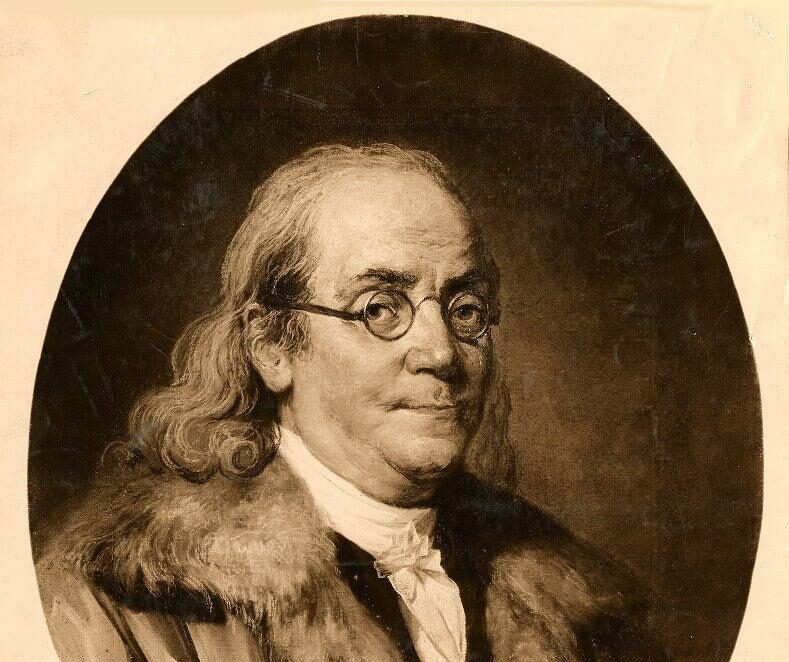


Most of the left, including virtually every corporate media “journalist” who publishes news and opinion pieces about politics, hold the nation’s founding fathers in low regard. The public is daily subjected to screeds enumerating the faults of Washington, Jefferson, Madison, Hamilton, Franklin, et al. Yet, when these scribblers wish to justify some pernicious Democrat policy proposal, they frequently rummage through the writings of these men for some quote “proving” that its author would have supported the latest bone-headed boondoggle. A classic example is “Benjamin Franklin, Champion of the Wealth Tax,” by Harold Meyerson at the American Prospect.
In the post-war agrarian economy “superfluous” property primarily meant good land gone to seed.
The subtitle of this work of fiction claims, “When public needs were great, he wrote, its claim on the ‘superfluous’ property of the rich was strong and just.” To support the implausible assertions made in the title and subtitle of his column, Meyerson quotes a paragraph plucked from a 1783 letter Franklin wrote to Robert Morris that does not contain any of the following words: “wealth,” “tax,” “rich,” “needs,” “strong” or “just.” All Meyerson has done here is deceptively paraphrase a long and discursive paragraph about the distinction between public and private property in order to substantiate the notion that Franklin believed “wealth taxes were both proper and necessary.” This nonsense cannot be reconciled with Benjamin Franklin’s actual words.
Before digging into the passage quoted by Meyerson, a review of Franklin’s attitude on taxes before and after the revolution is in order. His first notable public statements involving taxes were delivered in 1766, when he testified against the Stamp Act in the British House of Commons. The Act was soon repealed. He also spoke on taxes during the Constitutional Convention: “[T]here are two passions which have a powerful influence on the affairs of men. These are ambition and avarice; the love of power, and the love of money. Separately each of these has great force in prompting men to action; but when united in view of the same object, they have in many minds the most violent effects.” Now let’s take a look at the passage Meyerson quoted:
All Property, indeed, except the Savage’s temporary Cabin, his Bow, his Matchcoat, and other little Acquisitions, absolutely necessary for his Subsistence, seems to me to be the Creature of public Convention. Hence the Public has the Right of Regulating Descents, and all other Conveyances of Property, and even of limiting the Quantity and the Uses of it. All the Property that is necessary to a Man, for the Conservation of the Individual and the Propagation of the Species, is his natural Right, which none can justly deprive him of: But all Property superfluous to such purposes is the Property of the Publick, who, by their Laws, have created it, and who may therefore by other Laws dispose of it, whenever the Welfare of the Publick shall demand such Disposition. He that does not like civil Society on these Terms, let him retire and live among Savages. He can have no right to the benefits of Society, who will not pay his Club towards the Support of it.
The first thing you will realize about this paragraph is that it is about property. As noted above it does not contain a word about taxes. It is clear from Franklin’s testimony before the British House of Commons and his remarks at the Constitutional Convention, he could be quite eloquent on the subject of taxes, yet Harold Meyerson would have us believe that he would write a 167-word paragraph in a letter to a friend on the subject of taxes without using the word, “tax.” It should also be obvious that Franklin was discussing the distinction between public and private property in an agrarian economy in which 90 percent of the population worked as farmers and agriculture accounted for the vast majority of the nation’s assets and employment.
This is why Franklin begins and ends with images of “savages” who, for all intents and purposes, own no property. It is also why he makes a distinction between their little acquisitions and, “All the Property that is necessary to a Man, for the Conservation of the Individual and the Propagation of the Species, is his natural Right, which none can justly deprive him of.” Now we come to that word “superfluous” that so obviously captured Meyerson’s imagination. Here, it’s important to differentiate between Benjamin Franklin, Robert Morris and that 90 percent of the population that earned their living in agriculture. Franklin and Morris were extremely rich men at the time the letter in question was written. In 2026 dollars both were billionaires.
Eventually, Morris lost most of his fortune on ill-advised land speculation, but that happened in the late 1790s. In 1783, Franklin wouldn’t have considered his or Morris’ wealth superfluous. His own longstanding success was built primarily on printing and publishing — and his various businesses provided products and services that were very much in demand until the end of his life and beyond. Ironically, Franklin’s definition of “superfluous” may well have applied to the land Morris bought with no intention of developing. He merely wanted to sell it at a huge mark-up to people who migrated westward after the end of the war with the British. In the post-war agrarian economy “superfluous” property primarily meant good land gone to seed.
Finally, it should be remembered that Franklin was one of only six people who signed both the Declaration of Independence and the Constitution. He also played crucial roles in composing the former and influencing the final draft of the latter. Both of these historic documents are antithetical to the redistributionist mentality that infects the left and the corporate media. The claim that Franklin would have advocated a wealth tax is quite frankly, ridiculous.
READ MORE from David Catron:
Was Redistricting Enough To Save GOP House Majority?