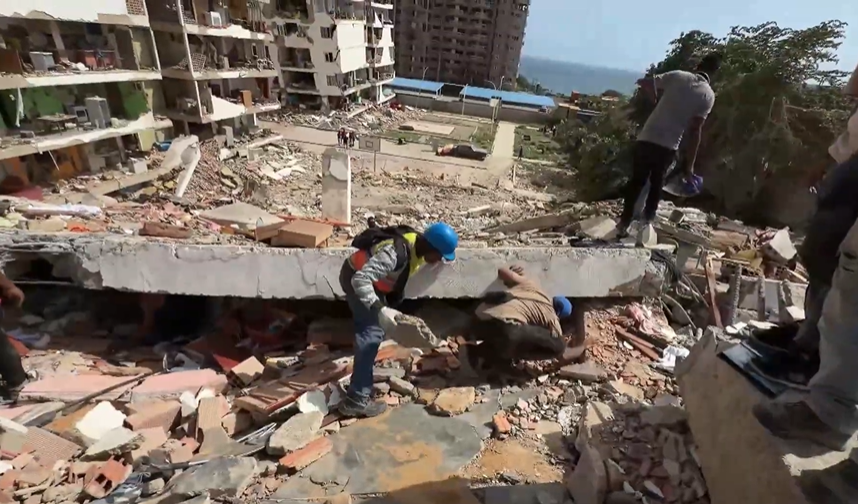


On June 24, two severe earthquakes within the span of a minute shook northern Venezuela, completely collapsing dozens of buildings and damaging others. Families of residents in the Belo Horizonte apartment complex in the city of La Guaira searched for 41 hours through the rubble without official rescue support. “Honestly, there wasn’t a single Civil Guard officer, rescuer or police officer there,” recounted one citizen in a missing-persons WhatsApp group last Friday morning. Only half an hour later did firefighters and emergency personnel finally arrive at the complex.
For much of the first few days, power outages, loss of water, and jammed roads into the disaster zones slowed the arrival of the heavy machinery needed to reach survivors. Many families and communities were left to dig by hand as the crucial first 72 hours for rescuing survivors quickly closed.
Five days later, the scale of the devastation remains grim. Venezuelan officials currently estimate the death toll near 1,450, with more than 3,000 injured and more than 12,000 displaced. The number of missing remains uncertain, but leading estimates put it in the tens of thousands.
An indicator of the health of a country is whether its response in the aftermath of a natural disaster minimizes or exacerbates the problem.
An indicator of the health of a country is whether its response in the aftermath of a natural disaster minimizes or exacerbates the problem. In Venezuela, the aftermath has exposed the decades-long decay of public institutions and infrastructure under Chavismo.
Former presidents Hugo Chávez and Nicolás Maduro spent years hollowing out Venezuela’s institutions for the sake of making socialism look viable, from the medical system and power grid to state media and public works. But the most relevant failure today is housing. In 2011, Chávez promised to solve “the housing drama inherited from capitalism” through a program that would see two million homes built over the next seven years. In March 2018, Maduro claimed to have fulfilled his predecessor’s promise and pledged to construct an additional three million homes by 2025. Many apartments built under the “Great Housing Mission” were constructed in the state of La Guaira after mudslides devastated the area in 1999.
The apartments were also built. But like so much of the Chavismo platform, it turned a genuine social need into empty political pageantry. Units were distributed through the state, built at speed, and presented as proof that socialism could provide what the private initiative of markets supposedly could not. What went unadvertised by the socialists was the weak oversight and questionable compliance with safety codes and construction in areas noted for soil instability.
Soft soil in parts of northern Venezuela, combined with the tall concrete apartment model favored by the Great Housing Mission, was always a recipe for disaster. “The risk was known,” said Eduardo Núñez Castellanos, a Venezuelan structural engineer and professor. In 2023, Núñez coauthored a study that found buildings higher than 20 stories and built to minimum code requirements had more than an 80 percent chance of collapse when shaken violently in an earthquake.
The victims of Venezuela’s earthquakes deserve rescue, aid, and mourning. But they also deserve accountability. The Chavista regime spent decades promising to protect the poor. It delivered a system with virtually no functional emergency response and infrastructure riddled with shortages.
Natural disasters test whether a country’s institutions are strong enough to protect its people when things go awry. In Venezuela, the earthquakes revealed in seconds a collapse decades in the making.
READ MORE from Henry Zavalick:
Kalshi Brings Insider Trading to the Ballot Box
Congress’s Iran War Vote Is More Symbol Than Law
The Backyard Problem of Data Centers
Image licensed under Creative Commons Attribution 4.0 International.