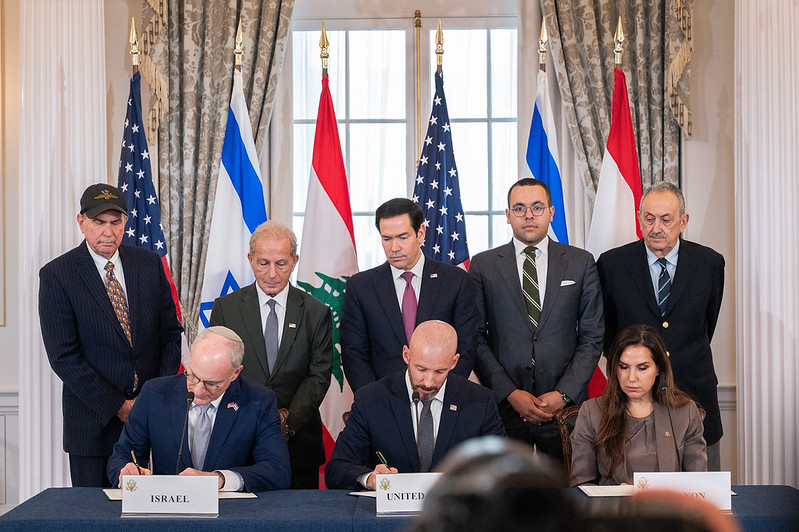


U.S. Secretary of State Marco Rubio oversaw the signing of a security framework agreement between Israeli Ambassador to the U.S. Yechiel Leiter and Lebanon’s Ambassador Nada Hamadeh at the State Department in Washington on Friday, June 26. The agreement outlined a preliminary security framework for the Lebanese Armed Forces (LAF) to occupy “pilot zones” in southern Lebanon and begin dismantling Hezbollah under the oversight of the Israel Defense Forces (IDF).
The bilateral talks between the two ambassadors were initially established by Rubio after the U.S.-Iranian ceasefire in April as a separate discourse to ensure that Iran would not have a place at the negotiating table in Lebanon. The talks were nearly derailed last week when the US-Iran memorandum (MOU) — now being negotiated in Switzerland — linked the cessation of hostilities in Lebanon to the U.S. peace deal with Iran.
The U.S.-Iran MOU’s allowance for Iran to dictate Lebanese affairs infuriated officials in Jerusalem and Beirut. Leiter and Hamadeh showed up to the fifth round of talks at the State Department on Friday hardened and on the defensive — neither of them willing to allow Tehran’s strategic maneuvers or the U.S.’s appeasement in Switzerland to dictate the security of their respective countries.
Leiter noted that because of Rubio’s leadership, they were able to prevent any Iranian inclusion. “Iran is out, Hezbollah is out, and the road to peace between Israel and Lebanon is in,” Leiter said.
But while the U.S.-Iran MOU is still being negotiated in Switzerland, Tehran and its proxies in Lebanon are insistent on nullifying the Washington agreement and using it as leverage to derail any further peace deals. “There’s a lot of work ahead. We don’t in any way underestimate the difficulty of the task ahead, but we understand the importance of it,” Rubio said, calling this just the “beginning of the beginning.”
The Israel-Lebanon agreement permits Israeli forces to remain in the security zone they established in southern Lebanon after the Iranian war last March and calls for the establishment of two “pilot zones.” The IDF will withdraw from these zones and transfer the territory to the LAF for disarming Hezbollah. The pilot experiment will determine if the LAF can demonstrate the capabilities of dismantling Hezbollah and assuming the responsibility of security.
Israel insists on maintaining its security buffer zone to ensure that southern Lebanese villages do not give a haven to Hezbollah and put them within firing range of northern Israel. Israeli troops from the 36th Division and the Commando Brigade continue to operate north of the Litani River with operational control of the strategic Beaufort Ridge. The agreement also grants the IDF freedom of action to respond to “immediate and emerging threats” from Hezbollah.
Despite this historic moment, support for the agreement is divided among political factions within Israel and Lebanon.
Officials in Israeli Prime Minister Benjamin Netanyahu’s government see this as a positive sign that Beirut is finally taking action to rid itself of Hezbollah and Iranian sponsorship. Others in Jerusalem are more skeptical, having endured decades of failed United Nations resolutions in the past that also mandated the Lebanese government and army to disarm Hezbollah, but to no avail.
In Washington, Hamadeh called the framework “the first step on the road to restoring Lebanese sovereignty and territorial integrity, securing a permanent and final cessation of hostilities, enabling our people to go back to their land and allowing all Lebanese to live in peace, security and prosperity.”
Beirut’s Maronite Christian Kataeb Party also expressed support for the agreement. “The Lebanese state has demonstrated that, when it negotiates on behalf of Lebanon and from its legitimate position, it is capable of securing the interests of the Lebanese people,” stated Kataeb’s representative in parliament, Samy Gemayel.
Lebanon’s President Joseph Aoun expressed his full support for implementing the agreement. Yet, with Hezbollah lawmakers and militants still deeply embedded in Beirut’s parliament and the ranks of the LAF, Aoun’s hands are essentially tied, giving Jerusalem reason to have little faith in diplomatic negotiations. “The state of Lebanon will not disarm Hezbollah,” stated Israel’s National Security Minister Itamar Ben-Gvir. “Hezbollah ministers are members of the Lebanese government and Lebanon cannot be trusted to take Hezbollah’s weapons … only IDF soldiers will destroy Hezbollah — no one else will do it for us.”
Beirut’s parliament speaker and Hezbollah ally Nabih Berri called the agreement an “incitement to civil war” between Hezbollah and the LAF. From a legal standpoint, Hezbollah politicians claim that the agreement violates the Lebanese constitution, which they interpret as saying that Zionism (i.e., Israel) is a threat to human dignity and must be eliminated. This allows Hezbollah to position Aoun’s government as illegitimate and a puppet of Israel and the U.S. Hezbollah’s ally and fellow Iranian proxy in Yemen, the Houthis, stated that “the Lebanese people have the right to overthrow this puppet government by any means possible.”
Hezbollah’s political leadership insists that the only ceasefire framework must be the U.S.-Iran MOU, currently being negotiated in Switzerland. Point One of the MOU calls for a cessation of fighting on all fronts, including Lebanon, and a respect for Lebanese sovereignty. Iran is using this as leverage to enforce an immediate and complete withdrawal of Israeli troops from all Lebanese territory. They are also insisting on the full implementation of Point One as a prerequisite for moving forward in negotiating any long-term peace with the U.S.
Iran wants the Israeli-Hezbollah conflict in Lebanon inseparably linked to the U.S.-Iranian ceasefire, but Rubio managed to sever this umbilical cord by brokering a separate agreement between ambassadors in Washington. As Netanyahu said in a press conference on Saturday, the agreement in Washington is essentially telling Iran: “This is none of your business. You have no status here, no involvement, and no role. Not you, not Hezbollah, not any terror group.”
What makes this agreement different from all failed ceasefire resolutions in the past is the absence of a U.N. or international peacekeeping force and the allowance of Israeli ground troops to remain in southern Lebanon for security oversight. While France and Italy have proposed a new multinational force to replace U.N. peacekeepers in Lebanon (UNIFIL) and assist in the agreement, there has yet to be any ratification of this in the Washington framework. The new Israeli variable could be the beginning of a new era of Israeli-Lebanese military cooperation against Hezbollah and ultimately a test of its collaborative deterrent strength in diminishing Iran’s involvement in Lebanon.
READ MORE from Bennett Tucker:
Israel’s War Objectives Challenged by US-Iran Negotiations
Missiles Fired at Northern Israel Break the Iranian Ceasefire