

As America marches toward its 250th birthday, a revival of CBS’s Bicentennial Minutes, the nightly Emmy-winning feature that aired from July 4, 1974, through December 31, 1976, would have been a scheduling coup on any and all media platforms.
For those old enough to recall, the Bicentennial Minutes was a one-minute historical vignette featured at the end of CBS’s primetime programming during the run-up to America’s 200th birthday. Each segment marked what had happened on that particular day “two hundred years ago,” turning America’s Revolution into a daily chronicle that was graceful and thought-provoking.
These historical snippets were born in a different America, yet they spoke to needs that remain painfully familiar. When the series began, the country was emerging from Watergate, Vietnam, and battling high inflation. Trust in institutions was low, and the national mood unsettled.
Yet every night for nearly two and a half years, Americans paused for 60 seconds to hear: “Two hundred years ago today…”
The Revolution wasn’t a mythic blur; it was a lived timeline reminding citizens they belong to something greater than themselves.
What made it powerful wasn’t its length, but its simple one-minute, one-narrator, one historical moment, delivered in primetime when tens of millions were watching. It was patriotic without being jingoistic, educational without being preachy, and unifying without being naïve.
That formula did something profound by anchoring the present to the past.
It reminded viewers that the American story was not a vague abstraction but a sequence of real days, real decisions, real people. The Revolution wasn’t a mythic blur; it was a lived timeline reminding citizens they belong to something greater than themselves. Placing that timeline inside primetime television, CBS made American history a shared civic experience rather than a private study. (RELATED: God and Man at the Revolution)
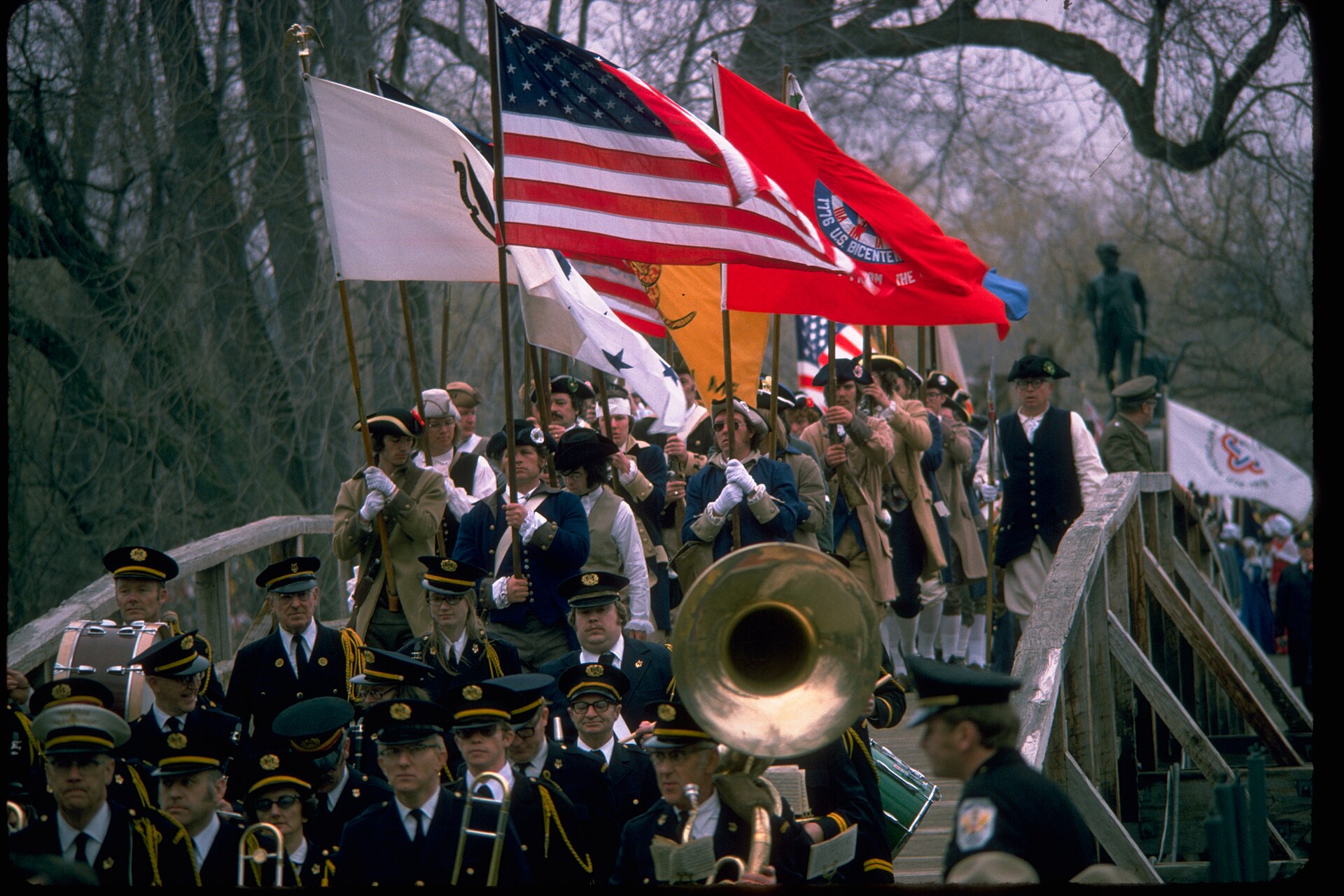
In 1976, the Bicentennial was a national celebration with parades, tall ships, reenactments, the Freedom Train, and a wave of patriotic symbolism. But the Bicentennial Minutes was the quiet heartbeat beneath it all: a daily pulse of historical memory.
Our public schools are turning out students who know less civics and history than their counterparts did 50 years ago. If ever there were a moment to reteach a nation its own story, this was it.
But it never happened. That’s tragic because the Bicentennial Minutes was memorable to a high school freshman in 1976, when the country still believed that knowing its past was essential to shaping its future.
Fast‑forward to 2026. The nation again finds itself fragmented and unable to agree on basic facts, let alone shared meaning. The Smithsonian’s historians note that the 250th anniversary is inherently plural, describing it as a “mosaic of perspectives,” not a single narrative. However, such a mosaic still needs plenty of grout.
Another Bicentennial Minutes message would have offered a shared civic touchpoint in a media landscape that no longer has very many.
In 1976, Americans watched the same four networks. Today, we live tucked away in algorithmic silos. A modern Minute broadcast on television, radio, streaming platforms, and social media would have cut across those divides to create a communal moment.
Moreover, it would have reframed patriotism as a reflection rather than a performance. It would be a daily reminder that the American experiment has always been contested, unfinished, and worth examining.
The Revolution was a long, uncertain, improvisational struggle underscoring that national identity is not fixed; it is built, argued over, and renewed.
The Bicentennial Minutes did not lecture or moralize. It offered a tranquil, factual, and reflective tone, which is rare in today’s media landscape. It was a reminder that history is not something we visit in museums but something we inhabit daily.
With Americans again searching for common ground, readopting a Semiquincentennial Minute would have provided exactly that.
One minute daily is no heavy lift. But in a divided country, it might have been enough to remind Americans that they still share a story.
After all, the next chapter is ours to write.
READ MORE from Greg Maresca: