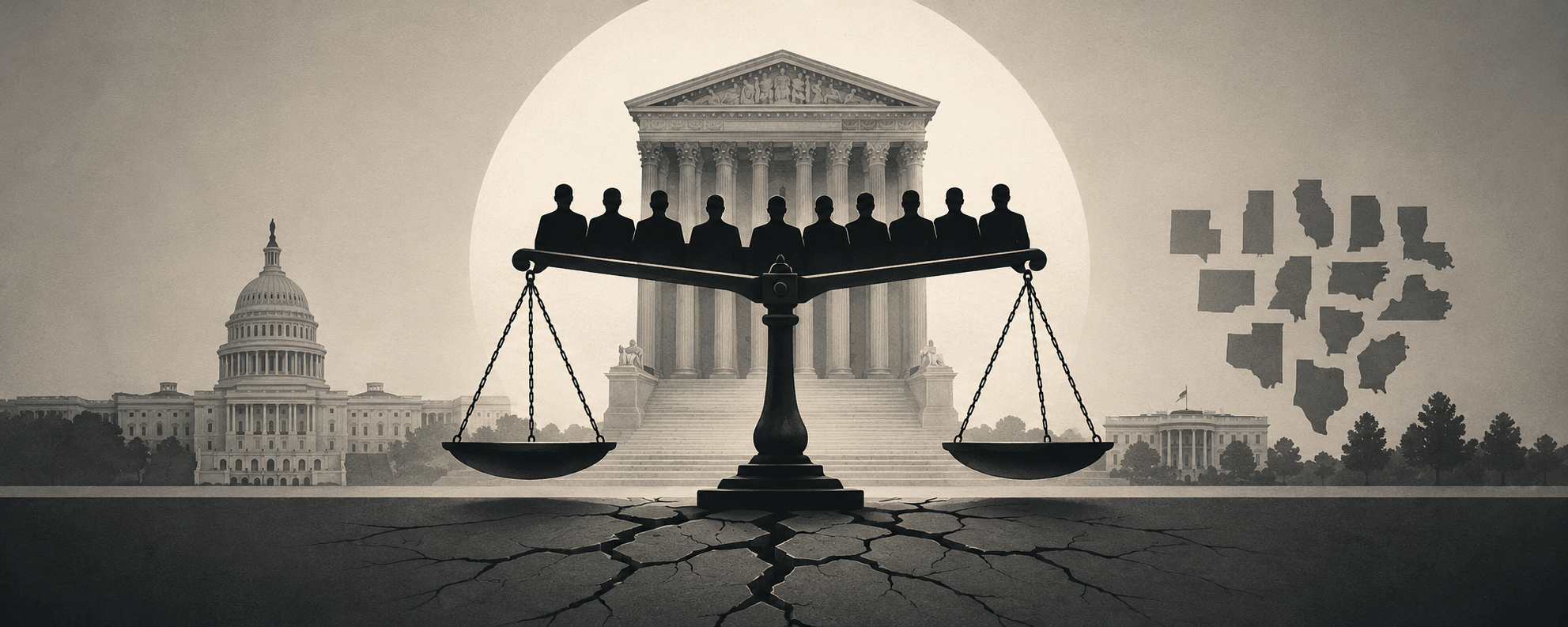


It is astonishing how many Americans have been misled by the progressive law school fable that the Supreme Court is somehow above politics and should be placed at the apex of federal power as the final interpreter and owner of the Constitution—at least as long as progressives have a majority of justices!
Sarah Isgur’s new book, Last Branch Standing, is an excellent example. But in this case, Social Sciences Dean at Hillsdale College, Paul D. Moreno, challenges the progressive myth in an excellent review. While giving her credit for recognizing that in fact the current Court is not led by some dominating conservative majority but is divided between three factions: 3 progressives, 3 moderate conservatives, and 3 conservatives — he goes to the heart of the matter.
Isgur is too prone to take contemporary judicial supremacy for granted. In her historical overview of the Court, she asks, “How did we end up with this Supreme Court — unique in the world — and perhaps the only one of the three branches that our Founders would recognize today?” In fact, it’s no longer unique in the world, and it is emphatically not the one that the Founders would recognize. I’d say that no feature of today’s current political system would surprise them more than judicial supremacy.
In fact, Moreno continued, “the belief that the Court had the last word in constitutional interpretation is a relatively late development. It was not until 1958, in Cooper v. Aaron, a school-desegregation enforcement case, that the Court overtly stated that its interpretation of the Constitution was as much the ‘supreme law of the land’ as the Constitution itself.”
In that same era, my generation was specifically taught by Yale University’s Robert Dahl’s sophisticated empirical analysis that scores of Supreme Court decisions had actually been overridden by Congress over the years. More recently, the Civil Rights Act of 1987 even overruled the Supreme Court’s Grove City v. Bell civil rights decision by name.
President Andrew Jackson not only refused to enforce the Supreme Court’s Worster v. Georgia decision but also specifically argued that all three branches equally interpret the Constitution. As Moreno also noted, even Abraham Lincoln questioned whether the Dred Scott decision was Constitutional as early as 1857. Lincoln led a Civil War to overrule this Supreme Court ruling with his Emancipation Proclamation, which was confirmed by the 13th Amendment.
It is no secret that with the coming of Wilsonian Progressivism, the New Deal, and the Great Society, things changed radically in favor of judicial supremacy. Progressive Supreme Court leaders like Earl Warren, William J. Brennan Jr., William O. Douglas, Louis Brandeis, and Thurgood Marshall led the way and were incredibly successful in nationalizing law, policy, and power over states’ rights.
Even with today’s moderate judicial retreat from that earlier legal progressivism, some right-leaning intellectuals like Ramesh Ponnuru have argued that today’s court has moved back too far toward states’ rights. Ponnuru recognized that some state government policy conflicts with Washington “are inevitable and perhaps even healthy in our system.” But at the end, he argues that national “rules must restrain those conflicts so that they do not undermine important national goods.” Ponnuru argues that today’s Supreme Court justices have become less and less willing to enforce limits on the states. These “have read the specific rules narrowly and are moving toward a version of the dormant commerce clause that stops only those policies that explicitly target other states’ economies.”
Today’s conservative judges are simply considered “skeptical of restrictions on the states.” Those justices “committed to originalism” believe that “laws should be interpreted as the public understood them at the time they were enacted.” Many even believe that the whole 20th-century interpretation of the commerce clause is simply “not in the text of the Constitution,” nor can the document explain how to interpret it.
These originalists, of course, are Justices Neil Gorsuch, Samuel Alito, and Clarence Thomas; and to a lesser degree, Brett Kavanaugh, John Roberts, and Amy Barrett. These are the more conservative judges who believe they are simply reversing what they consider were the extreme progressive court interpretations of the 20th Century. They particularly objected to courts moving from narrow interpretations of “procedural due process” into a much broader “substantive due process” that dramatically increased national power and limited 10th Amendment rights.
The right critics justify a broader view of due process as necessary for free markets and commerce. While substantive due process originated there, the drastic increases in Washington’s power over states more recently have limited state social policy powers — on issues such as marriage and the family, raising and educating children, on contraception and reproductive choice, on sexual privacy, on intimate relationships, and on abortion rights procedures — none of which have a national basis in the Constitution except by judicial fiat.
As Moreno noted, Justice Clarence Thomas’s 2022 concurrence in Dobbs suggested that much more needs to be done for a wholesale reconsideration of the Court’s 20th-century rush from its original, limited Constitutional procedural interpretations into vague and too broad substantive misinterpretations, creating new “rights,” often resulting in much of today’s social disorder.
In fact, from the very beginning, the Constitution has been a separation of powers instrument in which each of its five institutions — legislative, executive, judicial, states, and amendment — divides powers and rights where no institution has the final word and can challenge each other. Congress can pass new laws, states can mitigate and pass amendments, and the executive can interpret through enforcement actions to mitigate legal decisions.
But for the last half-century or so, the courts have overreached their powers, and it has taken the other institutions time to slowly create the conditions for a federalist rebalance more consistent with the original Constitution.
The way back requires interpretations and policies more consistent with the decentralized and balanced federalism that was built into the actual Constitution.
READ MORE from Donald Devine:
The Declaration, the Constitution, and the Consent of the Governed
Can Liberty Survive Without a Soul?
Forthcoming Ideological Battle on the Right?
Donald Devine is a senior scholar at the Fund for American Studies in Washington, D.C. He served as President Ronald Reagan’s civil service director during his first term in office. A former professor, he is the author of a dozen books, including his most recent, Thinking About Freedom and Tradition: Understanding the Philosophers Who Make the Case for Western Civilization; The Enduring Tension: Capitalism and the Moral Order; and Ronald Reagan’s Enduring Principles; and is a frequent contributor to The American Spectator.