
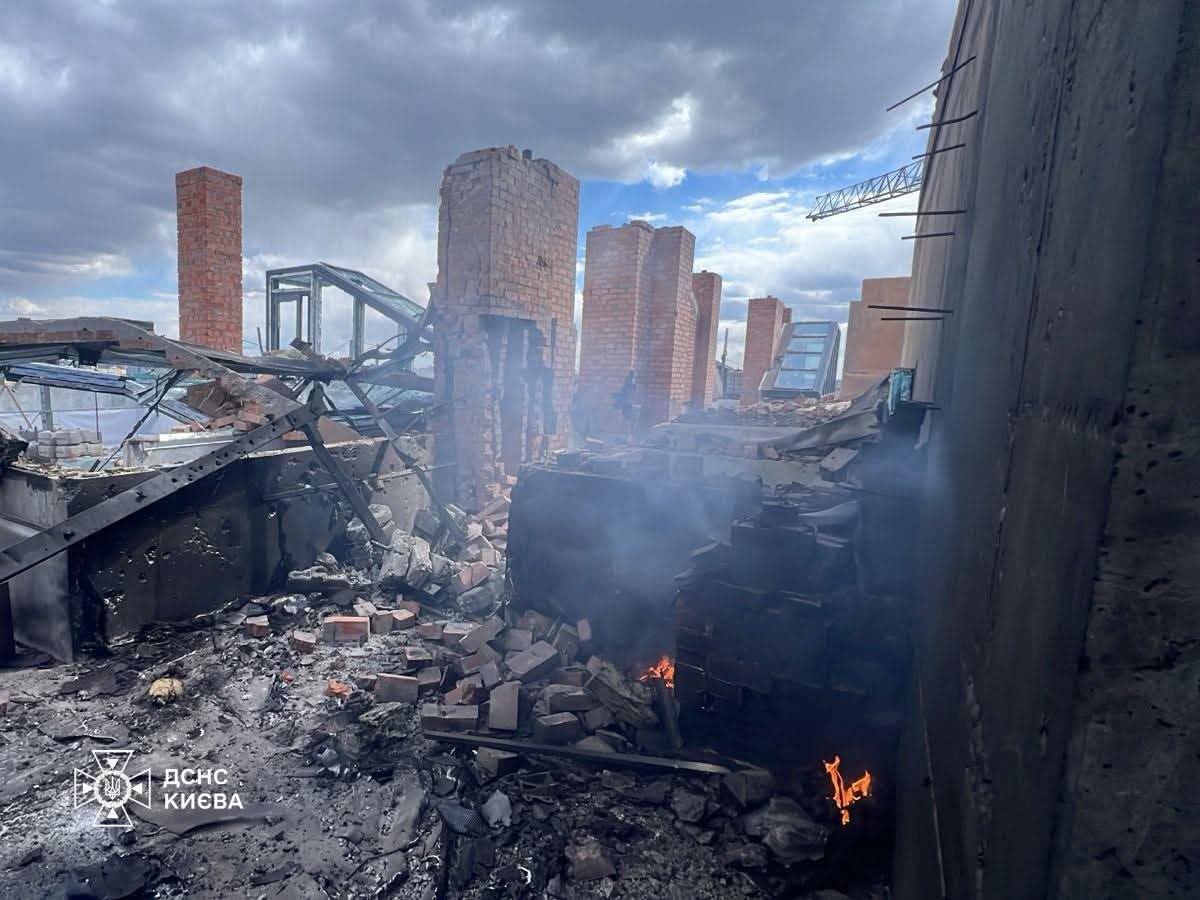


Russia and Ukraine exchanged devastating missile and drone strikes on each other’s capitals last week. Ukraine dazzled the world with its onslaught of jet-powered drones over Moscow, which destroyed the city’s main oil refinery, but Russia also demonstrated that despite Western sanctions and consistent drone strikes on key industrial facilities, it’s managing to produce a growing arsenal of ballistic and cruise missiles with improved precision, targeting, and guidance systems — which could be shared with Iran.
On the night of Monday, June 15, Russia launched almost 700 drones and missiles on Kyiv and the cities of Kharkiv and Dnipropetrovsk. There have been larger barrages in the past. But analysts noted an unexpectedly large number of ballistic and cruise missiles, numbering 70 in total with enhanced capabilities for evading Ukrainian air defenses and striking with great precision at often concealed production facilities for drone and electronic warfare, on which Ukraine’s overstretched army now mainly relies.
The target list, according to Russian sources, included: The Kyiv Radar plant JSC which develops and manufactures long-range UAVs and radars, a UAV production facility operating under the cover of the A.P. Dovzhenko film studio, the Bespilotnye Tekhnologii LLC assembly plant for long range UAVs that receives foreign components, the Mayak Plant JSC that produces UAV warheads and propulsion engines, the Burevestnik plant that produces long- and mid-range UAVs and radar systems, the Nova Poshta Innovation Center which stores and distributes dual use products used to produce UAVs, robots, and electronic warfare systems, “Greenhouse Solutions,” DT-1 Group LLC and PJSC Electromechanical plants which produce UAV warheads.
Ukrainian officials claim that most of the Russian missiles were brought down by air defense systems, but according to independent accounts, a large number hit their target, with only 15 intercepted. Phone video footage clearly shows several major impacts around Kyiv, indicative of high payload missile strikes.
Ukrainian authorities typically cordon off zones hit in major strikes, censoring damage reports except those concerning civilian targets and casualties to serve narratives highlighting Russian atrocities. President Zelenskyy denounced damage to a historical Russian Orthodox Church in Kyiv, which may have been hit by a drone, missile debris, or possibly stray air defense interceptors. But TV crews managed to film the blazing Nova Poshta warehouse complex outside Kyiv, mentioned in Russia’s target menu, identified as a reception center for drone components from Europe.
Russian officials have been clear about their objectives. Foreign Minister Sergei Lavrov told U.S. Secretary of State Marco Rubio in a recent phone call that Russia was “beginning systematic and consistent strikes on facilities in Kyiv used for the needs of the Armed Forces of Ukraine, as well as on the centers where the relevant decisions are made.”
Lavrov doubled down on the threat following Ukraine’s Thursday counter-attack in which a swarm of 1,000 drones hit Moscow’s main oil refining complex, crippling the capital’s fuel supply and causing a massive cloud of smoke that produced black rain.
“We will now conduct massive group strikes on a regular basis against targets whose condition directly affects the combat readiness of the Ukrainian Armed Forces,” Lavrov said.
Russia has been expanding its missile production with perfected guidance systems and counter-measures to deflect air defense missiles, according to a report by the Institute for the Study of War.
“Russian forces are increasing the production rate and modernization of their ballistic missiles and drones,” Chief Researcher of the Ukrainian State Research Institute for Armament Testing and Certification Colonel Oleksandr Zaruba reported on June 13. He reported that Russian forces are producing between 40 and 50 Kh-101 cruise missiles, between 60 and 70 Iskander-M ballistic missiles, and around 10 Iskander-K cruise missiles monthly as of spring 2026. Zaruba noted that Russian forces are integrating technical solutions from the North Korean KN-23 ballistic missile into the Iskander-M ballistic missile to increase production. Zaruba noted that Russian forces doubled the payload weight of Kh-101 warheads and modernized them to be harder for Ukrainian forces to detect and intercept. Zaruba stated that Ukrainian forces observed Russian Kh-101 missiles with automatically activated thermal decoys and chaff that disrupt radar systems during the recent strikes on Kyiv and noted that the missile has a terrain navigation system that scans terrain to increase strike accuracy. Zaruba stated that Russian Iskander-M ballistic missiles have updated countermeasures that imitate the missile’s signature to overload Ukrainian radars. Zaruba assessed that Russia is creating a new version of the Iskander-M called the Iskander-1000 with a range of up to 1,000 kilometers.
Col. Zaruba also remarked that “Russia is working on launching drones from tactical fighter aircraft to make it harder for Ukrainian air defenses to detect them during strikes up to 1,000 kilometers in depth.” Russia has managed over recent months to increase production of its high-performance Su-35 fighters and is soon expected to deploy fifth-generation Su-57s, roughly equivalent to the U.S. F-35 stealth fighter. Russia is also expected to engage in wider use of its newly developed multiple warhead intermediate-range Oreshnik ballistic missiles, which until now have been in experimental phases and used sparingly in only a few attacks.
Ukraine has no match for these weapons systems. Its military industries have been prolific and highly creative in producing a wide range of combat drones that are tearing into Russia’s battlefield logistics and oil industry with deep strikes behind the front lines and into Russian territory. Ukraine is also beginning to turn out significant quantities of domestically produced Flamingo cruise missiles, based on the British Storm Shadow. But ballistic or hypersonic capabilities remain out of Kyiv’s reach without U.S. technology transfers, which the Trump administration is likely to reject.
After years of pleading, Zelenskyy may finally obtain permission to produce U.S. Patriot air defense missiles in Ukraine. At the G-7 meeting in France last weekend, Trump said he would consider granting the necessary licenses.
The ISW also notes that, “available information suggests that Russia’s monthly missile production surpasses the U.S.’s monthly PAC-3 Patriot air defense interceptor missile production.” Patriots and similar systems produced by Germany and Norway have a limited effect against ballistic missiles. U.S. Terminal High Altitude Air Defense systems that are reliably accurate against incoming ballistic missiles are very expensive and in short supply, following their recent deployment to Saudi Arabia and the Arab Gulf states, where at least one THAAD network was destroyed by Russian-assisted Iranian strikes.
Whether Russia’s growing missile force can significantly degrade Ukraine’s UAV capabilities may determine the outcome of the war. Aside from domestically produced drones projected to reach 7 million this year, Ukraine receives massive supplies from NATO allies. The UK has just pledged delivery of 150,000 middle strike drones required in ever greater quantities for Ukraine’s current air offensive to cut off Crimea from Russia. Drone attacks averaging hundreds per day are targeting vulnerable bridge and railway connections to the peninsula running through occupied parts of southern Ukraine.
“Crimea is being isolated by drones. In the near future, it appears that the Crimean Peninsula will turn into an island,” said Ukrainian defense minister Mykhailo Fedorov. An average of 400–500 Russian logistical vehicles are being destroyed weekly along the Russia-Crimean corridor. But Ukraine’s intelligence chief recently stated in an interview that North Korea is replacing Russia’s equipment losses. “We track deliveries of vehicles and arms from North Korea and note corresponding intensifications of Russian operations,” he stated.
Massive supplies of drones are also required to hold back Russian advances in Kostyantynivka, the southern point of the Donetsk “Fortress Triangle.” There are conflicting reports about the degree of Russian penetration of the city in an intensifying summer offensive. According to Ukrainian military officials, Russia has managed to infiltrate up to 250 men into the city center, where they are taking positions in buildings and ruins as more groups crawl up through streets and maneuver to envelop the city along its flanks. Ukraine’s undermanned army will be relying heavily on aerial drones and ground robots to hold them back, requiring high levels of steady production to supply front-line forces.
Russia’s revamped missile technology could also find its way to Iran for IRGC efforts to rebuild its ballistic missile capabilities during the sixty-day cessation of hostilities negotiated with President Trump, which omits any reference to missile rearmament.
Iran is already rebuilding its missile and drone capacity and will be using the financial windfall it gets from the deal to acquire more of the weaponry, a Kuwaiti defense analyst has told the New York Times. As the Memorandum of Understanding was being negotiated with Trump, Iran was signing MOUs with Russia to acquire various types of military hardware, including Mi-171 heavy lift helicopters equipped with rocket pods and Su-35 fighter aircraft. Missile components and software could be easily smuggled as part of the package.
READ MORE from Martin Arostegui:
Cuba Is Prepared to Be a Second Iran
Ukraine Is Making Putin’s Life Miserable in Africa As Well
Moving Ahead on the Iran Front
Image licensed under Creative Commons Attribution 4.0 International.





















