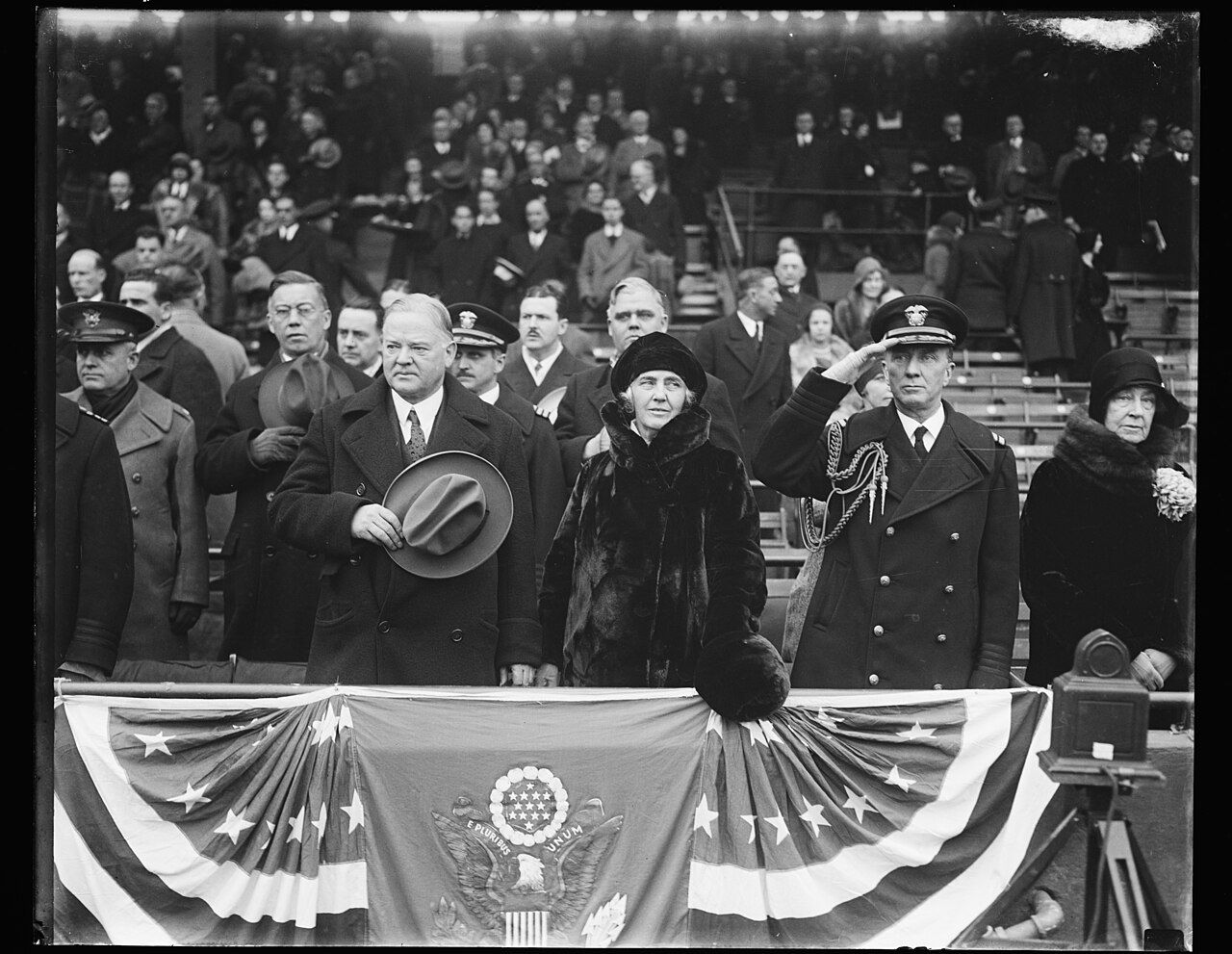


Herbert Hoover’s appreciation for the principles of the American founding was shaped from an early age. He recalled that as a young boy, his “first paid job” in West Branch, Iowa, was “picking potato bugs at one cent a hundred,” and his wages went to “secure firecrackers with which to commemorate properly the Declaration of Independence.”
Hoover described the American founding as the “American System.” He had a strong sense of American exceptionalism and never tired of defending the “American System” and what he described as the “Ark of the Covenant” of our liberty.
“The founders of our republic under Divine inspiration” established a “great political system,” which is “unique in the world,” argued Hoover. However, Hoover understood that principles of the Declaration of Independence and the Constitution were based upon heritage.
“God has blessed us with another wonderful word — heritage,” affirmed Hoover. Further, Hoover noted that the “great documents of that heritage” were “the Bible, the Declaration of Independence, and the Constitution, within them alone can the safeguards of freedom survive.”
Both Christian faith and the English constitutional heritage were foundational. “When our nation was founded, it drew its strength and being not only from great political and social truths, but from spiritual convictions from a deep and abiding faith in Almighty God,” proclaimed Hoover.
In addition, he argued that it was this Christian foundation, which led to the “pronouncement of the dignity of individual men in the Declaration of Independence, that is, men are ‘endowed by the Creator with certain unalienable rights’ upon which not even the government may infringe.” Hoover reminded Americans that their rights and liberties did not come from government, but from God.
“Our Founding Fathers did not invent the priceless boon of individual freedom and the respect for the dignity of men. That great gift to mankind sprang from the Creator and not from the government,” stated Hoover.
Hoover argued that the Founders “knew well the centuries of struggle in which men had died fighting bitterly” for liberties. “Step by step they had been secured through the Magna Carta, the growth of the common law, the Petition of Rights, and the Declaration of Rights, until they reached the full flower in the new republic,” stated Hoover in describing the influence of England’s constitutional heritage.
In February 1933, President Hoover, in a ceremony to lay the cornerstone of the National Archives building, stated that “this temple of our history will appropriately be one of the most beautiful buildings in America, an expression of the American soul.” Hoover was not just referring to the architecture of the building, but the contents inside.
“Further, there will be aggregated here the most sacred documents of our history, the originals of the Declaration of Independence and of the Constitution of the United States,” noted Hoover.
In the cornerstone, Hoover placed copies of the Declaration of Independence, the Constitution, and an American flag, among other items. The National Archive would not only preserve “all the other records that bind State to State and the hearts of all our people in an indissoluble union,” but also would “be one of the most durable, an expression of the American character.”
Hoover understood that no system of government or country could be perfected, but he argued that the United States could navigate and “solve our complex problems” by adhering to the principles of the founding.
“The bricks must come from the mold of religious faith, of justice, of integrity, of fidelity to the spirit of the Constitution. Any other mold is distorted; any other bricks are without straw,” stated Hoover.
On this 250th anniversary of the Declaration of Independence, let’s follow Hoover’s wisdom and begin to rebuild our faith in and look to those sacred principles for national renewal. As Hoover stated, the nation “really needs nothing more to revive again hope in a frustrated people.”
READ MORE from John Hendrickson:
Governor DeSantis Offers a Reminder on Fiscal Conservatism
Coolidge’s Heir in the Heartland
John Hendrickson serves as Policy Director for Iowans for Tax Relief Foundation.