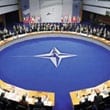
The core element in the American relationship with Europe is
membership in the North Atlantic Treaty Organization. After
President Barack Obama's recent trip to Europe it is not
unreasonable to inquire as to the relevance of that organization
to U.S. military and political interests.
Often quoted has been the justification for NATO in Europe given
by its first Secretary General, Lord Ismay: "to keep the Russians
out, to keep the Americans in, and the Germans down." It doesn't
appear to be working anymore.
The Russians have thoroughly penetrated West Europe as their
major supplier (controller) of energy. The Germans are calling
the tune when it comes to both European economic and military
matters. And the United States has proven itself to have little
in common with continental Europe other than near total failure
of memories of past glories and obligations therein. The concept
of "an attack on one is an attack on all" has aged to the point
of atrophy.
The European Union's new defense structure already has intimated
what the future will be as it now has an established claim on the
NATO military organization's assets if the latter doesn't want to
use them. All that NATO has now is a so-called "right of first
refusal." If that isn't a planned redundancy, it will have to do
until the new De Gaulle or perhaps Bismarck comes along. NATO's
28 member countries, 22 partner countries, 43 different agencies
and organizations plus 9 logistics bodies and 5 production bodies
appear formidable in theory. In practice it is little more than
an expensive bureaucracy.
The original purpose of NATO in 1949, with apologies to the
brilliantly cynical General Lord Ismay, was to convert the WWII
alliance of Western European nations into a similar grouping to
check the post-war Soviet expansion to the west. The North
Atlantic Treaty Organization has been the center of American
relations with Western Europe ever since. President Obama's
recent trip to Europe has clearly shown exactly how little that
relationship is now worth.
In simple terms, the arithmetic of American relations with West
Europe -- conspicuously excluding the United Kingdom -- is as
follows: Taking serious additional steps to stimulate the EU
economy so that it might increase its capability to assist the
rest of the world economy -- Zero! Acceptance of a fair portion
of NATO's obligation in Afghanistan -- Zero! Support for
strengthening of economic sanctions on Iran condemning their
nuclear weapon development -- Zero!
In fact, the entire basis for continued American participation in
NATO may have been undercut. Attempts to broaden NATO's role have
failed or simply been subsumed in the ambitions of the European
Union that instead of wanting the United States as an ally views
its onetime champion as a competitor.
In spite of U.S./UK efforts to drag NATO along with them in
Bosnia, Iraq, and now Afghanistan, the results have been either
negative or marginal at best. NATO may have some basing
advantages for U.S. forward defense posture, but in terms of
being an active military participant alongside US/UK forces, the
major powers in the European Union no longer see a profit.
NATO came under attack during the Clinton years and was strongly
defended by high profile generals. The thesis of the American
defenders of NATO was based on the perception of both the need
for and ability of the United States to maintain a special role
in Europe in the newly post-Soviet period. There was a logic to
that argument then, but that logic is now strained.
An oft-repeated defense of American continued military
participation has been to suggest the value to the U.S. of the
political leverage afforded by maintaining its physical presence
in Europe. This certainly has not turned out to be the case with
Germany, where the American military long has had its largest
continuing presence.
The current situation is as follows: There is no doubt the
Russians would love the suspension of NATO; that in itself could
be reason enough to keep it going. The reality, however, is that
the ineffectuality of NATO negates its value as an instrument of
American policy and severely diminishes its military worth to the
United States.
The solidarity of NATO has been severely weakened and its
viability as an effective military alliance has been endangered
by European popular political indifference. The United States
soon must ask what is in it for the American people.
About the Author
George H. Wittman writes a weekly column on international affairs for The American Spectator online. He was the founding chairman of the National Institute for Public Policy.
How about its status as the most successful military alliance in
human history?
How about the fact that although W looked into Putin's eyes and
saw he had a good soul, the Russians seem perpetually nostalgic
about the good old days when it was the US vs the SU?
Maybe we should just break all alliances and agreements and try
to go it alone?
That's always worked so well for us in the past.
SLG| 4.17.09 @ 11:56AM
Just like the UN, NATO has become a supercilious "debating
society" of a sort It’s neither equipped nor organized to
cooperate and fight. Germany, Italy and Spain, among others, have
reached a state that can only be called unilateral disarmament.
NATO fight against terrorism? Doubtful -- unless the EU members
are willing to multiply their defense expenditures by a factor of
ten and sustain them at that level for at least a decade, NATO is
nothing more than a hollow shell.
The 2,000 soldiers who constitute the Italian detachment in
Afghanistan seem to be using the “kinder, gentler approach;
they’re barred by their government from actually fighting (so why
are they called soldiers?) in combat – so they “listen to
residents’ problems, offer food and medical care,“ ad
nauseum.
Than -- I recall reading where France, under De Gaulle, pulled
out of NATO as a gesture of gratitude, after we had
saved-their-bacon once again - - and our United States (innocent
to the last) hung in. Until, finally, the Berlin Wall came down
and we were, truly, not needed any longer. NATO was irrelevant --
a mere social club that existed as an excuse to maintain a
headquarters and conduct lavish conferences. This point was most
emphatically driven home when a genocidal conflict erupted on
Europe's flank, Kosovo, and NATO -- Europe -- couldn't manage a
response….
The next-to-the-last brief paragraph said it all.
To do otherwise is sheer stupidity, dumbness!
Martha Francois| 4.17.09 @ 2:48PM
All treaties should be evaluated periodically -- to see if they
are adequate to present needs, if the treaty partners have
performed as promised and so forth.
NATO is a defensive treaty, entered into in our interest and in
the interest of Western Europe. Much has changed since then
(1949). My suggestion and hope (but not my expectation) is that
NATO be re-examined in terms of America's present needs and
interests. We should not be in Western Europe defending them from
high gas prices imposed by the Russians. They need to respond to
that themselves and it is no threat to us. The areas of Europe
that are threatened today are the areas that were behind the Iron
Curtain when NATO was established -- the Warsaw Pact countries. I
think we should negotiate for bases and facilities in Poland,
Hungary, Ukraine, Georgia to name a few, and at the same time
inform the Europeans that given the great success of NATO under
our leadership in protecting Europe from the Soviet Union, and in
fact bringing down the Soviet Union, we are now withdrawing from
NATO and removing our troops from Western Europe. We no longer
want them to languish under the burden of occupation. I think the
Obama administration should go for this -- after all, he wants to
withdraw from Iraq in the next year or so based on the situation
on the ground. Based on the situation on the ground in Western
Europe, isn't it time we withdrew from there?
If we could do that, we might then have the backbone to withdraw
from the UN -- I don't know if we are in there as a result of a
treaty or what -- and form one or multiple alliances with other
democratic nations.
I know this won't happen in my lifetime, but it's a nice dream.
JP| 4.17.09 @ 3:31PM
Tom Paine,
Exactly why would you call NATO the most successfull military
alliance in the world? It wasn't NATO that defeated the USSR, but
the US's ICBMs and promise to launch a missle defence system. To
which, Europe was against. When it counted, only the UK and
Thatcher backed Reagan. But that was in the context of our
relationship to the UK and not NATO. West Germany and France
backed Reagan only reluctantly and were totally against us
deploying the Pershings there.
NATO has meant only one thing to Europe -money. Europe saved
trillions from 1949-present, and invested thier savings in thier
eleaborate social welfare state. Meanwhile, the US now spends
over $100 billion a year in Europe (it was even higher during the
Cold War when 7th Corps and a beefed up Air Force presence was
there).
L. Ross| 4.17.09 @ 5:05PM
JP, I agree with you completely. American muscle in NATO has
allowed its other member countries to regress to an infantile
state regarding their own defenses. Brittain's military is OK,
but probably not as powerful as the military forces we have in
California alone. As far as the forces of France, Italy, Spain,
Portugal, Turkey, etc., etc., etc., they are all on life support,
hoping that no one pulls the plug. Germany may be the big boy on
mainland Europe, but even they have allowed their strength to
crumble away. Meantime, they have enacted cradle to grave
socialist societies, paid for with savings from not covering
their own defense. How many Americans get 6 weeks of vacation a
year and lobby for a 32 hour work week. Welcome to France, baby.
Let's put it another way. If NATO pulled out of all our recent
conflicts, Gulf War 1, Bosnia, Gulf War 2, Afghanistan and more,
if NATO never partcipated in any of those actions, from a
practical standpoint, could anyone tell a difference? What is the
biggest benefit of NATO for the US forces? It gives us a nice
place to visit in Europe cheap. Not quite the return on the
dollar that I think we deserve.
Xenophon| 4.17.09 @ 7:16PM
Europeans contemptuously refer to Americans as "cowboys". Fine.
Let them herd their own cattle. Who cares who dominates that pile
of socialist museums?
Paul Crowley| 4.18.09 @ 10:54AM
=>"Is there any reason to keep NATO going?" [The American
Spectator homepage]
The questions are:
WHY is NATO being kept going?
WHY Was NATO kept going?
Has there EVER been a good reason "to keep NATO going" since the
end of the Cold War (1946-89) was declared by G.H.W. Bush and
Gorbachev in 1989?
Or SEATO, or the EEC (become the EU) or any of the Cold War
organizations and economic alliances established as tactics to
facilitate the strategies of containing (1948-79) and then
defeating (1980-89) Marxist Russia?
Seriously. Obama’s actions in Europe are irrelevant.
The question itself is somewhat irrelevant, since France just
returned after being out of NATO for about 43 years, NATO just
celebrated its 60th anniversary, TWENTY years after the end of
the Cold War.
The question is WHY is NATO being kept going?
Paul Crowley| 4.18.09 @ 11:08AM
More the point:
What is going on?
What is the purpose of all of this?
What are the so-called “U.S. interests” that drive the American
government’s policies and decisions?
WHO has determined these "U.S. interests?"
[it sure hasn't been "We The People," except as the menial labor
force].
Is there a strategic goal of some kind that all of these tactics
are being employed to work toward?
Since American domestic policy has been formulated in accordance
with American Foreign policy (developed by the departments of
Defense and State, and set via the National Security Council and
Joint Chiefs of Staff, in the name of the President), for the
past 76 years, and especially the past 63 years, then these
aren’t minor questions.
[Ok: Defense and State departments: The former was departments of
War and Navy until 1947; the Combined Chiefs of Staff, 1941-47;
Department of Defense, Joint Chiefs of Staff, since 1947; and the
National Security Council since 1947]
Paul Crowley| 4.18.09 @ 12:57PM
=>“Let's put it another way. If NATO pulled out of all our
recent conflicts, Gulf War 1, Bosnia, Gulf War 2, Afghanistan and
more, if NATO never partcipated in any of those actions, from a
practical standpoint, could anyone tell a difference?” [L. Ross|
4.17.09 @
5:05PM]
Hi L. Ross:
This is exactly right, where troops and equipment are concerned.
I used to have the same phrasing for the Cold War era (1946-89).
( Korea, Vietnam, the Persian Gulf Expedition. . . )
Those troops of our “allies” who did take part, did no less, as
individual men, then Americans.
HOWEVER, if the troops of our “allies” hadn’t shown up, then it
wouldn’t have mattered.
If we Americans had not shown up, then NOTHING would have been
possible (From the Korean War to the Formosa Strait Crises to the
Vietnam War to the Persian Gulf Expedition. . . ).
I don’t agree with you about the Brits, at least not entirely,
since it sounds like our thinking may be close.
The Brits don’t provide nearly as much as they tend to take
credit for.
They also get tremendously more than the tiny bit they
contribute. They get cadres of experienced officers and command
and operations experience that they could never receive by
themselves, by assuming command of ‘joint’ task groups and such.
. .
In Vietnam the Brits provided only a TINY contribution: The
Aussies and New Zealanders.
Aussies bring very little in men and materiel, but massive
amounts of running-off-at-the-mouth and arrogance.
If Talk was a military, then the Aussies would have conquered the
world, long ago.
As it is, they depended entirely on American air and naval forces
just to transport their small expeditionary force for their
recent grab of Timor.
In ‘84 in Bahrain, we had a couple of drunk Brit sailors, off the
token ship of our “allies,” were running off at the mouth, asking
us where were we during the Falklands War?
I looked ‘em in the eye and said:
‘Where were we? We were refueling and re-supplying your ships, or
else your navy, such as it is, wouldn’t have been able to make
the transit from the north to the south Atlantic, and we were
supplying you with satellite intelligence. . . What the $#%*
-H##L more did you want us TO GIVE YOU? A Real Navy, and the men
to man it, so as to fight your
NOTHING little war for you?’‘
There was no fight. Shore patrol was kept in the little club were
this took place, and moved in quick.
To hell with the loud mouth, obnoxious Brits!
The Brits, French and Spanish rotated their contributions to the
Persian Gulf Expedition, providing ONE warship every so often to
the American carrier task group on station in the Arabian Sea,
and the four-five picket ships in the Gulf, 1979 onward, (two
carrier groups about 1980 onward).
Again, their sailors, as men, did no less than ours.
But if they hadn’t shown up, then it wouldn’t have mattered.
If we hadn’t shown up, then there would have been no expedition
at all.
Paul Crowley| 4.18.09 @ 1:04PM
=>“What is the biggest benefit of NATO for the US forces? It
gives us a nice place to visit in Europe cheap. Not quite the
return on the dollar that I think we deserve.” [L. Ross| 4.17.09
@ 5:05PM]
Hi L. Ross:
This I obviously disagree with.
LOGISTICS.
The NATO countries are critical to the logistical support of the
American military overseas: Industrial production and processing
and Advanced Bases. . ..
This is especially true in the advance into eastern Europe,
Africa, the Indian Ocean and
south-central Asia.
The same with the Japan and the SEATO countries, which also
provide a large proportion of military forces.
As I said before, Americans don’t “Support Our Troops,”
literally.
For what it's worth, in the event of a general war, centered in
Asia this time, then I don't believe that American ground forces
will be doing the primary fighting. That will be for the Asians,
who now have the militaries to do so.
Soon enough, the Lines of Communications, in the military sense
of the term, will be sufficient to make such a war possible, for
the first time in modern history.
Christopher J Ward| 4.19.09 @ 7:18AM
I'm with you Paul Crowley: this argument is flawed, mis-timed and
out of whack with reality.
Edwin Harwood| 4.19.09 @ 8:26AM
Although I believe the U.S. should continue to cooperate with
European law enforcement agencies in trying to prevent terrorist
attacks by Islamic and other fanatics, we should no longer belong
to NATO. Europe is unwilling to fund its militaries and, in the
case of Germany, unwilling to actually put soldiers in harm's
way. I cannot imagine that the U.S. would send a large military
force back to Europe to "protect" Europe against an emerging
threat of Eurasia or the Middle East. Europe's values are no
longer congruent with American values. We need to redirect our
military alliances to the Far East, as a Pacific Power, and also
try, if possible, to maintain the flow of oil from the Middle
East. But what is the point in trying to protect Europe, when
Europe will not fund its own defense?
Paul Crowley| 4.19.09 @ 12:28PM
In fairness to western Europe and the Brits:
I’ve noted that for at least the nine years or so, a NATO or
Canadian warship is now routinely attached to each of the
American Carrier Task Groups (A.K.A. Battle Group).
American-Japanese-Western Europe Finance is all intertwined and
western Europeans have been taking up the bulk of the burden of
‘developing’ post-Cold War eastern Europe over the past 20 years
since the end of the Cold War.
This theme is similar to the one decrying Japan in the late '80s,
especially about 1987-92, that was used to facilitate the greater
use of Japanese air and naval forces in the northwest Pacific
(now routine).
The Bottom Line remains:
Regardless of what they do or don’t provide, what’s the purpose?
Regardless of the industrial production and Advanced Bases
logistical support provided, why the American State-DoD
departments-led advance into south-central Asia and Africa at
all?
Why are American military forces still in Afghanistan at all, and
now advancing into the British Commonwealth country, Pakistan?
Why the bases in the ex Soviet-Russian republics (yes, critical
to logistical supply to the so-called Af-Pak)?
WHY continue NATO, or SEATO at all, in 1990, one year after the
end of the Cold War, or in 2009, twenty years after the end of
the Cold War?
Michele San Pietro| 4.19.09 @ 2:06PM
No, the Nato isn't needed anymore. America no longer needs
thankless and unloyal allies like the European countries.
Jim Dandy| 4.20.09 @ 2:57PM
I agree with the thrust of the piece: NATO is moribund and the
Euros aren't pulling their weight. It might be time to pull up
the tent pegs and go home, maintaining only an Anglo-American
alliance of any strength.
But one thing I've always suspected is that the Russians would
secretly like to be invited to join NATO. Putin suggested it once
in a summit, almost jokingly, but behind the jest was something
serious. Russia in NATO would formalize a north-south divide in
the world, with Russia an ally (again, as in 2 world wars)
against Islamism (they know how to put to boot in). It's not
beyond the realm of possibility.
567| 12.8.09 @ 8:56PM
M4A is an audio file format widely used by Apple' products like
iTunes Store and iPod series.
If you want to convert M4A files to other popular formats or
convert audio files to M4A for your specific needs, this M4A Converter for Mac
can help you a lot.
It can accomplish most audio format conversions such as M4A to
MP3, M4A to WMA, MP3 to M4A, FLAC to M4A, etc.
FLV to M4A Converter for Mac,
nbvcn| 1.19.10 @ 2:24AM
Convert to MKV is a
powerful MKV video converter and MKV file converter, that can
help you convert videos to MKV files with fast speed and
excellent output quality. Convert MKV to DVD
Tom Paine| 4.17.09 @ 10:25AM
Is there any reason to keep NATO going?
How about its status as the most successful military alliance in human history?
How about the fact that although W looked into Putin's eyes and saw he had a good soul, the Russians seem perpetually nostalgic about the good old days when it was the US vs the SU?
Maybe we should just break all alliances and agreements and try to go it alone?
That's always worked so well for us in the past.
SLG| 4.17.09 @ 11:56AM
Just like the UN, NATO has become a supercilious "debating society" of a sort It’s neither equipped nor organized to cooperate and fight. Germany, Italy and Spain, among others, have reached a state that can only be called unilateral disarmament. NATO fight against terrorism? Doubtful -- unless the EU members are willing to multiply their defense expenditures by a factor of ten and sustain them at that level for at least a decade, NATO is nothing more than a hollow shell.
The 2,000 soldiers who constitute the Italian detachment in Afghanistan seem to be using the “kinder, gentler approach; they’re barred by their government from actually fighting (so why are they called soldiers?) in combat – so they “listen to residents’ problems, offer food and medical care,“ ad nauseum.
Than -- I recall reading where France, under De Gaulle, pulled out of NATO as a gesture of gratitude, after we had saved-their-bacon once again - - and our United States (innocent to the last) hung in. Until, finally, the Berlin Wall came down and we were, truly, not needed any longer. NATO was irrelevant -- a mere social club that existed as an excuse to maintain a headquarters and conduct lavish conferences. This point was most emphatically driven home when a genocidal conflict erupted on Europe's flank, Kosovo, and NATO -- Europe -- couldn't manage a response….
The next-to-the-last brief paragraph said it all.
To do otherwise is sheer stupidity, dumbness!
Martha Francois| 4.17.09 @ 2:48PM
All treaties should be evaluated periodically -- to see if they are adequate to present needs, if the treaty partners have performed as promised and so forth.
NATO is a defensive treaty, entered into in our interest and in the interest of Western Europe. Much has changed since then (1949). My suggestion and hope (but not my expectation) is that NATO be re-examined in terms of America's present needs and interests. We should not be in Western Europe defending them from high gas prices imposed by the Russians. They need to respond to that themselves and it is no threat to us. The areas of Europe that are threatened today are the areas that were behind the Iron Curtain when NATO was established -- the Warsaw Pact countries. I think we should negotiate for bases and facilities in Poland, Hungary, Ukraine, Georgia to name a few, and at the same time inform the Europeans that given the great success of NATO under our leadership in protecting Europe from the Soviet Union, and in fact bringing down the Soviet Union, we are now withdrawing from NATO and removing our troops from Western Europe. We no longer want them to languish under the burden of occupation. I think the Obama administration should go for this -- after all, he wants to withdraw from Iraq in the next year or so based on the situation on the ground. Based on the situation on the ground in Western Europe, isn't it time we withdrew from there?
If we could do that, we might then have the backbone to withdraw from the UN -- I don't know if we are in there as a result of a treaty or what -- and form one or multiple alliances with other democratic nations.
I know this won't happen in my lifetime, but it's a nice dream.
JP| 4.17.09 @ 3:31PM
Tom Paine,
Exactly why would you call NATO the most successfull military alliance in the world? It wasn't NATO that defeated the USSR, but the US's ICBMs and promise to launch a missle defence system. To which, Europe was against. When it counted, only the UK and Thatcher backed Reagan. But that was in the context of our relationship to the UK and not NATO. West Germany and France backed Reagan only reluctantly and were totally against us deploying the Pershings there.
NATO has meant only one thing to Europe -money. Europe saved trillions from 1949-present, and invested thier savings in thier eleaborate social welfare state. Meanwhile, the US now spends over $100 billion a year in Europe (it was even higher during the Cold War when 7th Corps and a beefed up Air Force presence was there).
L. Ross| 4.17.09 @ 5:05PM
JP, I agree with you completely. American muscle in NATO has allowed its other member countries to regress to an infantile state regarding their own defenses. Brittain's military is OK, but probably not as powerful as the military forces we have in California alone. As far as the forces of France, Italy, Spain, Portugal, Turkey, etc., etc., etc., they are all on life support, hoping that no one pulls the plug. Germany may be the big boy on mainland Europe, but even they have allowed their strength to crumble away. Meantime, they have enacted cradle to grave socialist societies, paid for with savings from not covering their own defense. How many Americans get 6 weeks of vacation a year and lobby for a 32 hour work week. Welcome to France, baby.
Let's put it another way. If NATO pulled out of all our recent conflicts, Gulf War 1, Bosnia, Gulf War 2, Afghanistan and more, if NATO never partcipated in any of those actions, from a practical standpoint, could anyone tell a difference? What is the biggest benefit of NATO for the US forces? It gives us a nice place to visit in Europe cheap. Not quite the return on the dollar that I think we deserve.
Xenophon| 4.17.09 @ 7:16PM
Europeans contemptuously refer to Americans as "cowboys". Fine. Let them herd their own cattle. Who cares who dominates that pile of socialist museums?
Paul Crowley| 4.18.09 @ 10:54AM
=>"Is there any reason to keep NATO going?" [The American Spectator homepage]
The questions are:
WHY is NATO being kept going?
WHY Was NATO kept going?
Has there EVER been a good reason "to keep NATO going" since the end of the Cold War (1946-89) was declared by G.H.W. Bush and Gorbachev in 1989?
Or SEATO, or the EEC (become the EU) or any of the Cold War organizations and economic alliances established as tactics to facilitate the strategies of containing (1948-79) and then defeating (1980-89) Marxist Russia?
Seriously. Obama’s actions in Europe are irrelevant.
The question itself is somewhat irrelevant, since France just returned after being out of NATO for about 43 years, NATO just celebrated its 60th anniversary, TWENTY years after the end of the Cold War.
The question is WHY is NATO being kept going?
Paul Crowley| 4.18.09 @ 11:08AM
More the point:
What is going on?
What is the purpose of all of this?
What are the so-called “U.S. interests” that drive the American government’s policies and decisions?
WHO has determined these "U.S. interests?"
[it sure hasn't been "We The People," except as the menial labor force].
Is there a strategic goal of some kind that all of these tactics are being employed to work toward?
Since American domestic policy has been formulated in accordance with American Foreign policy (developed by the departments of Defense and State, and set via the National Security Council and Joint Chiefs of Staff, in the name of the President), for the past 76 years, and especially the past 63 years, then these aren’t minor questions.
[Ok: Defense and State departments: The former was departments of War and Navy until 1947; the Combined Chiefs of Staff, 1941-47; Department of Defense, Joint Chiefs of Staff, since 1947; and the National Security Council since 1947]
Paul Crowley| 4.18.09 @ 12:57PM
=>“Let's put it another way. If NATO pulled out of all our recent conflicts, Gulf War 1, Bosnia, Gulf War 2, Afghanistan and more, if NATO never partcipated in any of those actions, from a practical standpoint, could anyone tell a difference?” [L. Ross| 4.17.09 @
5:05PM]
Hi L. Ross:
This is exactly right, where troops and equipment are concerned.
I used to have the same phrasing for the Cold War era (1946-89). ( Korea, Vietnam, the Persian Gulf Expedition. . . )
Those troops of our “allies” who did take part, did no less, as individual men, then Americans.
HOWEVER, if the troops of our “allies” hadn’t shown up, then it wouldn’t have mattered.
If we Americans had not shown up, then NOTHING would have been possible (From the Korean War to the Formosa Strait Crises to the Vietnam War to the Persian Gulf Expedition. . . ).
I don’t agree with you about the Brits, at least not entirely, since it sounds like our thinking may be close.
The Brits don’t provide nearly as much as they tend to take credit for.
They also get tremendously more than the tiny bit they contribute. They get cadres of experienced officers and command and operations experience that they could never receive by themselves, by assuming command of ‘joint’ task groups and such. . .
In Vietnam the Brits provided only a TINY contribution: The Aussies and New Zealanders.
Aussies bring very little in men and materiel, but massive amounts of running-off-at-the-mouth and arrogance.
If Talk was a military, then the Aussies would have conquered the world, long ago.
As it is, they depended entirely on American air and naval forces just to transport their small expeditionary force for their recent grab of Timor.
In ‘84 in Bahrain, we had a couple of drunk Brit sailors, off the token ship of our “allies,” were running off at the mouth, asking us where were we during the Falklands War?
I looked ‘em in the eye and said:
‘Where were we? We were refueling and re-supplying your ships, or else your navy, such as it is, wouldn’t have been able to make the transit from the north to the south Atlantic, and we were supplying you with satellite intelligence. . . What the $#%* -H##L more did you want us TO GIVE YOU? A Real Navy, and the men to man it, so as to fight your
NOTHING little war for you?’‘
There was no fight. Shore patrol was kept in the little club were this took place, and moved in quick.
To hell with the loud mouth, obnoxious Brits!
The Brits, French and Spanish rotated their contributions to the Persian Gulf Expedition, providing ONE warship every so often to the American carrier task group on station in the Arabian Sea, and the four-five picket ships in the Gulf, 1979 onward, (two carrier groups about 1980 onward).
Again, their sailors, as men, did no less than ours.
But if they hadn’t shown up, then it wouldn’t have mattered.
If we hadn’t shown up, then there would have been no expedition at all.
Paul Crowley| 4.18.09 @ 1:04PM
=>“What is the biggest benefit of NATO for the US forces? It gives us a nice place to visit in Europe cheap. Not quite the return on the dollar that I think we deserve.” [L. Ross| 4.17.09 @ 5:05PM]
Hi L. Ross:
This I obviously disagree with.
LOGISTICS.
The NATO countries are critical to the logistical support of the American military overseas: Industrial production and processing and Advanced Bases. . ..
This is especially true in the advance into eastern Europe, Africa, the Indian Ocean and
south-central Asia.
The same with the Japan and the SEATO countries, which also provide a large proportion of military forces.
As I said before, Americans don’t “Support Our Troops,” literally.
For what it's worth, in the event of a general war, centered in Asia this time, then I don't believe that American ground forces will be doing the primary fighting. That will be for the Asians, who now have the militaries to do so.
Soon enough, the Lines of Communications, in the military sense of the term, will be sufficient to make such a war possible, for the first time in modern history.
Christopher J Ward| 4.19.09 @ 7:18AM
I'm with you Paul Crowley: this argument is flawed, mis-timed and out of whack with reality.
Edwin Harwood| 4.19.09 @ 8:26AM
Although I believe the U.S. should continue to cooperate with European law enforcement agencies in trying to prevent terrorist attacks by Islamic and other fanatics, we should no longer belong to NATO. Europe is unwilling to fund its militaries and, in the case of Germany, unwilling to actually put soldiers in harm's way. I cannot imagine that the U.S. would send a large military force back to Europe to "protect" Europe against an emerging threat of Eurasia or the Middle East. Europe's values are no longer congruent with American values. We need to redirect our military alliances to the Far East, as a Pacific Power, and also try, if possible, to maintain the flow of oil from the Middle East. But what is the point in trying to protect Europe, when Europe will not fund its own defense?
Paul Crowley| 4.19.09 @ 12:28PM
In fairness to western Europe and the Brits:
I’ve noted that for at least the nine years or so, a NATO or Canadian warship is now routinely attached to each of the American Carrier Task Groups (A.K.A. Battle Group).
American-Japanese-Western Europe Finance is all intertwined and western Europeans have been taking up the bulk of the burden of ‘developing’ post-Cold War eastern Europe over the past 20 years since the end of the Cold War.
This theme is similar to the one decrying Japan in the late '80s, especially about 1987-92, that was used to facilitate the greater use of Japanese air and naval forces in the northwest Pacific (now routine).
The Bottom Line remains:
Regardless of what they do or don’t provide, what’s the purpose?
Regardless of the industrial production and Advanced Bases logistical support provided, why the American State-DoD departments-led advance into south-central Asia and Africa at all?
Why are American military forces still in Afghanistan at all, and now advancing into the British Commonwealth country, Pakistan?
Why the bases in the ex Soviet-Russian republics (yes, critical to logistical supply to the so-called Af-Pak)?
WHY continue NATO, or SEATO at all, in 1990, one year after the end of the Cold War, or in 2009, twenty years after the end of the Cold War?
Michele San Pietro| 4.19.09 @ 2:06PM
No, the Nato isn't needed anymore. America no longer needs thankless and unloyal allies like the European countries.
Jim Dandy| 4.20.09 @ 2:57PM
I agree with the thrust of the piece: NATO is moribund and the Euros aren't pulling their weight. It might be time to pull up the tent pegs and go home, maintaining only an Anglo-American alliance of any strength.
But one thing I've always suspected is that the Russians would secretly like to be invited to join NATO. Putin suggested it once in a summit, almost jokingly, but behind the jest was something serious. Russia in NATO would formalize a north-south divide in the world, with Russia an ally (again, as in 2 world wars) against Islamism (they know how to put to boot in). It's not beyond the realm of possibility.
567| 12.8.09 @ 8:56PM
M4A is an audio file format widely used by Apple' products like iTunes Store and iPod series.
If you want to convert M4A files to other popular formats or convert audio files to M4A for your specific needs, this M4A Converter for Mac can help you a lot.
It can accomplish most audio format conversions such as M4A to MP3, M4A to WMA, MP3 to M4A, FLAC to M4A, etc.
FLV to M4A Converter for Mac,
nbvcn| 1.19.10 @ 2:24AM
Convert to MKV is a powerful MKV video converter and MKV file converter, that can help you convert videos to MKV files with fast speed and excellent output quality.
Convert MKV to DVD
szdfh| 2.2.10 @ 9:59PM
M4A to MP3 Converter,
M4A to MP3 Converter for Mac,