


The world of sports suffers from a dearth of funny men.
One can canvas entire sports for humorous characters and find nary a one. Who’s funny in football these days? The Mannings — brothers Peyton and Eli — can induce a wry smile occasionally with their back-and-forth. And Pat McAfee — is he funny or just loud? Basketball features Sir Charles and Shaq, who are more honest than funny. Bill Raftery maybe? He has his moments. But to find true wit in roundball you have to go back to Abe Lemons, or at least Al McGuire.
A true, genuine, sui generis funny man of sports died last week. Bob Uecker passed away at the age of 90.
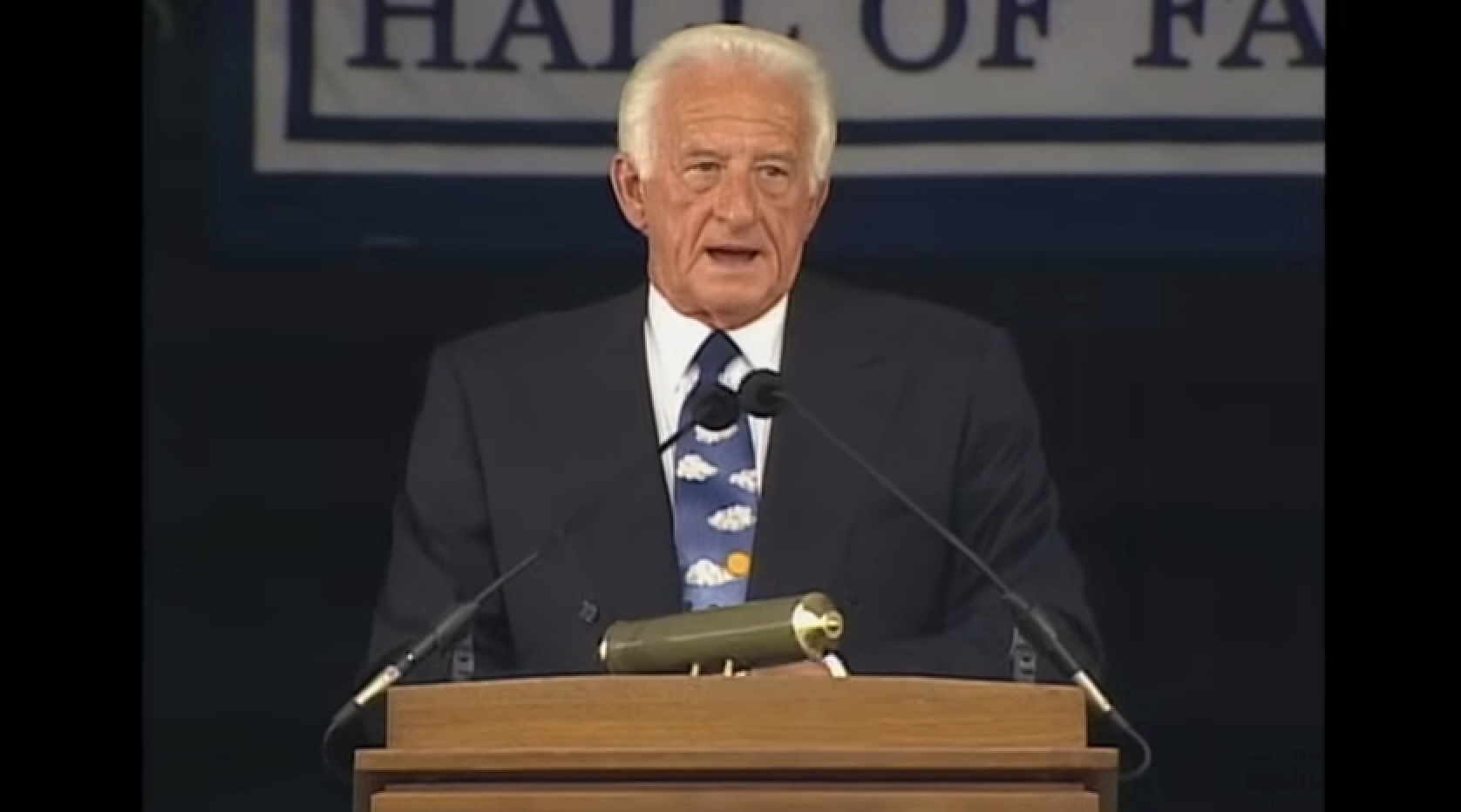
Uecker, who bore the ironic title of “Mr. Baseball,” became a staple on late-night television. He made over 100 appearances on The Tonight Show and put Johnny Carson in stitches for minutes at a time. His Hall of Fame acceptance speech reduced the greats of the game — Willie Mays, Joe Morgan, et al. — to tears.
He parlayed a forgettable baseball career as a catcher into a highly successful broadcasting career and an acting résumé that included the big screen, television, and memorable commercials. He was beloved in his hometown of Milwaukee and throughout the baseball world.
Raised in the Beer City, he claims to have actually been born across the Illinois state line while his parents were on an “oleo run.” I grew up in Milwaukee and have heard much about such southern expeditions. See, Wisconsin did not allow yellow coloring in margarine — to protect the butter trade — so frugal Wisconsinites drove across the line to buy, in bulk, Illinois oleomargarine, which was cheaper than butter, and also yellow. Uecker’s mother, great with child during one of his family’s excursions, bore Bob on an exit ramp, beneath an overhead light, in the backseat of a 1937 Chevy, just across the border. Or so says the Ueck.
He signed a contract in 1956 with the old Milwaukee Braves, he said, for $3,000. This made his father, a Swiss immigrant, angry. Said Uecker, “My old man didn’t have that kind of money to put out, but the Braves took it.”
He bounced around the minors until 1962 when the Braves called him up to the big club. He was moved to St. Louis, “where I won the world championship for them in 1964” — fact check: while on the roster, he didn’t get into any of the seven World Series games that year. The next year he was a Phillie, and two years after that, back on the Braves, as knuckleballer Phil Niekro’s “personal chaser.” Upon being released by the Braves, he hung up his catcher’s mask for good in 1968.
All told, he played 297 MLB games in six seasons for four clubs. He belted 14 home runs, drove in 74 runs, and hit .200 for his career, which, he said, “tied me with another sports great averaging 200 or better for a 10-year period.” That would be Don Carter, a bowler.
After his career on the diamond, he transitioned in 1971 to broadcasting and helmed the radio booth of the Milwaukee Brewers until his retirement last year — a total of 54 seasons. He joins a dying breed of radio voices whose lengthy careers are associated with one franchise — legends like Vin Scully, Jack Buck, Marty Brennaman, Denny Matthews, and others.
He found time between Brewer games to take up network gigs for ABC and NBC, and to showcase his talents on the big screen, where, most famously, he portrayed broadcaster Harry Doyle in the Major League movies. In one memorable scene, a pitcher played by Charlie Sheen unleashed a pitch many feet off the plate, which announcer Doyle characterized as “juuuuuust a bit outside.” The line has become a catchphrase in the business for any dramatically errant pitch.
On the small screen, he played a sportswriter on the sitcom Mr. Belvedere from 1985 to 1990. But his great fame came in Miller Lite commercials, which in the 1980s featured retired big league athletes and personalities like Billy Martin, Mickey Mantle, and John Madden, among many others.
In his most famous spot, he tried to commandeer a second-row seat at the ballpark, only to be informed by a brusque usher that he was in the wrong seat. He stands to depart points toward the field and says, “I must be in the front row.” In fact, his seat is way up in the second deck, in the nosebleeds. They created a statue of him for that.
In fact, he has two statues at the Brewers’ stadium, what is now called American Family Field. One is out front, with Hall of Famers Henry Aaron and Robin Yount, and the other is in the top row of the upper grandstand, in homage to his Miller Lite commercial. Fans can sit in the seat next to his image and snap photos.
The key to his humor was his self-deprecation. He was an outstanding athlete — he made a major league roster for numerous seasons, after all. He played his sport at its highest possible level. And yet he made his comedy bones making fun of himself. What athlete today does this? What athlete today does not puff up like a sausage on the grill and boast about his accomplishments and his greatness?
This is the source of Bob Uecker’s greatness and his lovability.
But, dare I forget, he does have one distinction as a player. He led the MLB in one category in 1967 — passed balls. Ueck let 27 of them slip past him that year while playing only 59 games. In his defense, he was catching Hall of Fame knuckleballer Phil Niekro in many of those games, which gave rise to another of his most famous one-liners: “The easiest way to catch [a knuckleball] was to wait until it stopped rolling and just pick it up.”
Baseball is a lot less funny now that Bob Uecker is gone.
READ MORE from Tom Raabe:
Christian Churches Mark 1,700th Anniversary of the Nicene Creed



















