

The last fireworks have burst, the bunting has been stored, and the old copies of the Declaration of Independence have been rolled back up. Amid this month’s celebration of America’s venerable culture and political legacy, another less salutary tradition has also been on display: the re-purposing of the Founders’ virtues to advance contemporary political agenda.
Free marketeers are quick to point out the ahistorical nature of many left-wing critiques, yet are too often tempted in the opposite direction, imbuing the Founders with modern notions of capitalism.
The Founders, Wood reminds us, need not be retrofitted with modern economic ideas to be worthy of admiration. They were great enough as they were.
Gordon Wood, preeminent historian of the Founding, cautions us against this. Wood, who died tragically a month shy of the Declaration’s 250th anniversary, showed with his scholarship that the Founders of 1776 were men of a preindustrial age to whom the concepts of comparative advantage, marginalism, and creative destruction would have been as foreign as the ideas of today’s socialist left.
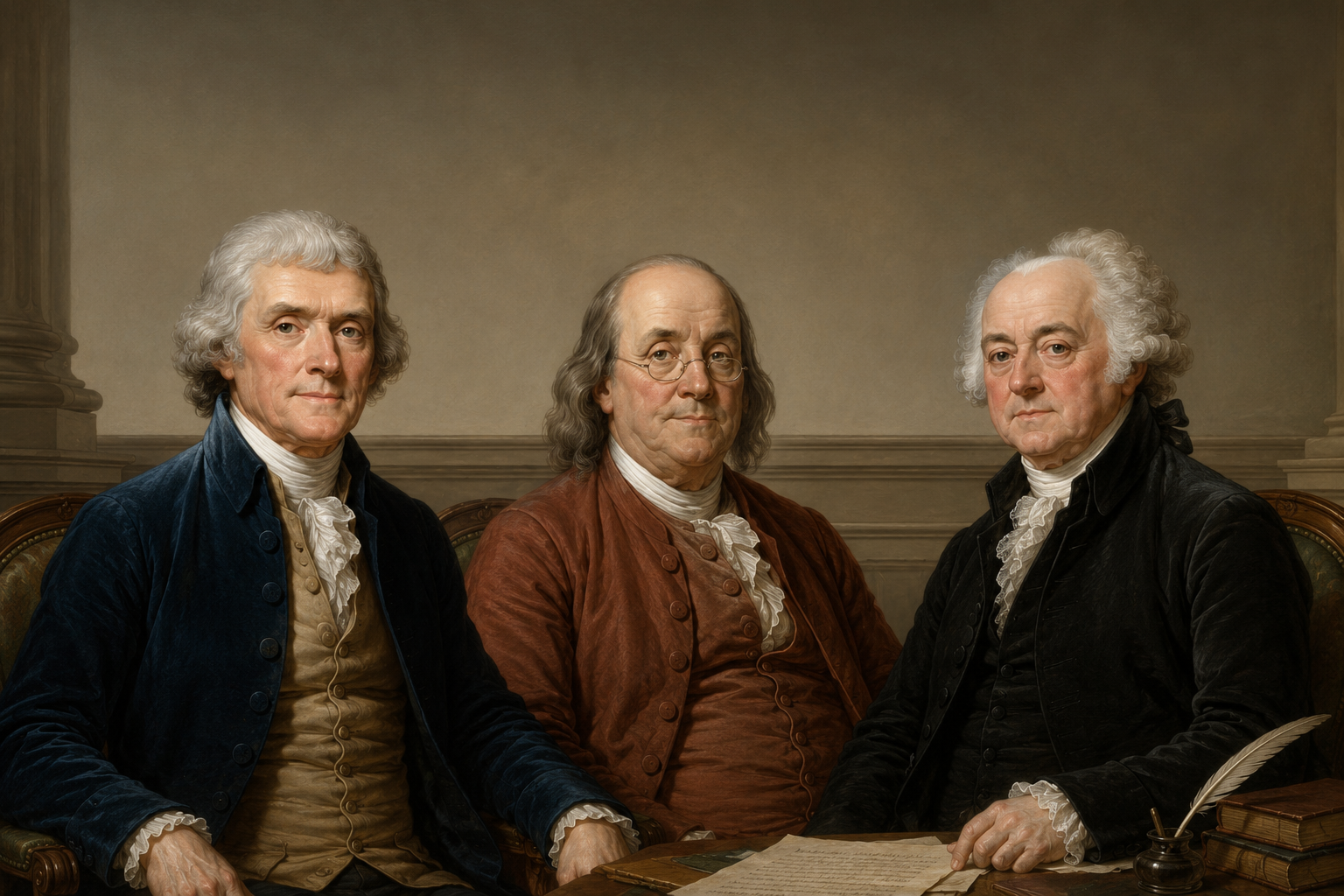
Wood’s 1991 tome The Radicalism of the American Revolution draws readers into the minds of the three most-revered intellectual leaders who carried the revolution forward: Thomas Jefferson, Benjamin Franklin, and John Adams. What these men shared at the deepest philosophical level was not adoration of the market economy, but a commitment to concepts of republican virtue and to the demolition of the British world’s hierarchies. Though Britain’s economic policies gave motivation, their mission was moral, social, and political, not economic.
While the commercialization of the European and Atlantic economies was well underway as the Founders formulated their claim to sovereignty, Wood stresses that the impersonal system of regional, national, and international exchange that would emerge in the 19th century was as yet inconceivable. (Even the pathbreaking Adam Smith, with whom Franklin was in contact in the years leading up to the Declaration, had not alighted upon ideas as central to capitalist development as the subjective value theory.)
Private property, undoubtedly, was a fundamental concern of the Founders, and one with most profound economic implications. Yet the Founders’ notion of it differed markedly from the way we think of it today. Jefferson famously emphasized the importance to a republic of widespread property holding. “Property in a republic,” Wood summarizes in Radicalism, “was still conceived of traditionally, in proprietary terms, not as a means of personal profit or aggrandizement but rather as a source of personal authority and independence.” To a man, Jefferson, Franklin, and Adams saw property — land, above all — as vital to gentlemanly, republican virtue, but the pursuit of profit as tangential, even deleterious, to it.
America’s Founders, Wood explains, sought to emulate the Roman civic virtues of honor and disinterestedness. They lionized and pursued the life of the gentleman, “without their exertion or direct involvement in the interests of the marketplace.” They were, Wood writes, “deeply involved in commercial and entrepreneurial activities … but they engaged in them with something other than a pure money-making spirit.”
Franklin, often painted by history as a proto-capitalist, distanced himself from business as soon as he could, Wood argues, as an expression of this republican, landed worldview. For all the valorization of Franklin’s years wearing a leather apron that would come later, Wood holds that for Franklin, very much a man of his time, labor did not have strong moral valence. Labor for Franklin and his contemporaries was “not thought to expand the prosperity of the society.”
Long before the egalitarianism of the age of Andrew Jackson, the vision of Jefferson, Franklin, and Adams (and, indeed, of George Washington) was of a country led by a moral aristocracy. For them, this meant men learned in the liberal arts and untainted by the profit motive for which America would later be known. Adams, Wood notes, took aristocratic distance to what we would now consider an extreme, writing in a 1771 diary entry that “common persons” whose “vulgar, rustic imaginations are easily excited” had “no idea of learning, eloquence, and genius.”
And yet, despite all this, the polity Jefferson, Franklin, and Adams created freed common persons to pursue material advancement. For that reason, it would become the greatest engine of market capitalism and economic growth the world has ever seen. The causal link is the social dynamism that inevitably arose from their assault on arbitrary authority and privilege, put forth most succinctly in Jefferson’s immortal words: all men are created equal.
Whether they, as republican aristocrats, understood it or not, by dissolving bonds of obligation and hierarchy they set off an extraordinary chain reaction from which Americans are still benefitting today. While not conceived of in economic terms, the Founding was an economic revolution indeed.
The Founders, Wood reminds us, need not be retrofitted with modern economic ideas to be worthy of admiration. They were great enough as they were.
READ MORE from Jordan McGillis:
Autonomous Trucking and the Truckers
Biden’s Environmental Tent Cannot Stand
The Climate Litigation Wave Crashes Into Hawaii’s Supreme Court
Jordan McGillis is a fellow at the Economic Innovation Group and a 2025-2026 Novak Journalism Fellow with the Fund for American Studies.