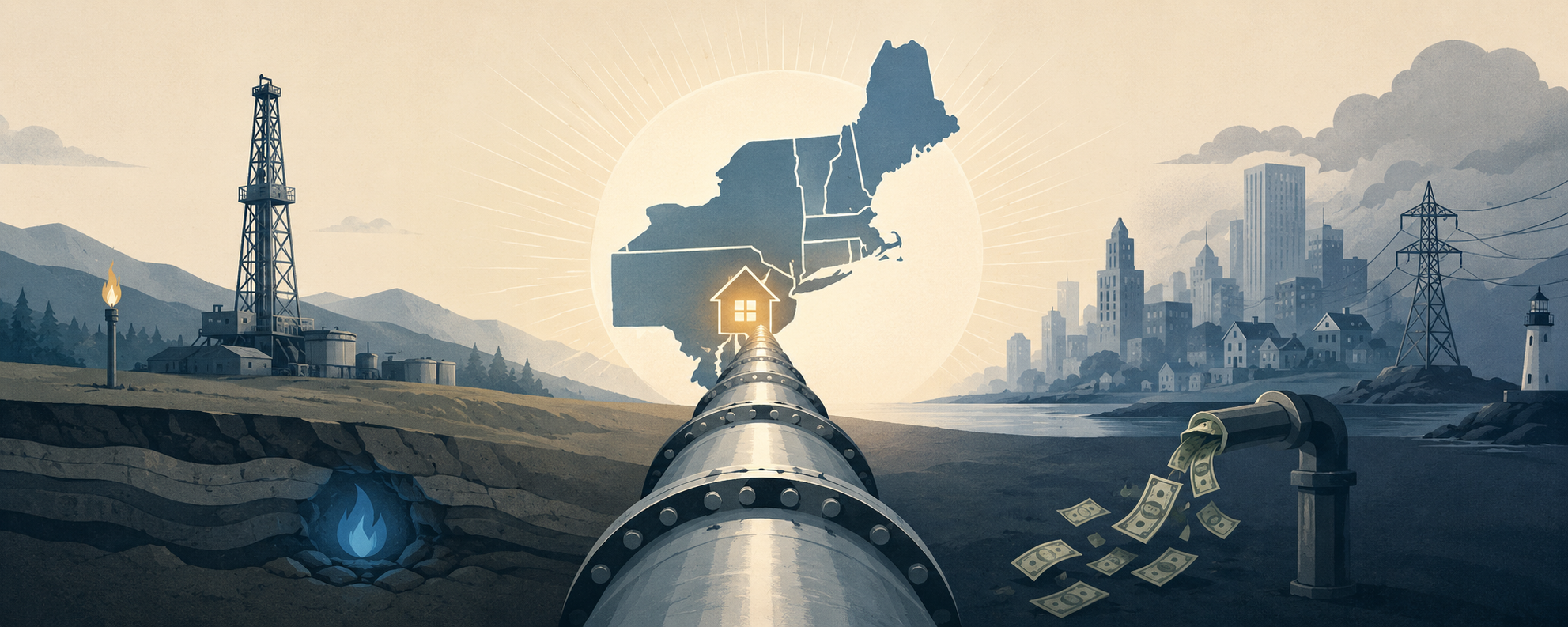


Northeastern states are scrambling to address rising energy costs. New York, Massachusetts, Rhode Island, and others are even considering abandoning some of their most restrictive Green New Deal-style emissions policies to increase the supply of affordable sources.
Such new energy projects are among the most difficult endeavors to bring to fruition. Requiring massive investments and at least a modicum of public support, they have no chance of becoming reality without people of influence standing for their success.
Take the proposed Constitution Pipeline, for instance. The benefits of this 125-mile-long pipeline, which would deliver Pennsylvania natural gas to energy-starved New York and New England, are so numerous that one might wonder why it hasn’t already been built. Except that the project is among many such enterprises that have languished in a regulatory morass fueled by anti-development activists and nurtured by incompetent political leadership. (RELATED: Under the Radar of the ‘Doomcasting’ Media, There Is Massive Industrial Investment Occurring in the U.S.)
Yet, new life is stirring for this much-needed supply line. Having first proposed the project in 2013, Williams Cos, a Tulsa-based energy firm, received federal approvals more than a decade ago. In 2016, the company sidelined the project after New York regulators denied a water-quality permit. (RELATED: Drill, Baby, Geopolitics: Now It’s a Matter of National Security)
Earlier this year, Williams resubmitted applications to regulators, projecting the pipeline to be in service by early 2028. The Federal Energy Regulatory Commission (FERC) has received more than 600 comments since January as part of its review.
New England has “resorted to importing natural gas from foreign nations, located thousands of miles away…”
“The need for this project is well documented,” said Jim Welty, president of the Marcellus Shale Coalition, in comments to FERC. “Customers throughout New York and New England have experienced significant supply disruptions in recent years due to inadequate natural gas supply and constrained access to the market.”
New England has “resorted to importing natural gas from foreign nations, located thousands of miles away because a more efficient … manner to connect to domestically produced natural gas currently does not exist,” noted Welty.
Connecticut State Sen. Ryan Fazio, a Republican, said Constitution would mitigate New England’s high gas prices, saving customers up to $8.5 billion over the project’s life.
“Historically, peak winter gas prices in the region have averaged at least 2.5 times the national benchmark, and daily price fluctuations can reach up to 30 times the average annual levels due to (pipeline) capacity limitations,” he said.
The 30-inch-diameter pipeline would run from gas fields in northeast Pennsylvania’s Susquehanna County to upstate New York. Connecting with the Iroquois and Tennessee interstate systems, Constitution would deliver enough gas for 3 million homes, or about three percent of Pennsylvania’s current production.
Williams estimates that construction will create 2,500 jobs, generating nearly $300 million in direct labor income and almost $1 billion in total economic output.
Producers of natural gas have long struggled with a lack of pipelines to match production capacity and market needs. The Marcellus region “is by far the most prolific natural gas production area in the U.S., accounting for about one-third of the nation’s daily output,” notes Housley Carr, an energy writer and analyst for RBN Energy.
“The shale play experienced phenomenal growth in the 2010s, its gas production rising [by a factor of 16],” writes Carr. “But the pace of growth has slowed dramatically in recent years, mostly due to takeaway constraints.”
Refusing the construction of the Constitution Pipeline is “absolute insanity,” says Mike Sommers, CEO of the American Petroleum Institute.
In the Texas Permian Basin, where natural gas is a byproduct of oil-well drilling, the price of gas sometimes is driven so low by the pipeline shortage that producers must pay to have it taken away.
Electricity prices in New England are 55 percent higher than those in Pennsylvania, thanks to limited access to natural gas. However, affordability issues are softening northeast governors who have long opposed pipelines.
This April, Bloomberg Law reported that Williams CEO Chad Zamarin had received support for Constitution in meetings with all New England governors. In neighboring New York, Gov. Kathy Hochul moderated positions on energy projects last year as her election campaign got underway.
Following his pattern of avoiding controversial issues, Pennsylvania Gov. Josh Shapiro has said nothing publicly about the Constitution Pipeline, even though natural gas represents arguably the Keystone State’s most promising industry.
In fact, of the hundreds who submitted comments to FERC, those identifying as state politicians were only the Connecticut state senator and 13 Republican members of the New York State Legislature, whose joint statement supported the pipeline. Bloomberg’s report of New England gubernatorial support notwithstanding, a search of public statements favoring Constitution turned up just one — from New Hampshire Gov. Kelly Ayotte.
Leadership matters in developing energy projects. Following the 2025 inauguration of President Donald Trump, five pipeline projects, including Constitution, were revived in the Northeast after years of being stalled by political hostility, according to an S&P Global analysis. Outside the region, 10 projects received federal or state approvals.
With due acknowledgment to those openly backing the Constitution Pipeline, surely a project benefiting most of the Northeast deserves stronger support. Frankly, small town America displays more enthusiasm for ice cream shop ribbon cuttings than the leaders of states promised the bounty of affordable energy and a thriving gas industry.
Gordon Tomb is a senior fellow with the Commonwealth Foundation, a Pennsylvania free-market think tank.