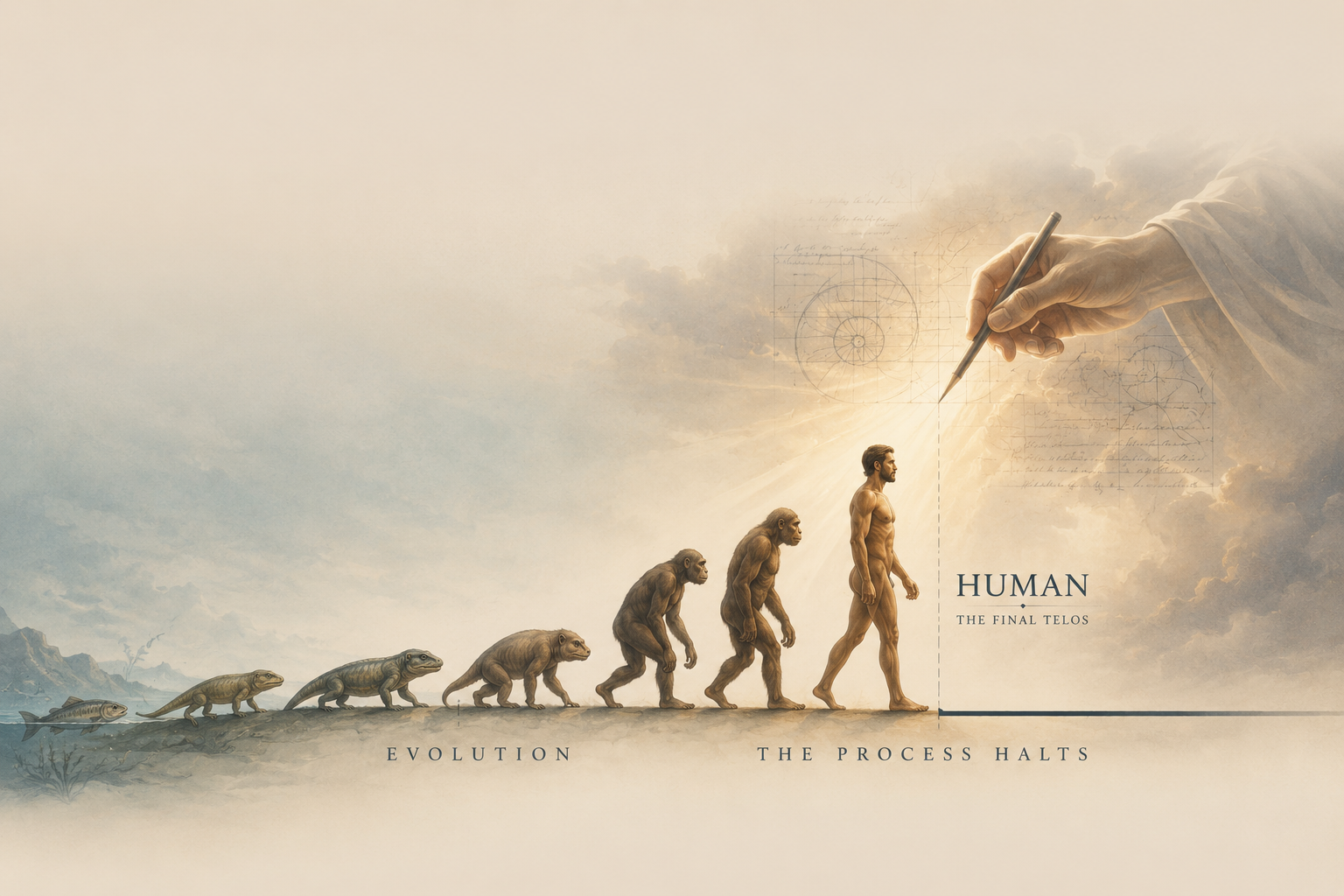


The text of Genesis says that God rested from his creative activity after the creation of humans (2:2-3). Therein for the faithful lies a rationale for the Sabbath. But could science offer any insight on the idea of divine rest? Maybe so.
Less than a year before his tragic death, German paleontologist Günter Bechly posted a long and powerful article at Discovery Institute’s Science and Culture Today. It detailed, “Three Modern Scientific Challenges to the Causal Adequacy of Darwinian Explanations.” The challenge that especially caught my eye at the time was the “species pair” problem.
Within the last 10 million years, the creative process, for some reason, ceased or rested, with the arrival of humans.
As is generally known, new organs and entire new body plans seem to consistently appear suddenly in the fossil record. Harvard paleontologist George Gaylord Simpson summarized the fossil record on this point. From “The History of Life,” in Volume I of Evolution after Darwin, University of Chicago Press, 1960:
It is a feature of the known fossil record that most taxa appear abruptly…. Gaps among known species are sporadic and often small. Gaps among known orders, classes and phyla are systematic and almost always large. These peculiarities of the record pose one of the most important theoretical problems in the whole history of life: Is the sudden appearance of higher categories a phenomenon of evolution or of the record only, due to sampling bias and other inadequacies?
Of course, evolution must be gradual if Darwinism or any other materialist explanation is possible, so Simpson, like Darwin and almost every other evolutionist since, goes on to argue that the “sudden appearance of higher categories” is an illusion, that these major changes were not really sudden, only rapid. After all, the Cambrian and other “explosions” could have taken as long as 5-10 million years.
I have often pointed out that gradual development of the new features or organs that gave rise to new orders, classes, and phyla would require the development of new but not yet useful features, and the gradual development of these new features through their useless stages would be no easier for Darwinism to explain than their sudden appearance. In the video Why Evolution Is Different, beginning at 14:40, I show how similar the evolution of life is to the “evolution” of software or automobiles or other human technologies, with similarities between new creations and previous designs but with large jumps where major new features appear, for the same reasons.
Bechly refutes the idea that unguided evolution could explain new body plans even if the Cambrian and other explosions lasted several million years. He does so by looking at living species pairs:
The morphological similarity of modern species pairs that have diverged in a similar time frame poses a severe problem, because it implies that the macroevolutionary processes that were at work and common in the history of life in all periods of Earth’s history and all groups of organisms, apparently were totally absent in the origins of all of the millions of living species.
To make this point I surveyed TimeTree.org, a databank of 148,876 living specieswith molecular clock estimates of their time of divergence based on 4,185 studies. When probing any pair of species, even those with longer divergence times than available for the development of the body plan differences between, for example, pakicetids and basilosaurids (separated by about 4-5 million years), we find without exception that their morphologies are hardly distinguishable for laymen and they often still can hybridize.
After citing several examples, such as Asian elephants and their African counterparts, which apparently diverged about 8 million years ago, Bechly summarizes:
Most of these recent species pairs only differ in allometric measures and minor color pattern. They usually look so similar that they could hardly be distinguished by laymen, even though they were separated for a much longer time than was available for most major transitions in the fossil record.
His point is that, “There are clearly limits to what unguided evolution can do within a few million years, and these limits are far below the level of any major body plan transitions.”
The living species pair argument is powerful and interesting, but what is especially of interest to me is that there seems to be one exception:
So, what about great apes and humans? Chimp (Pan paniscus) and gorilla (Gorilla gorilla) diverged according to TimeTree 8.6 million years ago and humans (Homo sapiens) from chimps 6.4 million years ago, which agrees with the hominin fossil record. There are two possibilities: Either you follow those scientists who consider the biological difference between humans and chimps as marginal. Then this example would just confirm the pattern described above. Or, you consider humans as very different from chimps, based on their different bipedal locomotion and especially their mental capacity and cultural achievements. In the latter case humans would represent the only exception to the pattern that I could find, which arguably would represent a remarkable confirmation of Judeo-Christian human exceptionalism.
Despite false and misleading claims about a 98 percent similarity between human and chimp DNA, anyone with common sense can see that the differences between humans and chimps are not “marginal” but that this is in fact a spectacular exception to the pattern.
In his 1956 book, A Biologist’s View, (Wm. Heinemann Ltd.) French biologist Jean Rostand writes “However obscure the causes of evolution appear to me to be, I do not doubt for a moment that they are entirely natural,” but acknowledges:
It does not seem strictly impossible that mutations should have introduced into the animal kingdom the differences which exist between one species and the next … hence it is very tempting to lay also at their door the differences between classes, families and orders, and, in short, the whole of evolution. But it is obvious that such an extrapolation involves the gratuitous attribution to the mutations of the past of a magnitude and power of innovation much greater than is shown by those of today.
It therefore seems to me that we must fall back upon variations of a type not known to observation or experiment to explain the transformations which life has undergone. Quite a number of biologists do, in fact, fall back on hypothetical variations to account for those major steps in evolution which they call “macro-evolution.”
Are these hypothetical variations still produced in living races, though so slowly and discretely that they are unnoticeable? Or do they no longer arise in our ageing world? For my part, I find it easy to believe that living nature is now exceedingly stable, and that it no longer displays the processes which gave it birth.
Bechly ends his section on the species pair problem with a similar observation but offers a very different explanation for the facts.
In my view the cumulative evidence suggests that the only adequate explanation is that Darwinism is wrong, and this applies not only to the neo-Darwinian process of random mutation and natural selection but to any unguided evolutionary processes. There is no evolutionary reason why the creative power of this process should have been active over all of Earth’s history but then ceased to function within the past 10 million years.
Intelligent design proponents can easily explain this pattern: there was creative intelligent intervention in the history of life, but this creative activity deliberately ceased with the arrival of humans as the final telos.
Within the last 10 million years, the creative process, for some reason, ceased or rested, with the arrival of humans. “Any further identification of the intelligent cause would have to transgress the methodological limits of the design inference,” Dr. Bechly wrote. “But Judeo-Christian theists will certainly recognize an eerie correspondence with the Biblical message.”
READ MORE from Granville Sewell:
The Story of Everything: A Cinematic Exploration of Design in Nature
What Science Now Knows — and the Public Rarely Hears
A Mathematician’s View of Evolution