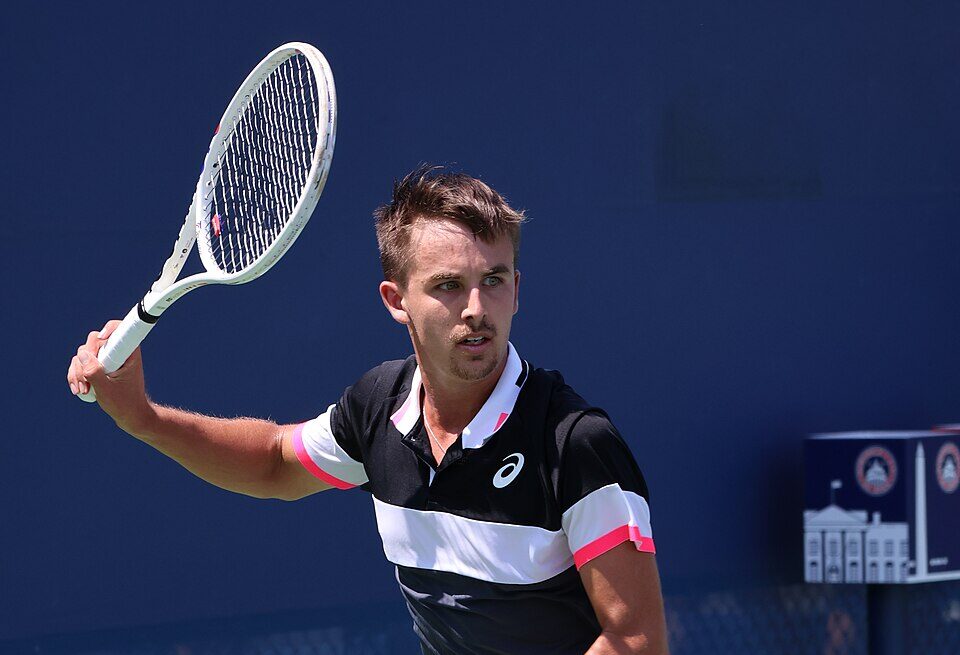


Zachary Svajda had Cruz Hewitt on the ropes during most of their match on Sunday, but it’s never over till it’s over in tennis, as in many other human endeavors.
The 23-year-old California native took the first set in scarcely half an hour by keeping the Australian prodigy — he is 17 and just arrived here from the Wimbledon Boys’ junior final — off his game, which he did by a shrewd combination of change-of-pace, well-timed aces, and some superb shot placement.
Keeping you off your game is merely another term for the one invented, or at least popularized, by Bill Tilden, America’s first tennis superstar, a hundred years ago. Tilden said that since at the level the sport was practiced by players in his class, everyone is about as good as can be, the way to win a match is to “disrupt” the opponent’s game.
Taking the first set 6-1, the Californian’s tactics were working almost to perfection. The side spin he was putting on his forehand groundstrokes was playing tricks with his opponent’s racquet, whose exasperation looked like it might boil over as he kept sending balls long and out of bounds. And the second set went according to plan — the other fellow’s plan. Serving at 3-5, the thought may have crossed his mind — or his father’s, who accompanies him — that his classy groundstrokes simply were not clicking well enough to prevent another — and final — break of serve.
Banish the thought!
Young Cruz — the reader will have guessed he is the son of Lleyton Hewitt, the great Australian champion of the early aughts — plays with righteous power from either wing on the baseline, but he also is speedy and nimble, and he can chase almost anything down and find the right place to aim for when sending it back across the net. And what happened in that ninth game of the second set confirmed the old adage that you do not know what you can do until you do it. It may or may not surprise you, but you sure know it when it happens.
For sure, Svajda was finding it difficult to sustain the pressure and maintain the energy needed to set up winners or, no less key to his success so far in the match, set up the other’s losers, or faults as they are more politely called.
Whether this was due to heat or a bug or a strain, the fact is he blew a chance to break that game, then failed to hold when serving for match at 5-4, then again could not break, then managed to hold for 6-6, and then very nearly got wiped out in the tiebreak. At a set each, the match was not over, but Svajda retired after two games, which suggests he was ill.
Mishaps happen; they cannot take away the fact that there is a winner and a loser. And this is a lesson for life. Because Zach Svajda will nurse his disappointment or will put it behind him immediately, but in any case he will stand up and move on.
He can take some comfort in the fact that in the match at the grand old FitzGerald Stadium (over seven thousand seats) directly after his game, his younger brother Trevor, who is 20 (Zach is 23), beat the excellent McKenzie MacDonald, year in and year out one of the top Americans since winning the NCAA Division I singles title 10 years ago. Trevor could meet Cruz in the quarters in the middle of the week.
The qualification rounds for the main draws, women and men, which concluded with the matches on Sunday, brought out spectators in large numbers. Even if the old tournament, presently called the Mubadala D.C. Open, has become a chic event and many fans, apparently, come to see one another as much as to watch the matches, surely there are a few people who will take home the right notion of what it — losing and coming back aiming to win — is all about. For life is a ball game, being played each day/ Life is a ball game, everybody can play.
More to come, folks, but if you happen to be visiting Washington, D.C. this week, this may be a good time to ride the bus up 16th Street to Kennedy Street, get off; the show is on your left. It’s an easy trip after coming out of the National Archives building on Pennsylvania Avenue (enter on Constitution Ave.), where surely — in this time and place — you will have spent the morning reading an early copy of the Declaration. And tickets are still available, or so I’m told.
READ MORE from Roger Kaplan: