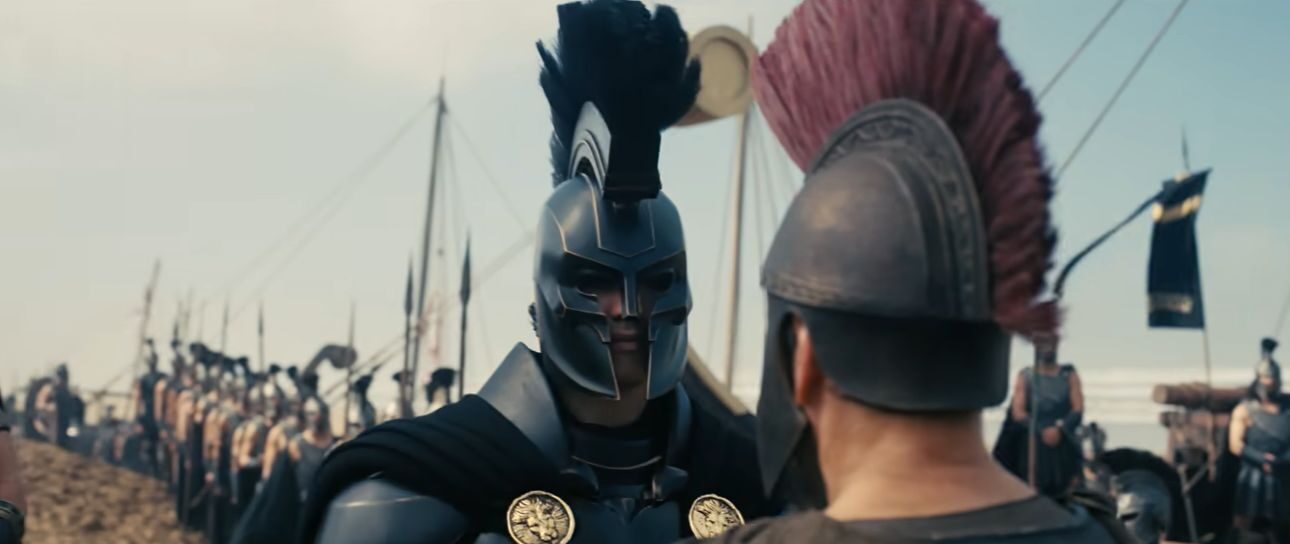


Hollywood works itself into a tizzy over a lot of new movies. Its buzz as a rule feels more manufactured than organic — PR types often think that there is no need for steak if they can crank up the volume of the sizzle.
But something’s a little different about this one. This new movie has an old name, The Odyssey, and it’s a story that has been told for about 3,000 years. There may be a steak here.
We are all letters in the scroll of the greatest of stories, a story that reveals the infinite and the finite as partners in the drama of human life.
What does seem novel about The Odyssey is this: in the face of the war to erase history and build a utopia on the ruins of Western Civilization, Hollywood is abuzz about something so ancient. Can something preserved from the past be big box office? The long-dead lion roars within the motto Ars Gratia Artis, always ironically. But just maybe, something deeper is surfacing.
As Ben Shapiro likes to say, reality has a way of reasserting itself, and the reality, as Jordan Peterson never tires of telling us, is that we humans have no better way of wrestling with our life’s meaning than through the great story.
In the Genesis verse that the second-century rabbi Ben Azzai identified as the key verse of all the Torah, the text reads:
“This is the storybook of the offspring of Adam — in the day that God created Man, He made him in the likeness of God.”
The human experience in all its variety and in its quest for realizing within itself unified, coherent meaning reflecting the superordinate oneness of God — this is the story of this Book. (The Hebrew for “book” is sefer, which comes from the same Hebrew root as the word for “story,” and so I translate it here as “storybook.”)
Centuries of reading of the Bible teach us that the biblical story is about us and for centuries, people and nations have dug deep into those stories to understand their purpose and their right track in the world.
So it is for all tellings of the human story — if it is done well, it helps us to understand ourselves and our purpose and path to meaning. Great stories prove their worth again and again. (My test for classic books is how I reread them and find their stories helping me map my course in life.) That the story of The Odyssey is news today is itself newsworthy — as well as proof of the power of its story is somehow our own as well.
A landmark of modern world literature finds this ancient story playing out in the minds, words, and actions of everyday people on one ordinary day in a great city. It is June 16, 1904, in Dublin, and instead of the kings, the warriors, and the sirens, instead of the cyclops, instead of Circe and Calypso and the Sirens, there are real people of Dublin, poets, doctors, aspiring singers, priests and teachers, drunks, haters, lovers. Instead of Greece and sea islands, instead of Troy or Ithaca, we have city neighborhoods and suburbs.
And yet, on that ordinary day, seen from inside the minds of people as they touch the ridiculous and the sublime, the workaday ordinary and the redeeming epiphany, we begin to glimpse that it all plays out the story line of Homer’s The Odyssey. Each stage of the day, each new Dublin locale, each turn of Joyce’s ever-inventive language pulses with the character of Odysseus on his long journey home, or of Penelope’s fight to keep her home and her love whole.
Great books are great because they show the eternal and the redeeming in the midst of the blinding blizzard of uncountable event-flakes that obscure our vision and blind us to the landscape which we must negotiate. These books map the way towards what we seek — the freeing order that Isaiah talked about when he declared, “God did not create the world for chaos; it is for a settled life.”
Joyce’s Ulysses defined modernity as no other work of storytelling. It is an exploration of the actual mind of ordinary people, encompassing the moments when people are distracted by memories, plans, random observations, half-thoughts struggling towards expression – our minds in all their grand sweep of the world in their constant search for a unifying thread that pulls together the whole of our humanity as conceived in the highest possible way — a story within a greater story.
That idea of stories within stories is central to Scripture. The late Chief Rabbi of the United Kingdom, Jonathan Sacks, taught that we can best understand ourselves as letters in the scroll. Each of our lives plays out as a story we choose to tell ourselves and act upon with others. That shared life has its own story, and the process iterates on our minds until in a kind of integral leap, we perceive the sweep of the Great Story and our full meaning. The illuminating spark of that vision, however fleeting, gives us for a moment a view of the landscape in which we are traveling, and the map that shows us forward.
I was blown away by Joyce’s Ulysses when I first read it in high school. It changed the way I read and write forever. The buzz that preceded the release of the film The Odyssey moved me to take the book up again and I am there again on that June day in Dublin, discovering the journey that is mine uniquely but which is a part of everyone else’s story, as Joyce takes us deep into our consciousness to the place where all the great stories point.
Joyce is not content with the pretty surface of a story or of the people he portrays. He takes us together into the chaos of the moments that we all face every day. Each of us, in our own way, faces the heroic task of finding our path through the maze toward a deeper knowledge of our truer selves — arriving at a place of the soul where we can exist in peace, whole within ourselves, and bound to our fellows by love.
How much of each day passes with no words and no clear thought! Our mind is not always ready to voice a thought, however small. We constantly negotiate chaos, like heroes, true to our task. But the chaos is the aliveness of this world to becoming — it is the matrix from which the universe of our own story is emerging.
Sometimes, the gleam of the sun catches our eye; sometimes there is an aroma that seems to hint at a time or place we can’t quite remember. Sometimes we let associations, however random-seeming, just bubble up, daydreaming perhaps. Maybe we don’t even want to put a name on it; maybe we simply float upon a deep current. Somehow, we draw all these things into the unfolding story of who we discover ourselves becoming — a person who coheres, who inhabits the first-person voice of this journey, the narrator of our own becoming.
Somehow the seemingly endless variations of many storytellers come into one story that is told to many — our human odyssey, through the chaos of war and then through the illusions of shallow stories we decode and at last escape, on at last to home and love that we prove greater than every trial.
We are all letters in the scroll of the greatest of stories, a story that reveals the infinite and the finite as partners in the drama of human life. It is a life freed to become life at its highest: a life in which art and beauty are joined with truth, and in which we discover the great good of a shared and settled existence — a vibrant peace born from knowing ourselves as letters in a story far greater than ourselves.
READ MORE from Shmuel Klatzkin: