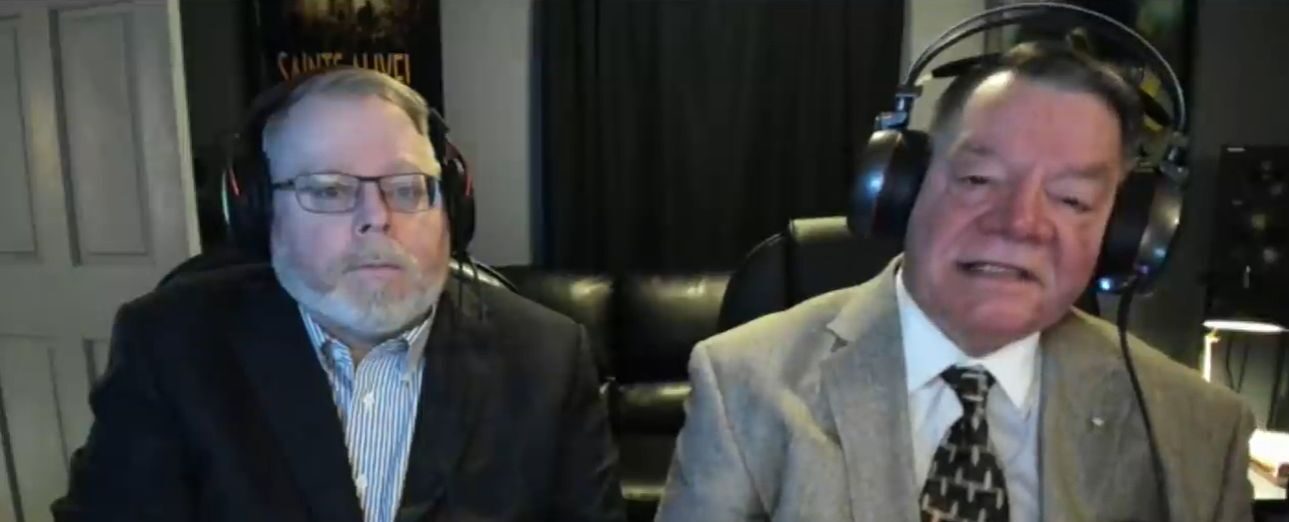


The faithful lost a distinctive voice this week. His name was Richard Payne. You might not know the name, though you might recognize the voice, especially if you watched any of his excellent documentary films.
Born in Ottawa in March 1938, Payne was raised in a devoutly Catholic family. Educated by the Sisters of St. Joseph and the Oblates of Mary Immaculate, he studied the sciences at the University of Ottawa and philosophy and theology at Saint Paul University. He discerned a vocation to the priesthood but ultimately felt called to marriage and to serve the Church in other ways, which he would do nobly in the medium of film. This, however, came later in life. He was in his 50s that Richard hit his stride and started truly fulfilling his calling.
It’s said that the best writers have a “voice.” That’s obviously even truer for those with a talent for narration. You don’t read them; you hear them.
“In 1991 he left it all,” said his son and film partner Stephen, “to return to work rooted entirely and unmistakably in his Catholic faith. That same season, I left a career in Hollywood, and father and son joined our lives and our gifts to found Arcadia Films.” For more than 30 years, the father and son were, in Stephen’s words, “two men and one work — he the writer and researcher, I the director and craftsman — and together we made more than 150 films in service of the truth, beauty, and moral clarity of the Catholic faith, filming across the United States, Europe, Asia, and the Americas.”
If you watch EWTN television, you have seen their work. The Paynes created the series The Saints Speak, Saints Alive!, and Parable. They did a superb exposé on Saul Alinsky, the Frankfurt School, Antonio Gramsci and others of their ilk, titled, A Wolf in Sheep’s Clothing. The sequel was A Wolf in Sheep’s Clothing II: The Gender Agenda (for which they interviewed me at length). The Gender Agenda focused on the unholy Left’s redefinition of gender, sexuality, and marriage, profiling two different “wolves:” French weirdo Simone de Beauvoir and Indiana pervert/sex-freak Alfred Kinsey. The research and acting and imagery were top notch. If you haven’t seen these films, click the hyperlinks and watch and share.
What those two daring documentaries revealed was highly unsettling. What they revealed about downright evil individuals seeking to infiltrate and undermine the Church, the Judeo-Christian faith, and their larger world was remarkable. In this, the Paynes did the Lord’s work. And Richard was the voice who drove the narrative.
Richard Payne narrated these films with such a distinctive voice, ideal for capturing and conveying the seriousness and sobriety of the subjects. He possessed one of those voices that just isn’t replaceable. Certain voices aren’t. I think of the late, great David McCullough, who did terrific books on topics as diverse as the Johnstown flood, the Brooklyn Bridge, and Teddy Roosevelt. McCullough was also a gifted narrator. He narrated Ken Burns’ epic Civil War series. He also hosted PBS’s splendid The American Experience back before it went woke — obsessed with race, sex, and gender — and now sadly isn’t worth following. Particularly superb was The American Experience series on presidents, which was narrated by several individuals, including David Ogden Stiers.
I remember McCullough introducing the Harry Truman series, fittingly so, given that he wrote the best biography of the man from Independence, Missouri. The voice for the Truman episode was actor Jason Robards, who choked me up with his narration of Harry Truman talking about his father. Likewise, Stiers’ stirred me with his narration of The American Experience episode on Ronald Reagan, particularly the opening scene at the Statue of Liberty in 1986 and the footage of the Rock River where a young Reagan lifeguarded in the 1920s. That imagery impacted me deeply and surely helped prompt me a decade later to open my book, The Crusader: Ronald Reagan and the Fall of Communism, with Reagan at the Rock River. That book ended up becoming the basis for the 2024 film, Reagan, starring Dennis Quaid as the adult Reagan and David Henrie as Reagan the lifeguard.
Vivid, moving works of film can impact you that way. I’m a writer, historian, biographer — a man of the researched and printed word — and yet, when I think of certain moments from the lives of, say, a Reagan or Truman, I visualize indelible scenes created by documentaries like The American Experience, and I hear the voices of the likes of McCullough and Stiers.
Those voices soothed, engaged, allured. Combined with the right, skilled imagery, they can create a magical, almost mystical feel. They can put you in a state or frame of mind that is as integral to the film as good cinematography. A good narrator — voice — can do that. It can elevate an otherwise decent film into a form of art.
Richard Payne did that with his documentaries. He, Stephen, and I have wanted to do a documentary on Bella Dodd, based on my 2022 biography. Dodd was akin to a female Whittaker Chambers, an ex-communist who became a courageous witness against communist infiltration and an all-around incredible story of betrayal and redemption.
The Paynes jumped at the project. They approached me. We last spoke in November. The project has been derailed by Richard’s declining health and our difficulty finding a benefactor to provide funding. (It’s frustrating, the amount we need is so modest. Once again, the vexing problem for conservatives and Christians in film: finding charitable benefactors willing to support the arts. Liberals don’t have that problem.) I’m sorry to say now that if the documentary happens, it will not be in Richard’s voice. And that’s a loss.
It’s said that the best writers have a “voice.” That’s obviously even truer for those with a talent for narration. You don’t read them; you hear them. Some of the best examples are sports broadcasters. Think of baseball men like Mel Allen (his voiceover for “This Week In Baseball”), Vin Scully, Ernie Harwell, Jack Buck, Joe Buck, Curt Gowdy, Jon Miller, Bob Costas, Joe Garagiola, Harry Caray, Skip Caray, Red Barber. Living in Washington, D.C. in the early 1990s, I used to tune in to NPR once a week to hear an aging Red Barber interviewed by the gentlemanly Bob Edwards. It was the only thing worth listening to on NPR’s Washington, D.C. affiliate, WAMU, the radio station located at The American University, which I was attending at the time as a grad student.
In Pittsburgh, we were blessed with Pirates announcer Bob “The Gunner” Prince, and we’re lucky today to have the superb Greg Brown for three decades running. In football, for the Steelers, we had the ultra-distinctive, hilarious Myron Cope. (In hockey, we had the brilliant Mike Lange.) Don’t even get me going on football: Pat Summerall, John Madden, Al Michaels, Howard Cosell, Frank Gifford. I better stop. The point: The best of them transform the sports viewing experience by their mere voice.
Of course, many sports broadcasters became legends, even household names. Their voices are certainly appreciated. But narrators of documentaries? They’re considerably less appreciated, if even noted. Richard Payne was one of them.
“My father entered eternity on July 18,” writes Stephen, “the very date the Blessed Virgin Mary first appeared to St. Catherine Labouré in Paris in 1830, beginning the devotion of the Miraculous Medal. We receive it as a sign of Our Lady’s tender presence, gathering her son home under her mantle.”
The Paynes sought to direct our gaze in that direction, upward, toward the heavens, toward the Blessed Mother and her Son and the saints, rather than downward to the toxic ideas of Alinsky, the Frankfurt School, de Beauvoir, and Kinsey.
To Richard Payne, I say thank you for your excellent work. Thank you for your voice.
READ MORE from Paul Kengor:
MLB’s Pitching Craziness Continues