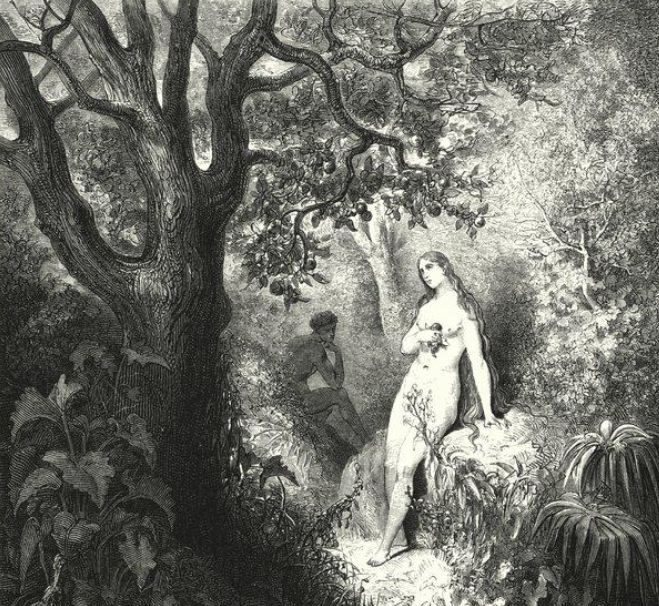


When Milton’s Satan is slithering around in the garden of Eden on the fateful morning in search of the human couple, he seeks them both, but he hopes to find Eve alone. There is not much chance of that, he knows, because the two are hardly ever separate, but sure enough, for once, there she is, by herself.
Shall Eve’s son, deprived of his father through her fault or the father’s fault or both, “marry” another man?
Adam has not recommended it, saying that the two of them would be stronger in meeting any temptation together than if either one were alone. But Eve has argued that each of them, single, is sufficiently armed to thwart the wiles of Satan. She is right, and so is Adam. Their discussion ends with no hard feelings. Adam gives in, saying that perhaps if they do stay together they will let their guard down. If Eve believes she has been sufficiently forewarned, she may go, “for thy stay, not free, absents thee more.”
Satan is glad of it. After suffering some momentary stupefaction at Eve’s sheer beauty, alone and near, he returns to his wicked purpose:
Then let me not let pass
Occasion which now smiles: behold alone
The woman, opportune to all attempts,
Her husband, for I view far round, not nigh,
Whose higher intellectual more I shun,
And strength, of courage haughty, and of limb
Heroic built, though of terrestrial mould,
Foe not informidable, exempt from wound,
I not, so much hath hell debased, and pain
Enfeebled me, to what I was in heaven.
She fair, divinely fair, fit love for gods,
Not terrible, though terror be in love
And beauty, not approached by stronger hate,
Hate stronger, under show of love well feigned,
The way which to her ruin now I tend.
Satan believes he can deceive the woman; he is not so sure about Adam. Indeed when Adam eats the fruit that Eve offers to him, he has to talk himself into it, hoping against hope that it will not result in misery. Why then yield? He does not want to be apart from Eve. If she is going to die, he wants to die with her. It does not occur to him to preserve his innocence and pray on her behalf. He feels the bond of nature, the might of his great love, which he sets above his love for God, though the sociable angel Raphael has warned him precisely not to do that. “Be strong, live happy, and love,” says the angel shortly before parting, after spending all day with Adam — with Eve present most of the time.
“But first of all,” he adds, “Him whom to love is to obey.” But Adam eats of the fruit, to accompany Eve in the sin that brings death into the world, “not deceived,” says Milton, taking his cue from Saint Paul (1 Tim. 2:14), “but fondly overcome with female charm.”
What female charm remains in our time of sexual chaos, disappointment, treachery, recrimination, and nose rings, I do not know, and I might say something similar about manliness and that “higher intellectual” that Satan says Adam possesses. “For contemplation he and valor formed,” says Milton in the first words that distinguish Adam and Eve as sexual beings; “For softness she and sweet attractive grace.” Contemplation, valor, softness, and sweet attractive grace are all good things. All involve hierarchy — a dirty word nowadays, but without hierarchy you cannot lay a road that will shed the rain, let alone govern a nation or lead a church. To contemplate is to acknowledge in wonder the superior object of your beholding, your grateful attention or rapture. Valor is for defending the good from attack, or for promoting it in the face of risk. Softness yields to the touch, but it also allays and soothes what it touches. To attract is to exert a power over what is attracted, and grace is a sheer gift; in the person of Eve, it is a gift bestowed upon her by God, which she bestows upon all whom she meets.
The order in the lives of Adam and Eve is not harsh. It is the order of a dance, with Adam the leader, and Eve who inspires him to lead. It is Adam who relates to Eve the purpose of the stars in the sky, and Adam who reassures her when she wakens one morning from an evil dream which Satan, unbeknownst to them, has whispered into her ear while she was fast asleep. And Adam is delighted to share with her all that he knows or has considered.
Very little of this order is to be found now in our common life. Yet there are still many things that an Adam may know by experience that an Eve does not know, because his life spans a greater range of things to be done. My neighbor has bought an old car, rusted through the floor. He will repair it himself, though he is not an auto mechanic. He has rigged up a truck engine, 3000 pounds of rusty steel, to serve as a wood-chopper, as he cuts down trees for his stove. Eve looks at such things from two removes: she does not do them, nor does she imagine doing them, so the question of how they may be done does not arise.
So also with many things in Adam’s experience or in that possible experience that lends its boundaries to his practical imagination. “Let’s build a log cabin!” said the 12-year-old boy Horatio Storer and his friends at their Quaker boarding school on Cape Cod, one day when the schoolmaster was ill. Storer would become the father of gynecology in the United States, and a devout Roman Catholic. But building a log-cabin meant getting out axes, hatchets, cross-saws, augers, and shovels. “Let’s build a log cabin!” said Eve to her girlfriends, never.
Adam’s physical strength, if it is to be of any help to Eve and their children, must be employed to practical use, so we find him drawn toward objects of mechanical advantage, no matter how primitive the native culture may be. To make a canoe, you have to imagine a canoe, and you have to imagine the tools to strip the bark from a birch tree; you have to bring into one coherent whole the coordinated parts of the machine. So too with a hunting party. Each “part” performs a task that has no meaning or purpose outside of the entirety, so that the action is of a hierarchically ordered artifice, not of a collective. But to do that, you have to have the natural authority to inspire other men with the desire, the confidence, and the courage to undertake the thing in the first place, submitting themselves to the overarching insights of the chief, the general, the quarterback, the master-builder. This too is outside of Eve’s imaginative experience, and thank God for that. Absorption in such action is the last thing you want from someone who must bear and nurse and oversee small children.
What do you want from Eve? Sensitivity to the least danger to the children, attuned to their feelings, noticing when they may be ill before they themselves do; the intelligence to perceive the immediate need, and the emotional inclination to satisfy it. Women thus help each another far more than men do, while men, outside of those coordinated actions I have described, tend to be loners. Thus do men need the opportunity to take part in those actions, without the distraction that women must cause by their presence. They need them for the health of both heart and mind.
Nothing in Scripture suggests that women are foolish, or that they are morally superior or inferior to men. Why then the credulousness? Why does Eve in our time fall for madness couched in kindly feelings, or in terms of abstract “theories” that make no sense and that bear no relation to reality?
We sense that if men governed, they could not entertain such nonsense as to say either that there are no important physical or psychological differences between man and woman, or that a man might be born in a woman’s body or a woman in a man’s body, much less to say both at once, a flat self-contradiction. Their acknowledgment of reality leads them to look with a cold eye on extreme claims, such as that the world is about to suffocate in an oven of carbon dioxide; a colder eye, in proportion as the claim is put forward with more emotional heat than intellectual light. If men taught boys, they would have the boys read George Eliot because she is great, but not the paltry feminist Margaret Atwood; and they would celebrate the heroism of honest men fighting in a bad cause, like Stonewall Jackson, because in the reality of the human world perfection is never to be found, let alone demanded by one sinner from another.
Milton’s Eve was caught up in the moment. She did not see, she did not consider, that her assent to the Tempter’s lies must require reinterpreting all the other elements and creatures in the universe. It is as if she were looking not at a game of chess with innumerable pieces on each side, but on one move, to advance or to protect one pawn, not thinking beyond the move, and not considering the status of the other pieces. Shall Eve’s son, deprived of his father through her fault or the father’s fault or both, “marry” another man?
Eve sees the child and wants to comfort him. She sees the pawn in trouble. She does not see the danger to which she will expose countless boys suffering the same deprivation and its consequences in self-doubt and loneliness. She justifies the action by her love, calling in support a theory-word like “equality,” a talisman to guarantee her intellectual and moral superiority over anyone who says, “This must not be.”
Meanwhile, there are threats to mankind, subtle and dangerous, like a trap hidden in the opponent’s apparent disarray of pieces, or like a glaring lion watching from the shadows, seeking whom to devour. These go unaddressed. And Adam, who is not deceived, will be to blame.
READ MORE from Anthony Esolen: