

The good old USA suffers from many vexing problems, as many of the other articles in this magazine show. It is time to start fixing them by convening a convention to discuss amendments to update our antiquated Constitution. That antiquated Constitution is the root cause of many of the public policy debates that befuddle us, as I show below.
• The most obvious example is our structural deficit. We have accumulated a national debt of $39 trillion and rising, a $112,000 millstone around the necks of each of our grandchildren. Interest payments on the national debt are now the largest item in the federal budget after Social Security.
• The Supreme Court’s role as neutral expositor of the law is under relentless attack for supposedly political decisions by its new conservative majority. This is not merely about overruling Roe v. Wade, which read a constitutional right to abortion into the word “liberty,” but also about Citizens United v. FEC and other decisions that cemented the outsized role of money in our politics. The Supreme Court’s prestige and reputation with the public are now at historic lows.
• The power of a president to start a war unilaterally is controversial, to say the least, as the upcoming debates about a War Powers Resolution and a possible third impeachment after the midterm elections will no doubt illustrate. That is true regardless of whether one agrees or not with Trump’s unilateral invasion of Iran to prevent that rogue country from developing nuclear weapons.
• And what about assassinations, random violence, gun control, and the Second Amendment?
• There is also the question of whether the Federal Reserve is insulated from politics — as are the central banks in virtually every other country. Is the Fed subject to the whims of presidents who will be tempted to favor “cheap money” for short-term political reasons?
• And what about “lawfare,” the campaign of politically motivated prosecutions against President Trump and his allies — and the accusations that he is doing the same against his political enemies? Is the Department of Justice really “independent,” or is it subject to presidential control?
• What about policy “flip-flops,” as in when one administration summarily reverses the climate change, immigration, and other policies of its predecessors?
• And what about the declining credibility of partisan state-run elections as both sides claim the elections they lost were “rigged,” and claims of thousands of illegal voters are hotly debated?
I could go on, but you get the idea. These recurrent symptoms of political dysfunction are not merely results of the personality quirks of Donald J. Trump. They may seem to be different problems, but they all trace back to a single underlying root cause: our antiquated Constitution, which is the world’s oldest, and to compound the problem, very difficult to amend.
This article is from The American Spectator’s summer 2026 print magazine. Subscribe to The American Spectator to receive the magazine.
Most of our vexing problems today involve issues that did not even exist when the Framers of the Constitution met in 1787. We have struggled unsuccessfully with each of these issues, with the courts using the technique of backward-looking constitutional interpretation for years. It is time to start looking ahead rather than back for answers.
The need for constitutional change is as clear as can be regarding our structural deficit. Today that problem is many times worse than when I first wrote about it forty-one years ago. Then we “only” owed about $1.85 trillion compared to the $38.99 trillion we owe today. Of course, that does not take into account massive off-budget obligations, so some economists say the real number for what the federal government owes is closer to $100 trillion.
We got close to partial solutions with the Gramm–Rudman–Hollings Balanced Budget Act of 1985 and the Line Item Veto Act of 1996, only to have the Supreme Court declare both attempts unconstitutional over minor technicalities.
Uncontrollable spending was not a big problem in the early days of our constitutional republic because the Framers gave the federal government only very limited powers. But in the subsequent two and a half centuries, the federal government — powered by the income tax, expansive interpretations of the Commerce Clause, and the Fed’s seemingly unlimited power to borrow money — has expanded to fund almost everything. The massive expansion in federal spending for all sorts of nominally good purposes brings built-in incentives for rent-seeking by special interests, and that in turn creates opportunities for politicians who specialize in handing out goodies to their supporters, with the costs externalized onto future generations that do not yet vote. A good example is the hundreds of millions of dollars for fictive “hospice care” in California.
Many of our other long-standing and unresolvable issues have similar hidden constitutional roots. For example, the power relationships between the White House and the administrative state are unclear, and that creates fodder for numerous pending Supreme Court cases almost a century after the expansion of the federal government in the New Deal.
The uncertainty about who is really running the government is primarily because the huge expansion of federal power was implemented by creating a “Fourth Branch” of government without a constitutional amendment. Today, Congress intentionally passes vague laws and delegates 90 percent of our lawmaking to administrative “rulemaking” by unaccountable and largely independent bureaucrats.
Subscribe to The American Spectator to receive our summer 2026 print magazine.
Other countries do a far better job of coordinating politics and expertise. For example, the Brazilian Constitution of 1988 specifically addresses the relationship between their president and administrative agencies by putting some decisions out of reach of presidential supervision and clarifying the president’s supervisory authority with regard to others. Admittedly, Brazil has this advantage because of its unfortunate bouts with dictatorship that have led to a series of constitutions, each learning from the experience of the others and of other countries. Our problem is the opposite: many of our long-standing problems are obscured and tolerated due to our overall success as a country.
What about the charge that the U.S. Supreme Court is “too political,” particularly now that a 6–3 “conservative majority” is temporarily in charge and is overruling prior decisions, including, most prominently, Roe v. Wade? George Washington University law professor Jonathan Turley has argued for decades that our nine-member Supreme Court is too small by comparison to others around the world. Its small size increases the frequency of 5–4 decisions, which are inherently more controversial than decisions by a larger majority.
A coauthor and I have argued the Supreme Court’s credibility problem is exacerbated by our practice of nominating additional Supreme Court justices only when death or resignation creates a vacancy. This tradition is not required by the Constitution but only by a nineteenth-century statute. However, as a result of this anomaly, presidents of different political parties do not get equal chances to influence the direction of the court. For example, in eight years, President Barack Obama only got two justices onto the court, whereas in his first term alone, President Donald Trump got three. One possible solution is to give each newly elected president an equal number of nominations and allow the size of the court to fluctuate, as my coauthor and I advocated in 2018.
What about the credibility of elections? There too we could learn a lot from other countries. For example, Chile has an independent national agency that supervises elections. Among other things, Chile randomly summons ordinary citizens to serve as poll watchers on election day like we do for jurors, whereas we use the party faithful as poll watchers. I don’t know for sure whether the Chilean system works better than ours, but the point is we ought to find out. Ironically, the success of our constitutional system is also its Achilles’ heel in that it lulls us into not learning from the successes of other countries.
I christened the practice of one country learning from the experience with legal and constitutional innovations of other countries “the third mover advantage” in a lecture I gave in Taiwan in 2010. I argued there that it is not an advantage for a country to be the first to try something new, particularly if it is not good at learning from its mistakes and the mistakes and successes of others.
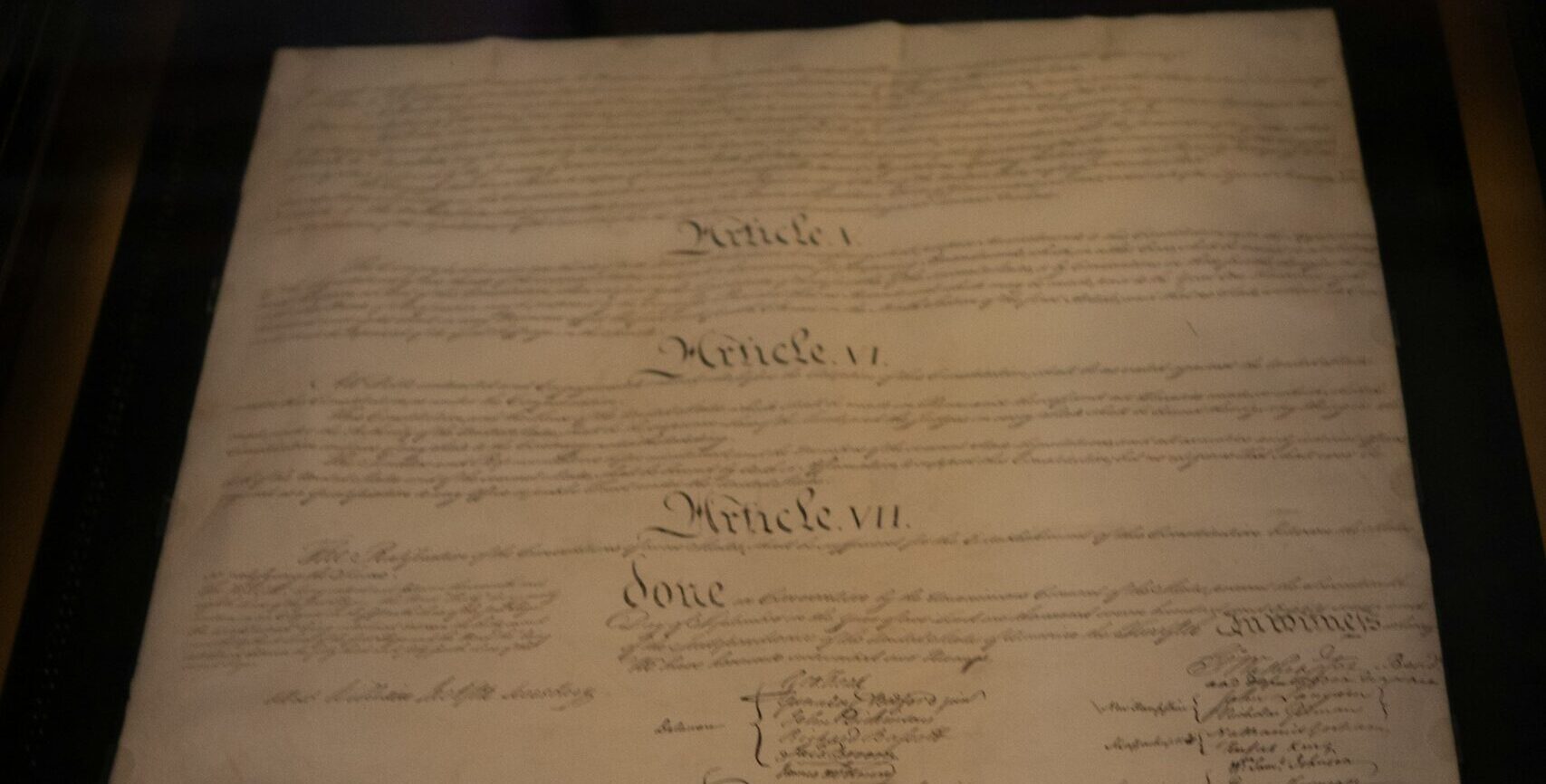
What’s the path forward? Reform is difficult because politicians of both political parties have learned to work the present system to their advantage, often obtaining great wealth in office, something that the Framers never anticipated from citizen legislators. Wisely, however, the Framers did provide a way to address abuses that those in office have no incentive to cure. Under Article V of our current Constitution:
The Congress, whenever two thirds of both Houses shall deem it necessary, shall propose Amendments to this Constitution, or, on the Application of the Legislatures of two thirds of the several States, shall call a Convention for proposing Amendments, which, in either Case, shall be valid to all Intents and Purposes, as Part of this Constitution, when ratified by the Legislatures of three fourths of the several States, or by Conventions in three fourths thereof.
In summary, the Framers understood that:
Congress could not always be trusted to do what was best for the country, and that when it was a practice of Congress itself that gave rise to the need for amendments, some other body should be made available to the people to initiate changes to the Constitution.
While the convention method of proposing amendments to the Constitution has not been used to date, we are getting closer and laying the intellectual foundations for such a convention. Thirty-four states are required to call such a convention. We are currently up to twenty-eight, so only six more are needed.
True, conservatives are on one side and progressives on the other of the divisive policies issues above, and each is afraid that the other side might use such a convention to impose an unfavorable outcome on the issue that they care about most. Meanwhile, no single issue alone has been able to rally a sufficient number of states to call a convention. Maybe there’s a deal to be had by our deal-making president, who would certainly go down in history for facilitating a second constitutional convention!
Seriously, I can think of no better way to honor our 250th anniversary than to join together to convene an effort to learn from our mistakes and adopt more successful innovations pioneered elsewhere.
Thomas Jefferson argued that prior generations lack the “moral right” to bind their successors. They bind us only through our inaction. It’s better that we look ahead by finding governing principles we can agree upon going forward than continuing to argue about what people back in 1789 probably thought the language of the new Constitution meant back then.
E. Donald Elliot is a former professor at Yale Law School.
Subscribe to The American Spectator to receive our summer 2026 print magazine.