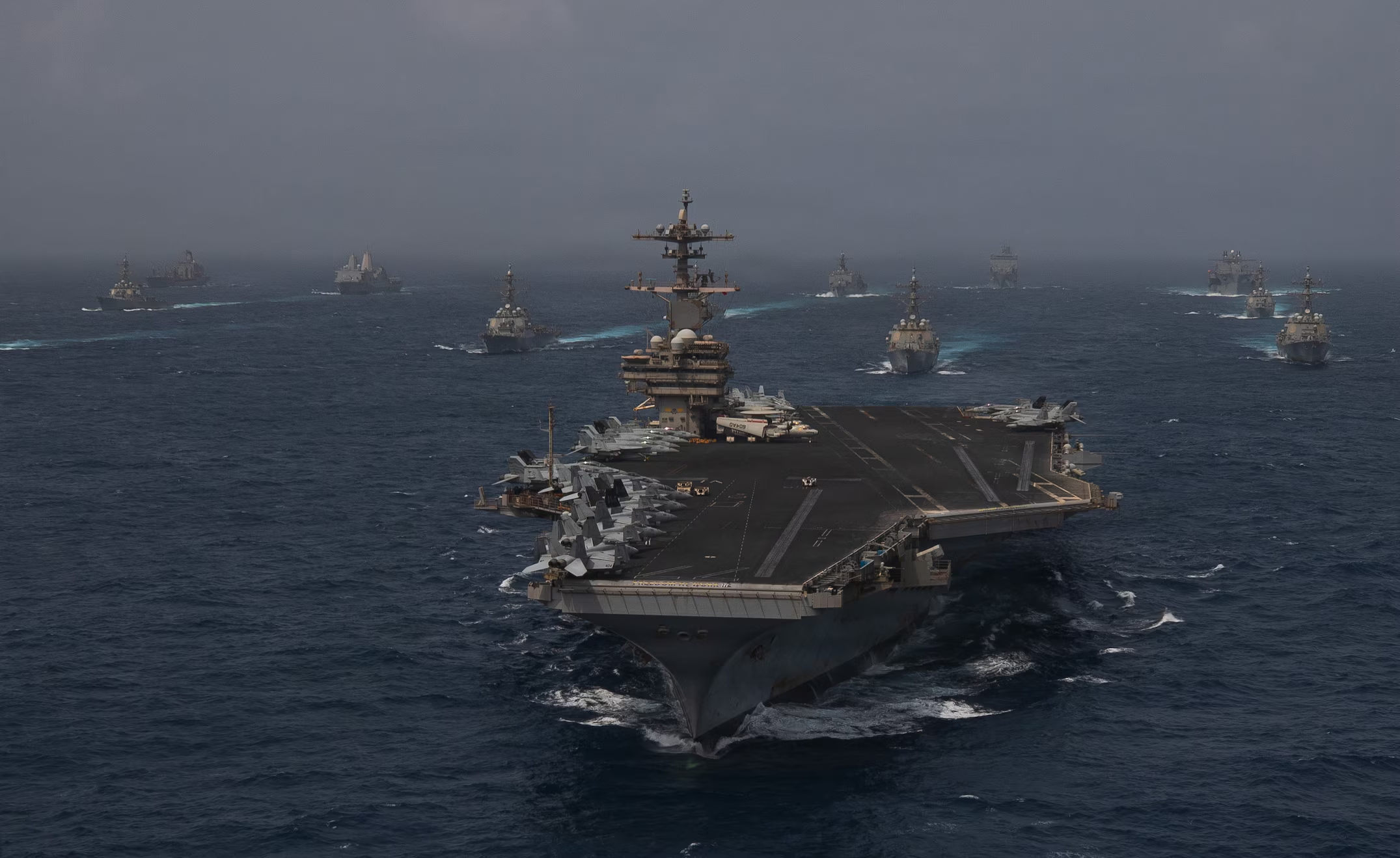


Renewed and increasingly intense exchanges of missile and air strikes between the U.S. and Iran may escalate further. As reported in past editions of The American Spectator, the IRGC under its most fanatical and dangerous chieftain, Ahmed Vahidi, is now clearly in charge of Iran. Diplomatic front men staging the kabuki theater negotiations in Pakistan to squeeze concessions from President Trump are shelved until further notice. (RELATED: The Iran War: Fasten Seat Belts)
Foreign Minister Araghchi, President Pezeshkian, and Speaker of Parliament Ghalibaf have been out of the picture since the mass funeral for Supreme Leader Ali Khamenei. It was held hours before the successive Iranian missile strikes on tankers crossing U.S. controlled zones of the Strait of Hormuz put an end to the “ceasefire.”
Purported successor, Mojtaba Khamenei, on whom the global media has wasted gallons of ink and air time spinning IRGC narratives on his sage leadership, is either dead or in a permanent coma hooked to a life support machine with Vahidi’s finger on the switch. Mojtaba wasn’t at his father’s funeral. Vahidi was. (RELATED: A Six-Day Funeral and a Long War)
The 60-day ceasefire negotiated with the “very reasonable people” Trump said he has found in Iran didn’t last a month. Attacks on shipping had never really stopped during the brief hiatus, which IRGC used to move $6 billion in oil sales to China to replenish its coffers and acquire the latest missile guidance and countermeasures technology from Russia for the more surgical war strategy it’s now applying.
Negotiations with terrorists conducted through heavyweight intermediaries often have more to do with the political interests of the mediators than realistic chances of a settlement. Pakistan wanted to use the ceasefire MOU it cobbled together between the U.S. and Iran for a regional power play. It failed. Dealing with a normally constituted government is one thing; trying it with a terrorist organization is another.
Pakistan’s strongman, Marshal Asim Munir, may have convinced Trump that he could handle Iran’s hardliners but never got much beyond kissing and handshaking Vahidi’s front men traveling to Islamabad for diplomatic theatrics. A hardline Iranian politician reputedly close to Vahidi said on Iran’s state media that Munir was never allowed to speak with Mojtaba, because “he could reveal his location to the Israelis.”
There are varying estimates as to how many ballistic and cruise missiles Iran has left. The Israelis put the number between 1,000 and 1,500. U.S. intelligence estimates place it closer to 2,000. Enough for IRGC to calculate that it can keep the war going with more precise and deadlier strikes on U.S. bases and neighboring Arab states, drive gas pump prices above $4, kill American soldiers, and deliver a midterm election defeat to Trump.
Totalitarian regimes can inflict endless economic hardship and suffering on their populations and remain in power. Democratic governments cannot.
Totalitarian regimes can inflict endless economic hardship and suffering on their populations and remain in power. Democratic governments cannot. That is the main, and perhaps the only, advantage that Iran holds over the U.S., and the IRGC will play the ace card for all its worth. But despite screaming media headlines about two or possibly three U.S. servicemen being killed by an Iranian missile strike on an air base in Jordan this week, underlying regional trends favor the U.S.
The Gulf states remain all in, with U.S. air defenses intercepting most incoming projectiles. UAE, Qatar, and Saudi Arabia are not being hit, and fearing the force of Israeli retaliation, IRGC has yet to fire on Tel Aviv in the current round. The group is being cautious.
The small vulnerable sheikhdoms of Kuwait and Bahrain suffering the brunt of Iranian attacks are conducting their own retaliatory strikes and giving no signs of weakening despite contrived signals that came from talks between Araghchi, Qatar and Oman during the “ceasefire.”
Israel and Lebanon’s government are coming together in U.S. sponsored talks for a joint strategy against Hezbollah with Syria and possibly Iraq now on board. In a game-changing development last week that received little mention in mainstream media, the Syrian government of ex-Al Qaeda member turned U.S. ally, Ahmed Al-Sharaa, intercepted a major Iranian arms shipment to Hezbollah, seizing large quantities of missiles, rockets, and drones crossing overland for delivery to the IRGC militias in Lebanon. (RELATED: Rubio’s Israel-Lebanon Agreement Cuts Iran Out of the Peace Process)
Syria was Hezbollah’s logistical backbone when ruled by the IRGC-supported Assad regime, ousted two years ago by insurgent forces led by Al-Sharaa. The Trump administration’s gamble in recognizing Al-Sharaa’s new government despite its radical Islamic connections has paid off. Without secure Syrian supply routes, Hezbollah cannot replenish its arsenals depleted from months of war with Israel.
Iraq’s new prime minister, Ali Al-Zaidi, is also seeking to disarm the myriad paramilitary militias in Iraq aligned or controlled by IRGC, moving beyond the fence-straddling policies of successive past governments. Al-Zaidi’s interest in defanging Iran’s proxies was reflected in his government’s official statements following the Hezbollah arms seizure: “The Joint Operations Command will coordinate with Syrian authorities to establish the circumstances of the attempted smuggling, hold those responsible to account, and strengthen security along the shared border.”
South Yemen’s Houthis declare that they are prepared to join the IRGC in a coordinated strategy to close the main choke points for Middle East oil. They have threatened to resume attacks on shipping in the Red Sea’s Bab Al-Mandeb Strait, which connects with the Suez Canal, while Iran blocks the Strait of Hormuz. But the extent to which Houthis can effectively seal Bab Al-Mandeb is questionable.
They were severely mauled by U.S. and British air strikes, which seriously degraded their missile capabilities a year ago. IRGC cannot significantly resupply the Houthis while sea and air routes between Iran and Yemen are policed by the U.S. and its regional allies. Saudi Arabia intercepted an Iranian airliner flying to South Yemen last week.
U.S. air strikes are now concentrated on knocking out IRGC capabilities and isolating its units around the Hormuz Strait, whose control is now central to the war strategy of both sides. Unrelenting U.S. strikes over the past 10 days have focused on Bandar Abbas and other Iranian ports along the strait area where IRGC’s main missile sites and radar installations are located.
Iranian-held islands in Hormuz waters have also been pummeled to eliminate what remains of the IRGC fast boat fleet mainly based there. University of Chicago Middle East expert, Professor Robert Pape, interprets current U.S. strike patterns as “suppressive fire” to prep the ground for eventual Marine or airborne landings to take Hormuz.
The plan has been on Pentagon drawing boards for some time, and as prospects for any negotiated solution diminish, Trump may yet decide on the biggest gamble of his presidency. He can count on regional support and calculate that it’s preferable to face the U.S. midterm electorate with decisive military action than mesmerized with returning to the “negotiating table” that Vahidi dangles before his eyes to manipulate and embarrass him.
READ MORE from Martin Arostegui: