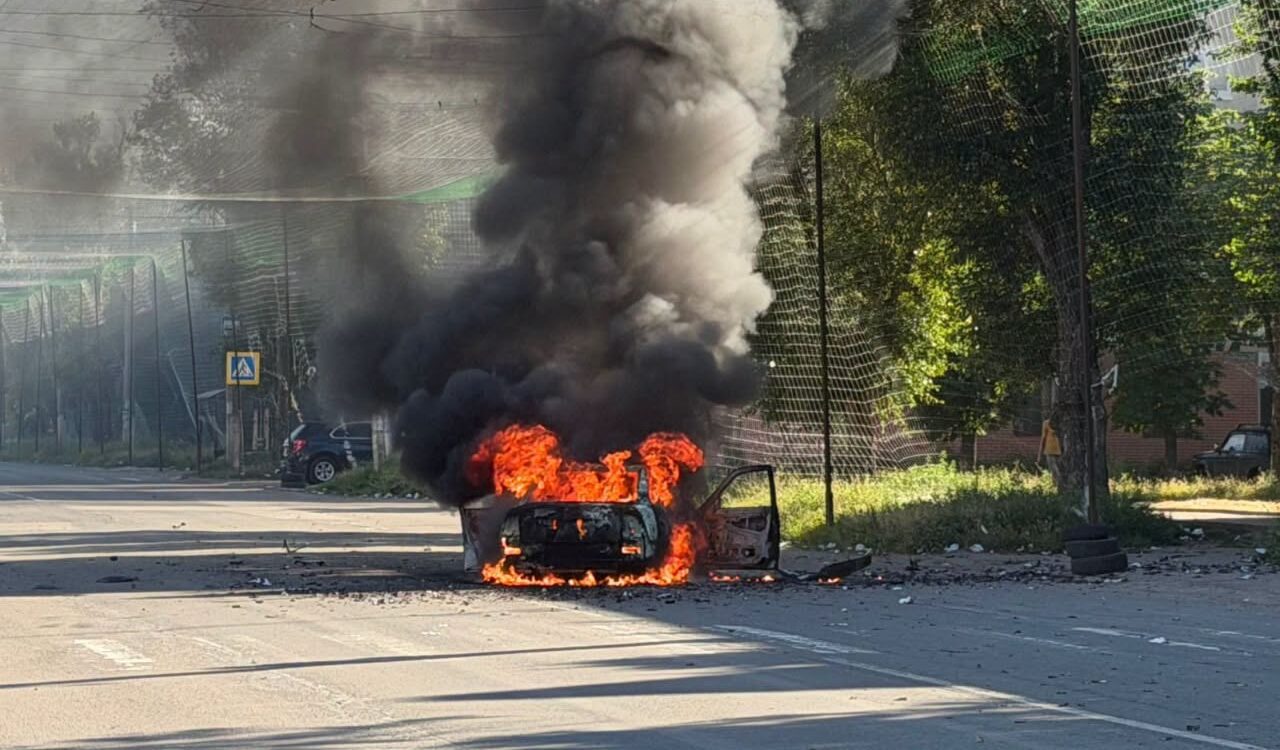


Ukraine’s unrelenting drone offensive to cut off Crimea from mainland Russia and occupied sectors of Donbas is making world headlines as midrange Hornet and Dart drones with 100-kilo explosive payloads reduce Russian road, railway, and maritime traffic to the Russian-occupied Peninsula by over 50 percent.
Turning Crimea into a virtual liability for Putin and neutralizing its function as a logistic, air, and naval hub may be a dazzling accomplishment. But Russia’s grinding ground offensive on the strategic Donetsk fortress belt, which has been gaining traction over recent weeks, may be potentially more decisive for the course of the war, despite its lax news attention.
Chronically short of manpower and bludgeoned by Russia’s ballistic missiles and conventional air superiority, President Zelenskyy has again opted for creative asymmetric strategies of targeting Russian weak points with his drone units. But this may be drawing them away from defensive operations, never much favored by Zelenskyy, to retain control of the critical urban corridor linking the main industrial cities of Donetsk, which are Vladimir Putin’s prime objective.
Last week, Putin held a televised briefing with his top generals in a bunker at an undisclosed location supposedly in Donetsk, where he announced the “capture” of Kostiantynivka, the southernmost fortress city, which would place him at the gates of the central citadel of Donetsk, Kramatorsk.
“I would like to note the positive dynamics of the actions of our troops which continue moving west… the capture of Kostiantynivka is only the first but very important stage in the destruction of formations of the Ukrainian armed forces still holding Kramatorsk, Sloviansk and Druzhkivka strongholds where the enemy has dug a deep and well-defined system of fortifications,” Putin said. (RELATED: Putin on the Rocks)
Gradual infiltrations by Spetznaz teams over the past several months, supported by air strikes using FAB guided bombs launched from jet fighters, combined with flanking maneuvers along the city’s outskirts by light infantry or “Motorized Rifles” have enveloped Kostiantynivka in a summer offensive whose strength was underestimated by many Western analysts. (RELATED: What Ukraine’s Moscow Strike Means Beyond the War)
The Russians have driven Ukrainian defenders from the southern sectors and deeply penetrated the city center. What appeared as a precarious salient some weeks ago has greatly expanded into a strengthened corridor into the main neighborhoods where urban combat is ongoing, according to the latest updated battlefield maps of Washington’s Institute for the Study of War and geolocated satellite images.
Russian commanders further claim that their troops have taken positions in the city’s northeast sector by infiltrating the area from the flanks and are beginning to move up the H-20 highway towards Druzhkovka, a virtual satellite city of Kramatorsk, sprawling 20 miles up the road. The head of Russia’s 3rd Army Corps told Putin that elements of his 6th Motorized Rifle Division were already “advancing towards Druzhkovka and engaging in combat operations on its southern outskirts.”
Zelenskyy and his chief spokesmen were denying that Russia “controlled” Kostiantynivka up to a week ago, saying that Ukrainian units continued resisting Russian encroachments. Russian commanders “exaggerate” the reach of their advances, according to ISW. “They are trying to gain favor with Putin,” British military analyst Hamish de Bretton Gordon tells the Daily Telegraph. But Ukraine’s hold over the southern anchor of the fortress line is slipping, and direct Russian infantry assaults on Kramatorsk, already targeted by increased air strikes, could begin in earnest by the fall.
The supposedly impenetrable “kill zones” of drone-saturated battlefields impeding mass troop movements and tank maneuvers, which U.S. general (ret.) David Petraeus credits with stalling Russian advances, works both ways. Russian FPV drones and loitering munitions operated by the increasingly experienced “Rubicon” units are similarly impeding Ukrainian reinforcements from reaching Kostiantynivka.
According to a recent battlefield report by the Kyiv Independent, Ukrainian troops trying to reach the embattled city have to move in very small units and mainly by foot to avoid detection by Russian drones, greatly reducing the level of resupply and reinforcements that can reach besieged fortifications. Video footage also indicates Ukrainian evacuations of troops and civilians as Russia conducts “mopping up operations” of defensive pockets, according to some reports.
Ukraine’s growing lack of manpower may be entering a critical stage as popular resistance to forced conscription seems to grow. Public rejection of serving in the war was recently dramatized by mass riots in Kyiv triggered when people came to the aid of a man being press ganged by a “recruitment patrol.”
However, many drone fleets are turned out by Ukrainian military factories, which are themselves under increasing Russian missile attack. Zelenskyy’s wonder weapons ultimately cannot hold or take ground, and Ukraine’s experimentation with machine gun-mounted robots to replace ground troops remains at very early stages. (RELATED: Deminers: The Dangerous Work of Giving Ukraine Back Its Land)
Ukraine’s strategy hinges entirely on the ability of its increasingly lethal and accurate long-range drones and cruise missiles…
Ukraine’s strategy hinges entirely on the ability of its increasingly lethal and accurate long-range drones and cruise missiles, now capable of reaching 75 percent of Russian territory, to inflict sufficient damage to raise the war’s cost to unacceptable levels. Massive losses have already been inflicted on Russia’s strategic oil industry, reduced almost to half its pre-war capacity by Ukrainian air strikes. Oil refining and transport facilities go up in dark clouds of smoke almost daily as fuel shortages lead to growing lines of cars outside gasoline stations in Moscow and other cities. Zelenskyy’s objective to “bring the war home to the Russians” has been reached. Russia is now having to import oil. But whether this can generate a sufficiently strong public backlash threatening Putin’s hold on power or his abandonment of battlefield objectives increasingly within his grasp is highly unlikely.
“We are relying on drone strikes for an experimental offensive in Crimea to force Russia to negotiate on Ukraine’s terms,” a Ukrainian military analyst recently said on a Kyiv Independent podcast. “Russia seems to show no adaptation to decrease the efficiency of Ukrainian attacks but we don’t have the manpower to re-take territory where we weaken Russian defenses.”
Small Russian reconnaissance teams in light-armored vehicles were spotted some 3 km from Kramatorsk this week, amid reports that major steel manufacturing plants were being dismantled and moved out of the industrial city of 150,000 people.
Russian forces massing to the north around Lyman, within striking distance of Sloviansk, however, were repelled in Ukrainian counterattacks, hitting them with drone swarms and elite air assault troops.
Putin has repeatedly insisted that if the remaining western portion of Donetsk, which is about the size of the U.S. state of Delaware, is not surrendered to him through negotiations, he will take it by force in what may yet turn out to be the war’s longest and most grueling battle.
Putin is expected to order a mass mobilization to raise the necessary number of troops to throw at Kramatorsk following parliamentary elections in September. It is a gamble that raises political costs. Forced conscription in Moscow and other main cities could generate anti-regime sentiment. But it’s the kind of gamble he appears prepared to take as he smells blood.
His military industry is producing “Ryvok-1” variants of T-90M tanks modified to counter drones. They are being equipped with on-board radars to track and fire interceptors at incoming threats, electronic warfare systems to create domes around the tank, cutting control links between drones and their operators, and heavy steel cages, bar screens, and specialized explosive reactive armor designed to force early detonation or tangle drone propellers before they penetrate the main hull. About 1,100 of the super tanks are projected to be in service by 2027. Whether that target can be met is questionable.
But a grim race is on, matching Ukraine’s ability to inflict crippling pain on Russia’s war machine and generate internal discontent against Putin with Russia’s capacity to breach the Donetsk fortress belt and take Kramatorsk. The fall of Kostiantynivka gives Putin the incentive to keep going.
READ MORE from Martin Arostegui:
Rummaging for Cash in the Ruins of Socialism
Walloping Each Other Harder and Harder
Cuba Is Prepared to Be a Second Iran
Image licensed under Creative Commons Attribution 4.0 International.