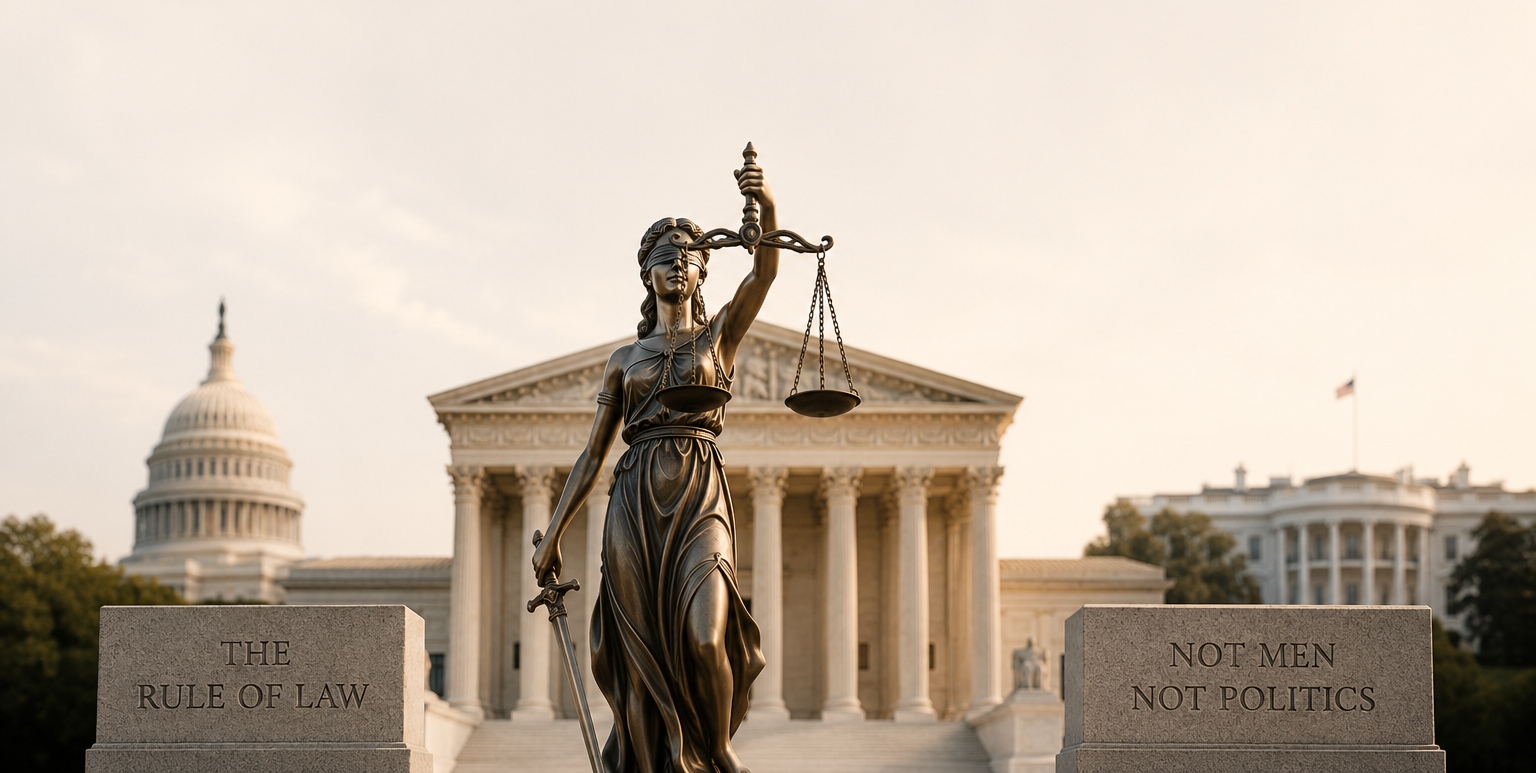


President Donald Trump and the MAGA movement have always felt uncomfortable with an independent federal judiciary, even after he filled it with his appointees. After all, the courts turned into an important line of resistance against the incoming administration last year.
Deputy Chief of Staff Stephen Miller called one decision “an assault on the very idea of democracy itself.” Vice President JD Vance sounded more moderate in tone but extreme in substance: “Judges aren’t allowed to control the executive’s legitimate power.” The administration’s conception of its own authority appeared essentially limitless. Yet the judiciary has upheld much of the administration’s agenda. This past term the conservative Supreme Court majority issued several important rulings supporting the president’s position.
Conservatives should fight hard to promote their principles. One of those is belief in the rule of law.
Ironically, despite his oft-expressed dissatisfaction with the opinions of some of his own appointees, the Democrats worked hard to push through their own appointees, with President Joe Biden eventually making two more federal judicial appointments than Trump. (The latter did two better in Supreme Court appointments than both his predecessors combined.) Although the Biden administration promoted a surprisingly modest judicial reform proposal, many progressives were not nearly so limited in their ambitions. They were horrified that the conservative majority resulting from Trump’s picks upheld the law and limited Biden administration abuses. Progressives were particularly appalled when the Supreme Court voted to reject previous judicial lawmaking and overturned Roe v. Wade. Even many traditional liberals criticized the opinion when it was issued in 1973, but five decades later most progressives viewed it as sacred writ.
Hence, a gaggle of legislators, commentators, and activists has increasingly demanded a radical transformation of the judiciary. The Left campaigned to effectively turn courts into just another form of legislature, allowed to make up new laws whenever the Zeitgeist struck. Which has been often. The result was a campaign for radical “disempowering reforms” including court packing.
Yet some conservatives today sound like lefties, especially in their attacks on Justice Amy Coney Barrett. The president has been especially sharp in his criticisms. They have forgotten that the judiciary’s fundamental role is to assess what the Constitution and statutes hold. Their job is not to uphold the president or impose MAGA policies. This means preserving Congress’ central role in policymaking. And enforcing constitutional and statutory limits on government power. MAGA activists often believe in and benefit from such decisions. But not always. Hence the outcry.
In fact, the New York Times got it right when it suggested that “even as the justices chose key moments to push back on Mr. Trump, the court’s conservative supermajority delivered generational, long-sought wins, including by expanding executive power, as the court that Mr. Trump remade in his first term continued a project of pushing the law to the right.” As a result, “The court’s rulings were more favorable to the administration as it defended the government broadly this year than during Mr. Trump’s first term or compared with all recent administrations since George W. Bush’s.” Indeed:
a conservative bloc routinely controlled the outcome in cases large and small, with the center of the bench shifting considerably to the right and delivering 13 ideologically divided decisions in which all six justices nominated by Republican presidents were in the majority and all three Democratic nominees were in dissent. That was nearly a quarter of all rulings in which nine justices participated, compared to 11 percent in the term that ended in June 2025.
Among the big decisions that went Trump’s way were cases involving executive authority, religious liberty, asylum claims, deportation limits, racial gerrymandering, conversion therapy, campaign finance, transgender athletes, and gun rights. For instance, the Supreme Court upheld the unitary executive, meaning the president can fire officials at nominally independent agencies, with the apparent exception of the Federal Reserve. The president lost on tariffs, but the majority correctly chose to follow congressional legislation rather than presidential preference. The high court did uphold birthright citizenship — which I, along with the president, consider a dubious policy — but even many constitutional scholars believe that it reflected the meaning of the 14th Amendment. (The president says he intends to press the jurists to reconsider their decision, undoubtedly a forlorn effort.)
The carve-out on firing a member of the Federal Reserve seems unprincipled, but that is an affliction common to appointees across the political spectrum. The controversial decision to uphold counting mail-in ballots after the election was a matter of interpretation of a law which did not directly address the issue; the ambiguity required a judgment on meaning, not policy. In many cases the popular majority disagreed with the court, but most people weren’t familiar with the cases, let alone the arguments behind them.
Conservatives who have gone into mourning over what they view as judicial heresies should reflect on the positive transformation of the federal courts over the last half century. Members of the Warren Court of the 1960s often acted like wannabe legislators, determined to transform American society. Returning judges to their proper constitutional role was a major priority for the Reagan administration. I dealt with the issue after leaving the Reagan White House. The Robert Bork saga highlighted vicious opposition to a nominee with a much more limited view of judicial power. The conservative mantra then was that jurists should respect the law even when they disagreed with it. It has taken several decades, but now a majority of Supreme Court justices, at least, generally accept this position.
The issue was always fidelity to the Constitution, not activism per se. Jurists are to vigorously uphold the law. However, they should not consciously make up the law. Notably, in recent years the courts, despite the increasing disdain of some progressive Democrats, have become a critical fortress for religious liberty. For instance, in the 2012 case Hosanna-Tabor Lutheran Church and School v. Equal Employment Opportunity Commission, the unanimous Supreme Court voided the Obama administration’s attempt to prohibit religious schools from setting faith as an employment requirement. Chief Justice John Roberts wrote the official opinion, noting that the government’s stance “is hard to square with the text of the First Amendment itself, which gives special solicitude to the rights of religious organizations. The Court cannot accept the remarkable view that the Religion Clauses have nothing to say about a religious organization’s freedom to select its own ministers.”
Of course, there is always more to do — conservatives should pursue broad judicial reform. A code of conduct would reduce perceptions of bias. Fixed terms and term limits would refresh the judiciary. Simplifying the amendment process for the Constitution would eliminate one argument for courts to act like constitutional conventions.
Conservatives should fight hard to promote their principles. One of those is belief in the rule of law. Famously, President Andrew Jackson was no fan of judges. Nevertheless, he argued: “All the rights secured to the citizens under the Constitution are worth nothing, and a mere bubble, except guaranteed to them by an independent and virtuous Judiciary.” That remains true today.
READ MORE from Doug Bandow:
Hong Kong’s Chief Executive. Chief Enforcer.
The Forgotten Christians of Egypt
Tiananmen Square Anniversary Reminds Us of Freedom Lost
Doug Bandow is a senior fellow at the Cato Institute. He is a graduate of Stanford Law School and a member of the California and D.C. bars. A former special assistant to President Ronald Reagan, he is the author and editor of several books, including The Politics of Plunder: Misgovernment in Washington.