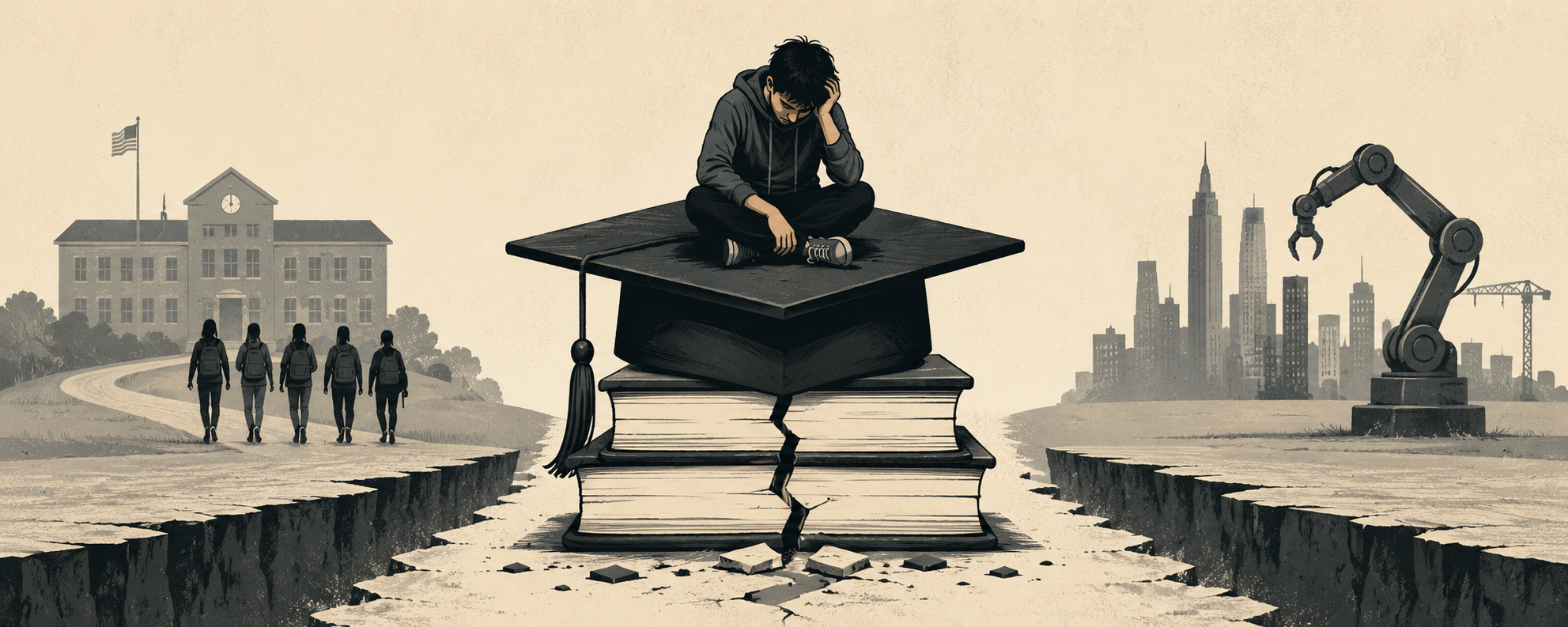


The news is awash with reports that younger Americans are learning less than their parents did a generation ago. One in eight freshmen at the highly selective University of California, San Diego campus place below high school levels in math, leading professors to complain that declining student proficiency is imperiling their ability to provide at least a modicum of math competency. Grade inflation is also leading university students to study far less than their parents or grandparents did in college — for much higher grades. Are we becoming a nation of lazy dumbbells?
Any college student who has finished even one course in basic economics knows that a nation’s output of goods (and, simultaneously, incomes for the producers of those goods) is dependent on the factors of production: land (and the natural resources contained within it), labor (workers), and capital (machines and tools).
For several decades, economists have emphasized that workers possess “human capital” — knowledge that enhances production far beyond that provided by their physical capabilities to produce goods. Nerdy computer analysts have been more productive than brawny and far more physically fit construction workers or farm laborers. Well-educated college graduates typically produce far more valuable output than workers with less than a high school education and, accordingly, are far better paid. If the nation’s stock of knowledge per capita starts falling, the nation’s ability to expand output through new discoveries and acquired skills using the sophisticated machinery of the modern age is imperiled, lowering or even ending centuries of growth in per capita incomes. (RELATED: American Education Is in Almost Irredeemable Decline)
A recent article in the Economist neatly summarized the evidence nicely in roughly 30 words: “About one in seven students at American colleges and universities scores no better in literacy tests than a typical ten-year-old. For numeracy, it is nearly one in five.” What is worrisome is that was not the case a generation or two ago. And while the COVID pandemic had negative effects, the problem is far longer-term.
We are demanding far less from students academically. I see that in my own family. My daughter, a high school teacher for more than 25 years in an Atlanta suburban school with a bachelor’s degree from Northwestern, says her administration prevents her from imposing high scholarly standards, making it almost impossible to fail anyone other than the most egregiously non-performing student. Her older brother, with a doctorate from a very respected public university, is a highly regarded public school administrator and is retiring early in a few weeks out of frustration, saying he would prefer to be a desk clerk in an upscale hotel to facing the aggravations of modern American public school administration.
It is even worse than that. Students have been infused with a woke-induced brainwashing by leftish teachers at both the secondary and collegiate levels. They are not taught much about the wonders of our nation’s founding, how an extraordinary group of men (and they were virtually all men) fashioned a new nation extolling the virtues of freedom, hard work and ingenuity, and implicitly implemented a society where the “invisible hand” of the market that Adam Smith extolled 250 years ago has been the primary determinant of the production, distribution and consumption of goods and services, in time making us the richest large nation in the world’s history. (RELATED: American Exceptionalism Is Worth Teaching)
Restore negative consequences for poor academic performance not only on students but also on their teacher mentors.
I once testified before a state legislative committee that I thought it should be a felony for a school principal or superintendent to knowingly hire a graduate of a college of education. States breaking from the old ways of the educational establishment are showing big gains in student performance. The poorest state in the Union, Mississippi, has shown eye-popping gains in student test scores by rejecting contemporarily fashionable curricular and evaluation practices and getting back to the basics. According to Education Week, less than 30 years ago (1998), only 47 percent of Mississippi students performed at or above the basic level of proficiency on the nationally used National Assessment of Educational Progress (NAEP) exam. Poor academically, poor economically. (RELATED: More Money Won’t Fix Our Schools. Our Data Proves It)
Fast forward a generation to 2022. The proportion scoring at the basic level or above on the NAEP exam rose substantially to 64 percent — above the national average. Why? Massive economic growth in Mississippi accompanied by a huge expansion in educational spending? No. The state remains the nation’s poorest. More native-born Americans are still leaving the state than are moving in. But the old educational ways have been interrupted and some adult supervision imposed, surprisingly in large part by Mississippi’s leading politicians. The legislature passed a Literacy-Based Promotion Act. Third-grade students doing poorly on a standardized literacy test are now not advanced to the fourth grade until they show at least minimal literacy competency. Horrors of horrors! Meaningful consequences for poor academic achievement.
There are lessons here that can be replicated. As Supreme Court Justice Louis Brandeis once memorably said: “A single courageous state may, if its citizens choose, serve as a laboratory; and try novel social and economic experiments without risk to the rest of the country.” The evidence suggests that the dumbing down of America is coming as the resources devoted to education reach new highs. For example, class sizes are smaller than a generation or two ago. Spending is up, but learning is down.
Education is too important to be left entirely to educators and selfish teachers’ unions. Students need to feel negative consequences for poor performance, just as much as positive rewards for exemplary academic achievement. The same is true of the educators who train them. Restore negative consequences for poor academic performance not only on students but also on their teacher mentors. And appropriately reward excellence.
Does rapid AI innovation change things dramatically? Maybe computer-based machines using AI can substitute for human knowledge, and a nation of dumbbells can still advance economically. But that AI technology came about from very smart humans using ideas emanating from their formal education. And it takes informed citizens to take the leadership of people in a world of technology that is capable both of expanding output and material abundance on the one hand and destroying the human race on the other.
READ MORE from Richard K. Vedder:
The Collegiate Anti-Woke Counterrevolution
Richard Vedder is a senior fellow at Unleash Prosperity, distinguished professor of economics emeritus at Ohio University, and senior fellow at the Independent Institute.