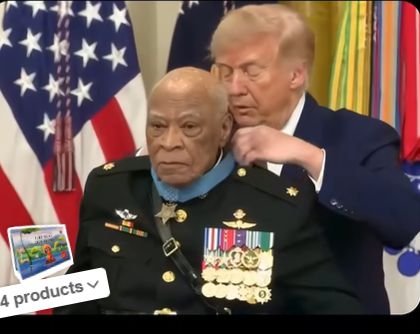


The most vital service the Stars and Stripes have delivered to us Americans over two and a half centuries is one sorely needed today — the flag tells us we are neighbors who share a homeland worth defending and loving. The recent decoration of former Marine Major James Capers Jr. with the Medal of Honor together with the irrepressible gushing of World Cup visitors over the greatness they see, not just in America, but in Americans themselves, suggests that the flag might still pack the power to serve us this way once more.
In Marine Major James Capers Jr. and the ongoing love-for-America fest the World Cup has become, we’re confronted with an unanticipated blessing and opportunity.
European visitors, to both their surprise and ours, are telling that our ubiquitous flag waving is impressive and appropriate. Not mainly because of our dazzling cities, stupendous stadiums, safe communities, and stunning abundance, but because we’ve received them with a hospitality and neighborliness they’ve never experienced anywhere else on the planet. They find their own new feelings for America crystalized in the display of Old Glory as tens of thousands sing the Star-Spangled Banner with hands on hearts.
Born in 1937 under Jim Crow in rural Lee (Robert E. Lee!) County South Carolina, Capers spoke less than a hundred words upon reception of the Medal of Honor from President Trump including these — “This is the greatest country in the world. I fought for that flag. I believed in it.” Though Capers is black and I am white, we both, separated by 23 years and 140 miles in the Palmetto State, absorbed respect for the flag in the same way — in Southern sanctuaries full of worshiping black faces.
For Capers this occurred every week. For me, only on those five or six Sundays when my mother’s schizophrenia demanded my father’s and grandparent’s full attention, leaving me without an adult to accompany me to my white Baptist church. So I placed my little white hand into the bigger black hand of one of our family’s black helpers who led me into a sea of poor black Baptist faces, abuzz and anticipatory, where together we sang the hymns I could not remember not knowing by heart; heard sermons preached, from sweating preacher faces, with tent-revival fervor, heaven and hell in the balance — like those I enjoyed at the all-white upwardly mobile blue-collar congregation just three miles away.
Two Baptist sanctuaries, two pulpits, two choir lofts, both flanked by two flags — not one but two and, significantly, not three — the Christian flag, the American flag, but not the Stars and Bars of the Confederacy, even in the state that first seceded from the Union. The first one requires no justification — the Christian flag: a white field with a blue canton in the upper-left corner containing a red Latin cross. But there was the American flag as well. To that flag too, in both churches, from the earliest memories of everyone present, was allegiance pledged.
Across America in those days, in tens of thousands of Protestant churches, the juxtaposition of the two flags in Christian sanctuaries generated not the slightest controversy. The thought that display of the American flag in worship spaces smacked of idolatry was simply not available to us. For us, as in the Constitution, but contrary to Thomas Jefferson’s famous message to the Baptists of Danbury Connecticut, worship of our Creator was distinguished but not separated from our love of country. How could it be? Love of neighbor was commanded by our Lord Himself.
Despite his politics, Bruce Springsteen evidenced a similar sensibility in his appeal for national unity during Super Bowl LV. His commercial spot featured a Christian Cross centered upon the American flag, framed and hung in a chapel at the geographical center of the nation in Lebanon, Kansas. A Christian chapel bearing a wooden cross framed by the Stars and Stripes within a humble worship space amid the storied amber waves of grain.
What church and state separation zealots demand, the good citizens of Lebanon, Kansas rejected. Support for America and the worship of God were never at odds, never mixed up, and never in competition for them. Nor have they ever been for me or Capers or millions of Americans for two and a half centuries. As our happy duty before the God we worship, before we’ve pledged our allegiance to our neighbors in our homeland.
The notion that America is a Christian nation for such people evidenced a reality lived long before it could express an opinion about the Founders, much less a political aim. Patriotism and Christian neighborliness sprang from that double love wherein love and gratitude to God gives rise to love of neighbor and homeland. Recoil of such people from Marxism and Islam, which alarmingly combine in the new Mayor of New York City, it stems from love of God and country. Marxism denies the existence of God. The God of Islam demands death of the infidels — especially of Christians and Jews. Surely neighbor love comprehensible by Major Capers or the insightful among World Cup visitors cannot but recoil from both.
But where love of God flourishes politics tends to stop at the water’s edge; neighborliness between American’s, even strangers, is felt and practiced; people from all over the world find themselves attracted to these shores like metal filings to a magnet. Visitors from many nations, though admittedly the subjects of decades of poisonous propaganda designed to induce disgust with us, cannot stop thanking us for being who they now see that we are.
Perhaps there was a time when our two political parties could be understood as offering differing paths toward similar goals. But more apt for our time is House Speaker Mike Johnson’s recent assessment that “the current political divide is a contrast between ‘people who love the country and its founding principles, and those who have open disdain and hatred for them.’” In Marine Major James Capers Jr. and the ongoing love-for-America fest the World Cup has become, we’re confronted with an unanticipated blessing and opportunity. Will we as a people endowed by our Creator with certain unalienable rights protect and employ those rights as neighbors sharing a homeland? Or will we destroy the home the rest of the world, at least for a moment, sees as the best place with the best people on earth? The feelings evoked by the American flag in our hearts will produce and tell much of the story.
READ MORE from Mark DeVine:
Don’t Confuse Obama’s Rioters With Martin Luther King Jr.’s Protesters