

As we celebrate the high-minded principles of the American founding as set forth in the Declaration of Independence, we should be mindful that the birth and survival of our nation was a result, in part, of the foreign policy realism practiced by our country’s earliest diplomats and leaders — Benjamin Franklin, John Adams, John Jay, Silas Deane, Alexander Hamilton, John Marshall, and George Washington. It was in every sense an “America First” foreign policy, was followed by subsequent U.S. diplomats and leaders, including John Quincy Adams and Abraham Lincoln, throughout most of the 19th century, and it resonates with most Americans down to the present day. It is only when America’s leaders and diplomats have strayed from realism that we have suffered setbacks and defeats.
Foreign policy realism is not a doctrine or an ideology. Instead, it is an approach that accepts the world’s imperfections; that understands the limitations of human nature; that embraces self-interest; that recognizes evil; that is wary of crusades and plans for earthly utopias; that understands the uses and abuses of power; that looks to history and experience, not philosophy or education, as guides to policy; and that considers issues and events through the lens of what Robert Kaplan calls a “tragic mind.”
Donald Trump was elected president in 2016 and again in 2024, in part, because he returned to a realist foreign policy that puts America First.
Most of our nation’s Founders were consummate realists and their realism manifested itself in the treaties, agreements, and policies that shepherded the birth of our nation, shaped the early years of our Republic, and enabled Americans to conquer — yes, conquer — a continent. During the War of Independence, our diplomats led by Benjamin Franklin sought assistance from the enemies (France, Spain, and the Netherlands) of our enemy (Great Britain). The February 6, 1778 Treaty of Amity and Commerce with France gained for the United States its most important alliance of the war — without French assistance, especially the French Navy, the United States would likely have been stillborn, and our cherished Founders would likely have been executed for treason.
Franklin’s realism sought to exploit the rivalry among the European great powers who assisted us not because of sentiment or sympathy with our cause, but rather to weaken Great Britain. Like the fledgling United States, France, Spain and the Netherlands understood that the enemy of my enemy was my friend — at least for the time being. But for realists, “friendship” has no place in international relations. Today’s “friend” may be tomorrow’s enemy, and vice-versa.
More than a decade after France helped us win our independence from Great Britain, President George Washington, following the sage advice of Treasury Secretary Alexander Hamilton, declared neutrality in the war between revolutionary France and Great Britain and its allies, despite the fact that our 1778 treaty with France was still in effect. Washington’s Neutrality Proclamation issued on April 22, 1793, stated that “the duty and interest of the United States require that they should with sincerity and good faith adopt and pursue a conduct friendly and impartial toward the belligerent powers.” For Washington and Hamilton, the “duty and interest of the United States” superseded our treaty with France. Geopolitical circumstances changed, so Washington the realist changed our nation’s commitments.
Washington’s Neutrality Proclamation proved to be controversial. So, too, did Jay’s Treaty of 1794-95, which resolved, at least temporarily, disputes between the United States and Great Britain that could have led to war. Hamilton had a hand in this treaty, too, for he sought to establish good commercial relations with our former enemy and, like Washington, wanted to avoid becoming embroiled in European wars. The treaty was far from perfect. Many critics thought that the U.S. made too many concessions to Great Britain. But Washington, Hamilton and Jay realistically assessed U.S. interests at the time.
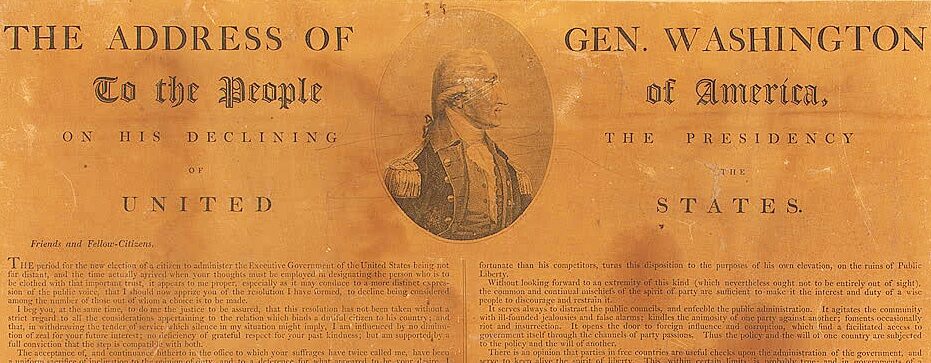
The Neutrality Proclamation and Jay’s Treaty foreshadowed the realist arguments Washington made in his Farewell Address, which was published on September 19, 1796. This classic realist document, which Hamilton also influenced, grew out of Washington’s wartime experience and his presidency. He counseled his countrymen to “Observe good faith and justice towards all nations,” and to avoid “permanent, inveterate antipathies against particular nations and passionate attachments for others.” Sentiment and sympathy for other nations, he warned, can create “the illusion of an imaginary common interest in cases where no real common interest exists.” Americans must be on guard against the “insidious wiles of foreign influence,” and must never “betray or sacrifice the interests of their own country” by misplaced allegiance to other nations.
“The great rule of conduct for us in regard to foreign nations,” Washington wrote, “is, in extending our commercial relations, to have with them as little political connection as possible.” Obviously reflecting on the controversy provoked by his Neutrality Proclamation and the Jay Treaty, Washington noted that our interests and those of Europe were different, and it would be “unwise in us to implicate ourselves, by artificial ties, in the ordinary vicissitudes of [Europe’s] politics or the ordinary combinations and collisions of her friendships or enmities.” The United States, he wrote, should “choose peace or war, as our interest, guided by justice, shall counsel.”
Washington’s advice in the Farewell Address was followed by his successor John Adams in resolving an undeclared war with France during 1798-1800, during which the French and American navies clashed. Adams was determined to avoid an all-out war against France despite France’s seizure of hundreds of U.S. vessels. In the process Adams greatly expanded American naval power so that, consistent with Washington’s counsel in the Farewell Address, the United States could “choose peace or war” as our interests required.
Thomas Jefferson as Secretary of State and Vice-President frequently opposed the realist foreign policies of Washington and Adams. But as president, Jefferson, too, proved to be a realist, no more so than in negotiating the purchase from France of the Louisiana Territory, which more than doubled the size of the United States and went a long way towards completing our continental Manifest Destiny.
Perhaps no American statesman embodied the idea and practice of foreign policy realism more than John Quincy Adams, who as Secretary of State during the presidency of James Monroe pursued American interests with a single-minded focus that would have made George Washington smile. Adams is the recognized author of the Monroe Doctrine, a realist concept that has been a mainstay of U.S. foreign policy from 1823 to the present.
The Monroe Doctrine was designed to lessen European influence in the Western Hemisphere, thereby helping to facilitate U.S. continental expansion. The other side of that realist coin was Adams’ wise counsel to U.S. leaders, in a speech to the House of Representatives on July 4, 1821, to avoid going abroad seeking monsters to destroy, and reminding Americans that we are the well-wishers of freedom and liberty for all, but the champions and vindicators only of our own.
Unfortunately, much of the 20th century and the early years of the 21st century saw the emergence and practice of a Wilsonian strain of American foreign policy that mostly abandoned the realism of our Founders by frequently sending American soldiers abroad in search of monsters to destroy, championing the freedom and liberty of other nations, exhibiting inveterate hostility to some nations and passionate attachments to others, and embarking on crusades that proved costly in American lives and treasure.
Donald Trump was elected president in 2016 and again in 2024, in part, because he returned to a realist foreign policy that puts America First. He inherited a world in turmoil, in part because of the reckless and failed policies of the Bush 43, Obama, and Biden administrations. He has the unenviable task of ending the Iranian nuclear threat, deterring China in the western Pacific, and helping to resolve a seemingly endless war in Eastern Europe that has the potential to escalate into World War III. Let the foreign policy realism of our Founders be his guide.
READ MORE from Francis P. Sempa:
In the Iran War, Trump’s Role Model Should Be Bismarck