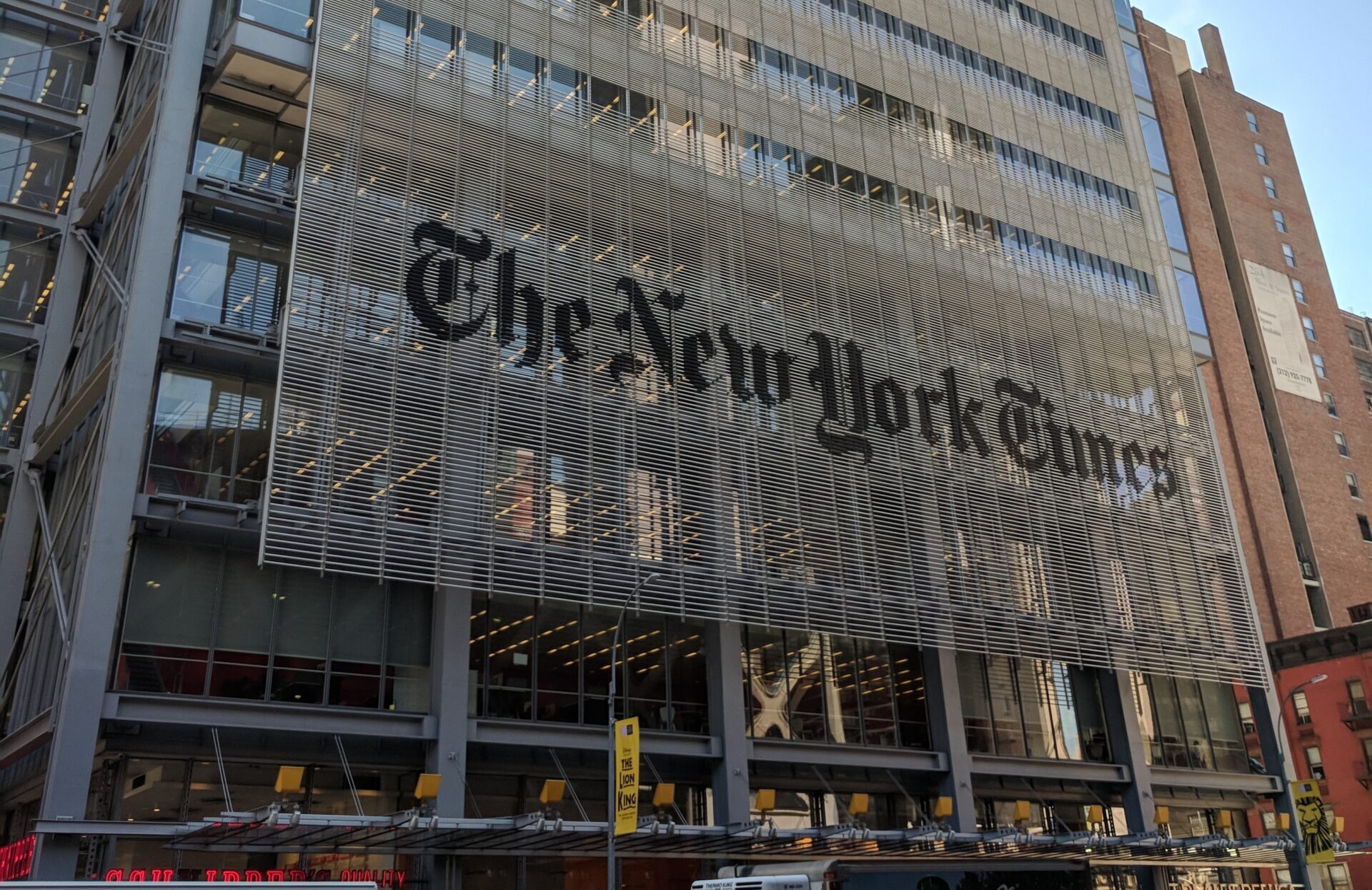


The New York Times, revered by some as the nation’s premier print media for general news and culture, detested by others for its liberal, virtue signaling condescension east of the Hudson, has now declared that President Trump has lost the war with Iran. On Sunday, the editorial board trumpeted this stunningly misguided proclamation: “President Trump Lost This War.” Nearby columns were entitled “Tehran Defied the West and Won,” and “The War Ended With a Surrender – Trump’s.” And the front page of “SundayOpinion” bellows, “What Was the War in Iran For?”
The Times has not bothered to wait up to 60 days to ascertain the outcome of negotiations between the United States and Iran. Nor in its journalistic derangement has it considered anything positive about the need to eliminate a mortal threat, a cadre of grizzled mullahs, a thugocracy of men of evil visage, for years hell-bent on obtaining a nuclear weapon. Diplomacy had failed for years: Would the Editorial Board prefer to see an Islamist pariah nation, bristling with “Death to America” sloganeering, put nuclear warheads on to a ballistic delivery system, or into backpacks or on trucks?
From its skyscraper on 8th Avenue, the Times should have presented a more balanced and nuanced argument, assessing what has been gained or conceded thus far.
Not only that, the Times has also not recognized that the Strait of Hormuz is being opened, albeit with mixed messages from Tehran, to assure safe passage of 20 percent of the world’s crude oil and LNG. It also does not seem to care that militarily, Iran has been badly weakened, along with its badly damaged military-industrial complex, and top Islamist leadership has been taken out. Finally, there is no acknowledgement that the U.S and Iran will negotiate a 14-point memorandum of understanding, and that discussions are taking place in Bürgenstock, Switzerland, high above Lake Lucerne to formalize the document.
Not everything in the U.S.- Iran war has gone well. While “no plan survives contact with the enemy,” to use the familiar quote of a 19th century Prussian field marshal, the ability of the Iranians to shut down the Strait of Hormuz was underestimated, along with their array of asymmetric weapons — ballistic and cruise missiles, drones, missile patrol boats and mining capability. Other messaging about regime change and “unconditional surrender” may have blurred objectives, but any observer should know that the war with Iran was first and foremost about eliminating their ability to produce and deliver a nuclear weapon.
Nonetheless, the assessment of the Times that the U.S. has lost the war is disgraceful beyond comprehension. The Iranians read Western media, and they must be delighted to see what seems to be gloating over America’s strategic predicament by leadership print media. The White House was quick to react vehemently.
It is obvious that President Trump called off more bombardments and stressed opening the Strait in view of potential Iranian retaliation against oil and gas infrastructure of our Gulf allies, further damage to the global economy, and depletion of U.S. missile inventory. As I have written in The American Spectator, an April study by the Center for International and Strategic Studies (CSIS) based on Department of Defense data, advised that the Terminal High Altitude Air Defense (THAAD) inventory, used to counter ballistic missiles, has been expended by over 50 percent, with no new deliveries expected in 2026. The situation with the Patriot system, used against various airborne threats, is evidently not much better. Recently, the president invoked the Defense Production Act to address munitions levels and constraints in supply chains. These are not signals that the U.S. has “lost” the war, but very sensible concerns.
Criticism of the memorandum is understandable, but we need to see what transpires over the 60-day period. Israel is not a party to the document, yet a ceasefire is expected in Lebanon. Further, there are impediments to navigation in the Strait such as fees charged by Iran, naval mines, and fear of attacks. Since the U.S. is releasing sanctions on Iranian oil, allowing shipments denominated in U.S. dollars, and is also contemplating a $300 billion reconstruction fund by private investors, it may appear that Iran is being rewarded before it has actually performed. Allowing nuclear inspections to resume by the International Atomic Energy Agency of Vienna, however, is a constructive development. As a point of negotiations, American inspectors should accompany those of the IAEC, anytime, anywhere. It is also envisioned that unfrozen funds will be used to purchase U.S. agricultural products, although Iran’s central bank advises that the country has no obligation to do so. Iran’s missile program is not up for negotiation, according to Iranian President Masoud Pezeshkian.
From its skyscraper on 8th Avenue, the Times should have presented a more balanced and nuanced argument, assessing what has been gained or conceded thus far. Iran has certainly emerged strategically as a force to be reckoned with. There will likely be twists and turns in the 60-day period, and when the negotiations conclude, who gains what and who gives up what should be more apparent. A free press is one thing, but such tendentious reporting while the Commander in Chief is prosecuting a war is yet another. Imagine the effect upon the morale of America’s men and women at risk in the Middle East.
Doubtless, the mullahs are smiling.
READ MORE from Frank Schell:
Iran: Crippled but Still Dangerous
America Needs to Prepare for a Long Iran War
Frank Schell is a former senior vice president of the First National Bank of Chicago and was later a management consultant. He was a lecturer at the Harris School of Public Policy, University of Chicago, and is a contributor of opinion pieces to various journals.